Google closed out December with a batch of AI updates designed for everyday use: speed, verification, and tools that organize your digital world. Can you imagine assistants that think faster, check videos for authenticity, and tidy your tab chaos? Here I explain the essentials without jargon and why it matters for you.
The most important in a few lines
Google focused on taking frontier intelligence out of the lab and into products you use daily. The idea is simple: technology should adapt to you, not the other way around. This round brought improvements in speed (responses in seconds), content verification (so you can trust what you see), and more human browsing and shopping experiences.
Notable updates
Gemini 3 Flash: speed and reasoning for everyday tasks
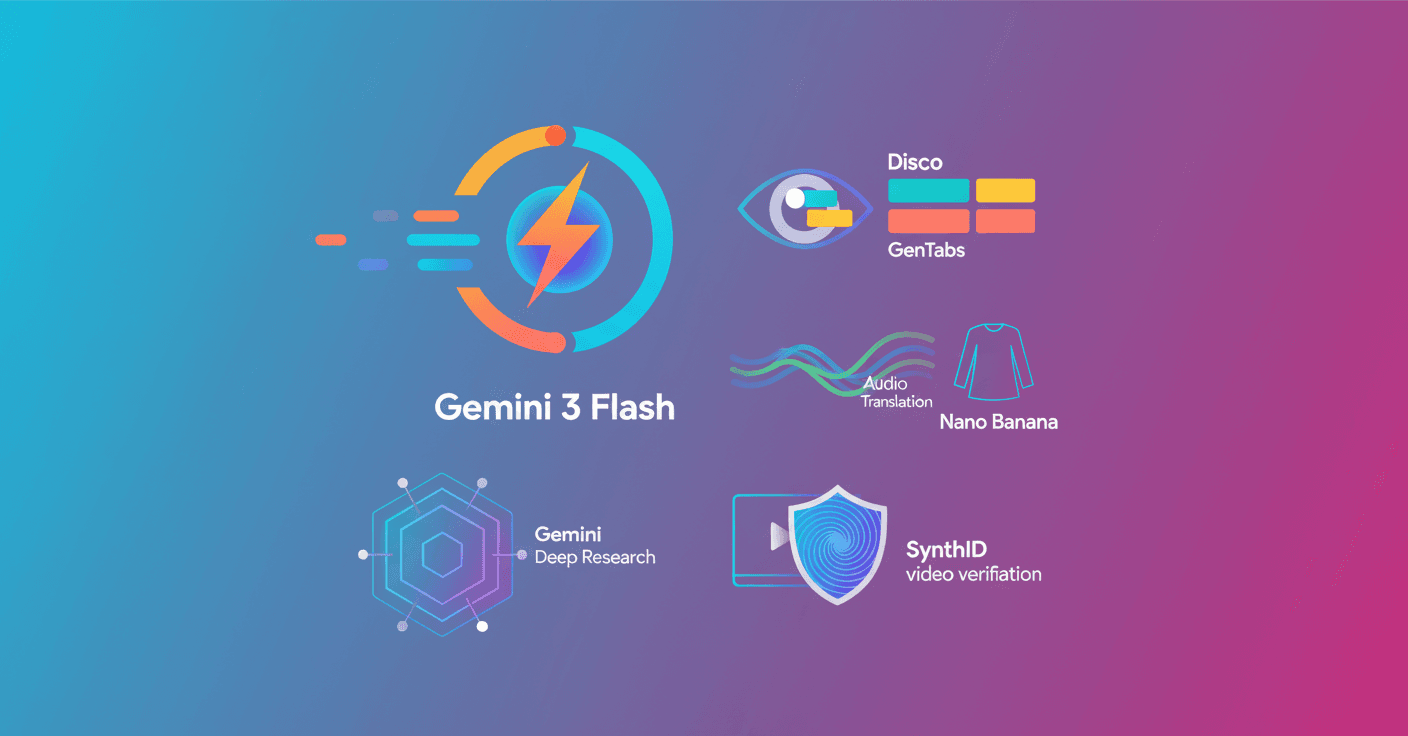
Gemini 3 Flash arrived, designed to be fast and capable of reasoning at the same time. Google is making it the default model in the Gemini app and in AI Mode in Search, which means snappier answers in products you already use. For you, that translates to less waiting and more useful results for daily chores.
Video verification in the Gemini app
Now the Gemini app can analyze videos up to 100 MB or 90 seconds and tell if they were generated or edited with AI. It uses SynthID (imperceptible markers) to check audio and video and point out exactly which segments contain AI-generated elements. Have you ever doubted whether a clip was real? This aims to remove that uncertainty.
Disco and GenTabs: tame the tab mess
How many tabs do you have open right now? Disco is a browsing experiment that tries to turn messy sessions into useful tools. GenTabs synthesizes your open tabs and chat history to create personalized interactive web apps. In practice, imagine planning a trip and having a panel that organizes itineraries, bookings, and notes without you doing it manually.
Improvements in voice and live translation
Audio capabilities also got better. The update Gemini 2.5 Flash Native Audio promises more natural conversations, better accuracy, and handling of complex instructions. Plus, Google Translate adds a beta for live voice translation in 70+ languages, preserving intonation and rhythm so communication feels more authentic.
Gemini Deep Research and tools for developers
Developers get access to a more powerful research agent via the Interactions API. This lets apps integrate synthesis of information and topic navigation for complex subjects. Google also released the DeepSearchQA benchmark to evaluate research agents on web tasks, pushing for more transparency. There are already practical examples: mobile assistants for people with visual disabilities or tools for cognitive autonomy.
Nano Banana and more accessible virtual try-ons
Virtual clothing try-ons now work with a selfie instead of a full-body photo. Nano Banana generates a realistic digital version of your body and combines it with garments from the Shopping Graph. The result: trying on clothes quickly without complicated photo sessions.
Gemini 3 Pro and Nano Banana Pro in Search
Gemini 3, in its Pro version, reached AI Mode in Search in nearly 120 countries in English, with visual options and higher limits for Pro and Ultra subscribers. They also expanded access to Nano Banana Pro to generate more detailed images and views in Search.
YouTube, Google Photos, and Year in Search 2025
YouTube published 2025 trends and launched its first personal Recap. Google Photos returned with an updated Recap, controls to hide people or photos, and CapCut templates to create and share memories. In Year in Search, beyond big headlines, Google highlights a shift in how we ask questions: more conversational searches thanks to AI.
Why should this matter to you?
Because these updates aren't distant experiments: they improve what you use every day. Faster answers, tools to check content authenticity, and features that organize your work or shopping sound like small tweaks, but they add up and change the experience. And yes, they also bring responsibilities: verifying information, understanding limits, and protecting privacy remain essential.
If you're a creator, entrepreneur, or simply curious, there are two clear messages: AI is arriving in everyday products, and there are new tools to use it with more confidence. Which feature would you like to try first?
Original source
https://blog.google/technology/ai/google-ai-updates-december-2025