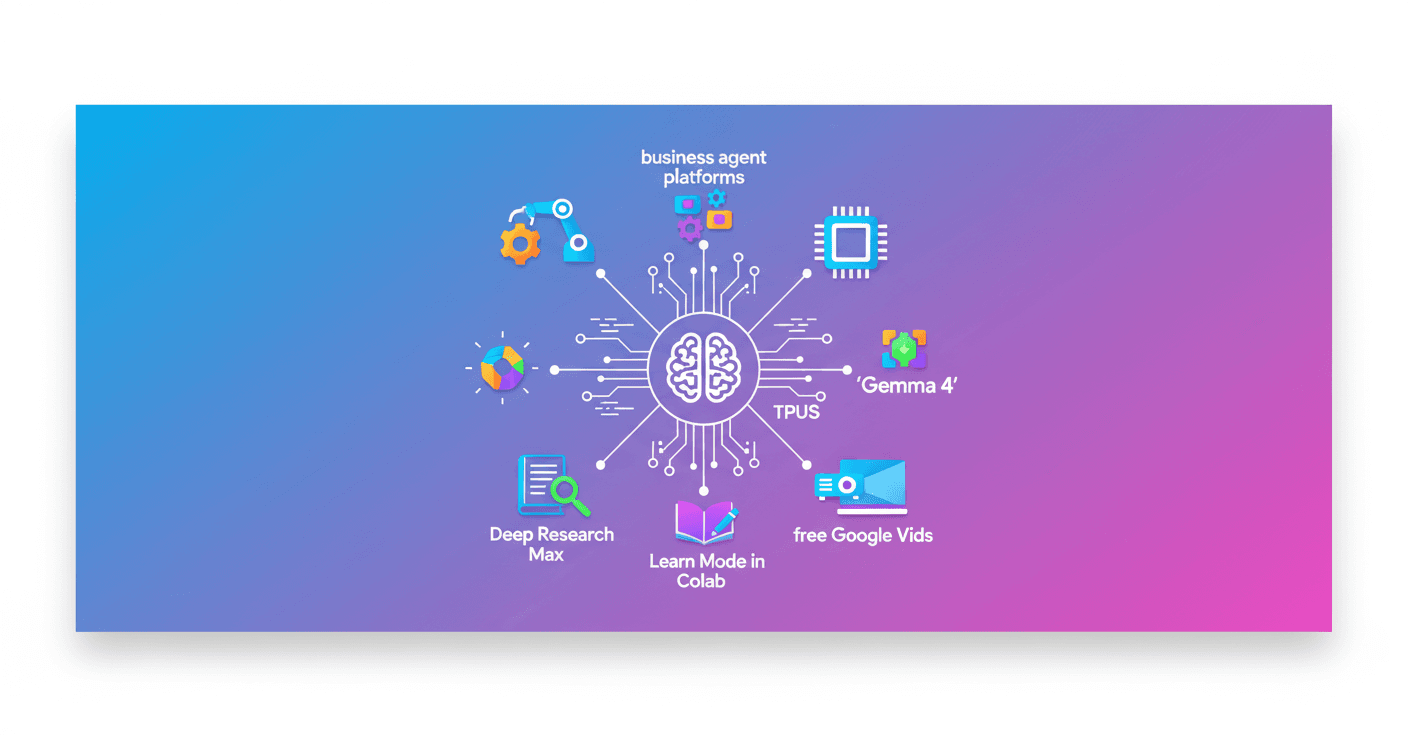
April 2026 was a month with clear news: Google unveiled tools and improvements designed to make artificial intelligence more useful, accessible, and practical in everyday life and business. What does this mean for you? From students preparing for exams to small businesses that want to produce video on a shoestring budget, there are concrete changes worth knowing about.
Quick summary of the most important
Google focused on the so-called "agentic era": systems capable of carrying out complex tasks and coordinating steps on their own. Among the announcements are new platforms to build business agents, more efficient chips for heavy compute, and more powerful open models. There were also consumer-oriented updates: free video generation, educational tools in Colab, and improvements in health and translation.
What did Google release and why does it matter?
-
Gemini Enterprise Agent Platform: a platform for companies to create and manage autonomous agents that handle multi-step processes. Can you imagine delegating repetitive admin tasks to an assistant that coordinates other tools? That’s the idea.
-
Eighth-generation TPUs: chips designed to handle huge compute loads with better energy efficiency. In simple terms: more power for large models without burning as much electricity.
-
Gemma 4: Google says it’s the most capable open model "byte for byte." That translates to better reasoning and performance for developers who want open models. -
Deep Research Max: a tool meant for high-level research that reduces the heavy lifting in data synthesis. Useful for academics, analysts, and teams that need to draw conclusions from a lot of material.
-
Google Colab with Learn Mode: Colab now offers a mode that guides you step by step, explaining the why as well as the how. It’s ideal if you’re learning to code or want your notebooks to be educational when you share them.
-
Google Vids free (up to 10 videos/month): anyone with a Google account can generate videos with the AI-powered editing suite. That lowers the barrier for creators, students, and small businesses that need professional-looking content without big budgets.
-
Google AI Studio and courses: higher usage limits for Pro and Ultra subscribers, and a joint course with Kaggle on how to use agents to build software without getting tangled in syntax.
-
TOEIC support in Gemini: Gemini now helps with TOEIC prep through exercises and personalized feedback. Very useful for international students and job-seekers.
-
Google Translate turns 20: 1 billion users and 1 trillion words translated per month. New pronunciation practice tool on Android to celebrate.
-
Rural health initiative: Google.org and the Johnson & Johnson Foundation will provide $10 million to deliver AI training to rural health workers in the United States.
-
Fitbit with a more personalized coach: the health assistant uses Gemini to analyze biometrics and give advice better tailored to each user.
Who benefits and how can you take advantage?
-
Students: tools like Learn Mode in Colab and Gemini’s test prep help (like TOEIC) make studying more guided and personalized.
-
Creators and small businesses: Google Vids offers low-cost video production; it’s a quick way to improve marketing and communications without hiring a studio.
-
Researchers and analysts: Deep Research Max cuts repetitive work in search and synthesis, speeding up discoveries.
-
IT teams and business leaders: the agent platform and next-gen TPUs let you automate complex processes and scale AI with better energy efficiency.
-
Rural communities and public health: the training funded by Google.org and J&J aims to make sure AI benefits don’t stay only in urban centers.
Are there risks or things to watch?
Fast adoption brings opportunities, but also challenges: agent governance, security, and privacy remain priorities. Google mentioned partnerships and security improvements to face new threats, but as a user or company it’s worth asking: who controls the data? How do I audit automated decisions?
In the end, what we saw in April is a mix of technical power and tools designed for real life. AI isn’t just giant models; it’s also interfaces that teach, agents that coordinate tasks, and features that put creation within reach of more people. Interested in something specific from the list? We can look at how to apply it to your project or work.
Original source
https://blog.google/innovation-and-ai/technology/ai/google-ai-updates-april-2026