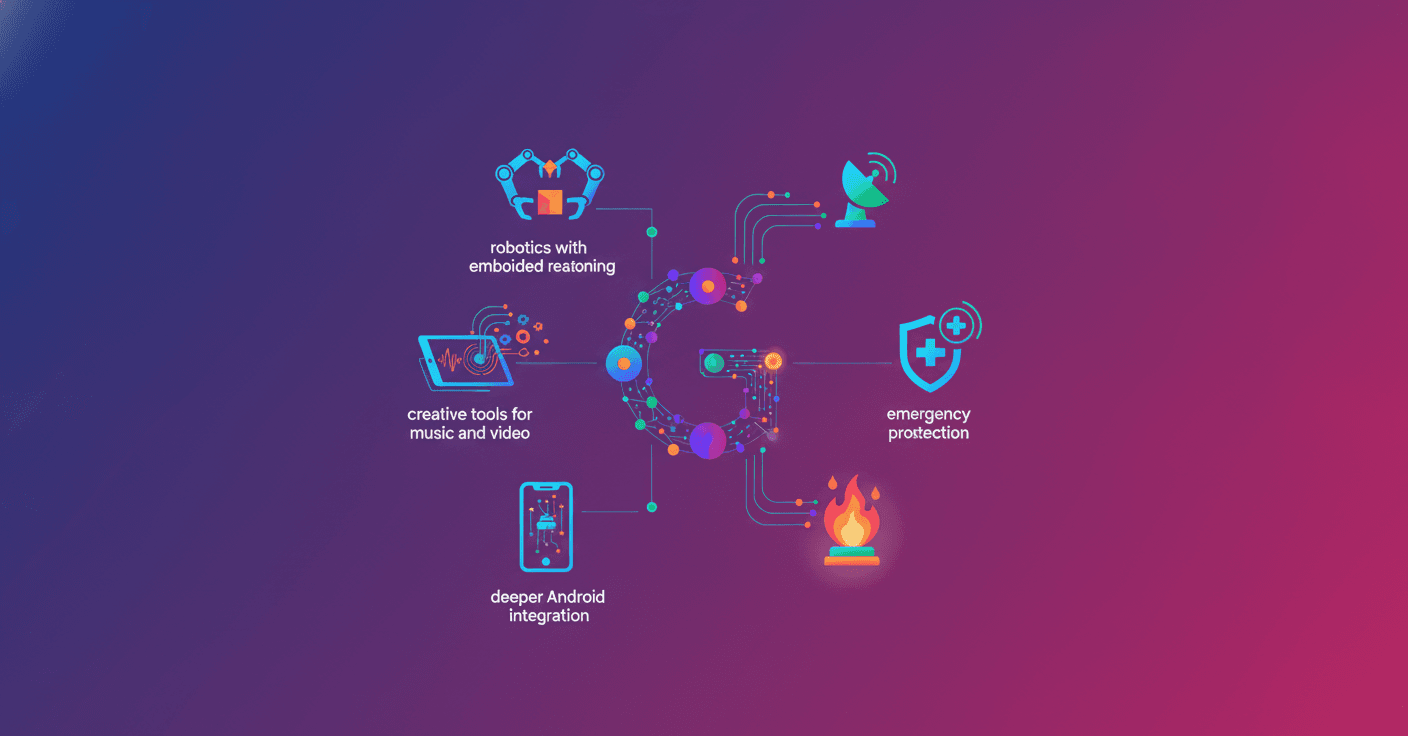
For more than 20 years Google has invested in AI research, tools, and infrastructure. What happened in July 2026? It was a month full of practical updates: more efficient models for developers, new creative tools, deeper integration into devices, and moves to protect communities and the environment.
Key updates from July
Google summed up a series of announcements designed to take AI from the lab into daily life. These aren’t futuristic promises: they’re tools and partnerships that are already starting to affect how you work, create, and respond to emergencies.
Three ideas to hold on to: more efficient models, AI that acts in the physical world, and deeper integration with your everyday apps.
Gemini models and robotics
Three new models arrived focused on scalability and efficiency: Gemini 3.6 Flash, 3.5 Flash-Lite, and 3.5 Flash Cyber. What does this mean for you as a developer or a startup? Lower token consumption, reduced latency, and more stable performance for agents in production.
In robotics, Gemini Robotics ER 2 is Google’s bet on giving machines embodied reasoning: understanding physical environments, conversing naturally, and carrying out complex tasks. Ever dreamed of robots that really help with household chores or collaborate in factories? This is a step toward that reality.
Phones, migration and productivity
At Galaxy Unpacked 2026 devices came with Gemini Intelligence built in. Android 17 introduces a native migration experience that makes moving data from an iPhone easier without extra apps. Moving phones? Now it’s less of a hassle.
Gemini Notebook (formerly NotebookLM) consolidates as a research and work tool: available inside Google’s ecosystem with a secure cloud that makes saving and working with your material straightforward.
Creativity: music, video and historical reconstructions
Google announced Lyria 3.5 for musical generation in Flow Music: better musicality, lyrics, and vocal quality so you can produce songs with more creative control.
In video, Google Vids adds Gemini Omni and personal avatars to generate and edit clips using everyday language. Want a version of you starring in a tutorial? It’s now easier to create.
A curious project: using DeepMind tech they reconstructed the supposed “lost” Pelé goal from 1959. It’s an example of how AI can help tell and recover stories.
Search, accounts and web tasks
Search and the Gemini app connect better with your favorite apps. With your permission, Gemini Spark can now use signed-in accounts and saved passwords to perform complex web tasks like scheduling appointments or starting booking processes. More convenience — with the important caveat that you control the permissions.
They also celebrated 25 years of Google Images with new visual features and AI image generation in search results.
Security, weather and emergency response
The collaboration with NOAA uses Google Cloud to modernize weather forecasting and run faster simulations. That directly impacts early warnings and risk mitigation.
In the fight against wildfires, three FireSat satellites join a global initiative to detect fires before they spread. Together with the UN report on multi-hazard early warning systems, the pieces are starting to align to improve disaster resilience.
Economy, training and biosecurity
Google released the first version of ATLAS to study how AI is used at work and in daily life. It’s a large-scale effort to understand economic and social impacts.
In education and employment, the Alliance for America’s Skilled Trades was launched with BlackRock, Carhartt, and Ford to strengthen trades training. Expected outcome? More practical pathways to technical jobs.
In the cloud, AlphaEvolve (based on Gemini) already helps Google Cloud customers automatically optimize algorithms, returning readable, improved code.
On biosecurity, DeepMind and Isomorphic Labs propose an approach to prevent harmful uses of models while allowing scientists and governments to use the technology to protect communities.
What this all means for you
Worried that AI is only for giant companies? These updates aim to lower the barrier: smarter devices, accessible creative tools, and services that help in emergencies.
If you work in tech, opportunities lie in adapting more efficient models and conversational agents to real products. If you’re a user, you’ll see more routine tasks automated and creative tools more within reach — always depending on how you manage permissions and privacy.
Demis Hassabis (founder of DeepMind) shared his view: we’re at a critical moment to steer AI toward uses that increase wellbeing and resilience. It’s not a utopia; it’s a roadmap that needs policy, companies, and society working together.
Original source
https://blog.google/innovation-and-ai/technology/ai/google-ai-updates-july-2026