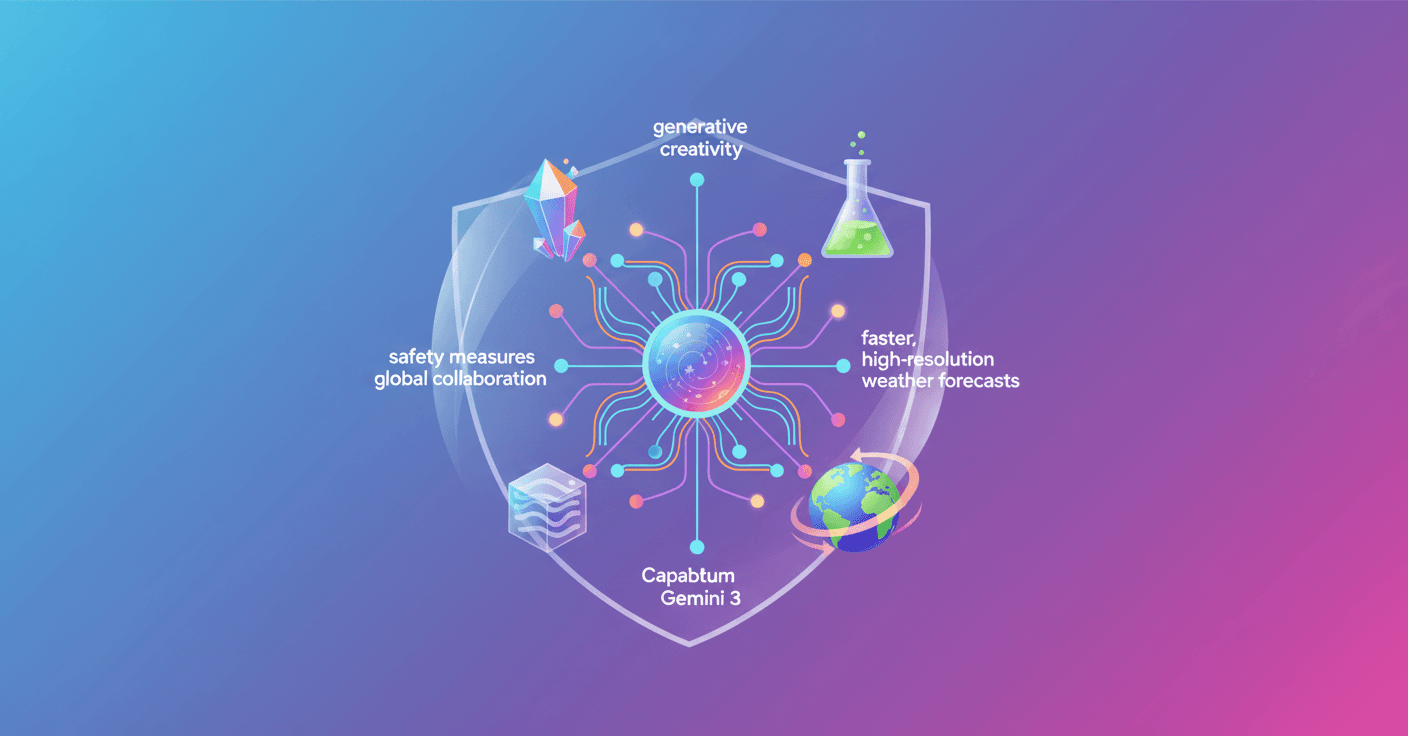
2025 was a year when AI research stopped being just a promise and became real utility. What does that mean? That AI is no longer only something you use — it’s something you put to work alongside you, in science, creativity, products and even weather prediction.
Resumen general
Google, Google DeepMind and Google Research review eight areas where they saw concrete advances in 2025: language and multimodal models, AI-transformed products, generative creativity, science and mathematics, quantum computing and hardware, robotics and world models, applications to global problems, and responsibility and safety.
The story of the year was clear: more power, better efficiency and practical applications. From Gemini 3 and Gemini 3 Flash to improvements in open models like the Gemma family, Google worked to make AI think, act and explore with us.
Modelos y capacidades clave
The 2025 releases showed leaps in multimodal reasoning, generation and efficiency. Gemini 3 Pro set the bar for advanced reasoning, while Gemini 3 Flash blended that power with low latency and low cost. The idea? Cutting-edge quality with the speed you need for everyday use.
There was also emphasis on open, lightweight models like those in the Gemma family: more context, better language support and multimodal abilities so more people and developers can experiment without technical barriers.
Key point: the trend is clear — what used to require huge models is now possible with more efficient, accessible alternatives.
Productos, desarrolladores y herramientas
In 2025 they didn’t just release models; they integrated them into products. From AI features in the Pixel 10 and Search improvements, to new experiences like the Gemini app and NotebookLM with Deep Research. For developers there were deep shifts: agentic systems that collaborate instead of merely assist, and projects like Google Antigravity that reimagine software workflows.
If you’re a developer, imagine a partner that proposes code, runs tests and suggests improvements in fast cycles. That stopped being theory.
Creatividad generativa y medios
Image, video and audio generation made notable progress. Models like Nano Banana, Nano Banana Pro, Veo 3.1 and Imagen 4 widened what anyone can create: from native editing in the Gemini app to professional tools for film and music.
Google Labs remained an experimental playground where projects like Pomelli, Stitch or Jules test new ways for people and models to collaborate. Can you imagine turning a sketch into interface code in minutes? It already exists.
Ciencias, salud y matemáticas
AI was used to push forward biology, medicine and math. AlphaFold celebrated five years of huge impact; genomics tools and complex data interpretations open doors in research and treatments. Deep Think from Gemini solved problems requiring abstract reasoning and achieved wins in international competitions.
Concrete example: models that identify genetic variants in tumors or speed up therapeutic discoveries help researchers move faster and with more precision.
Computación, hardware y mundo físico
Not everything is software. On the hardware side, chips like Ironwood (a TPU optimized for inference) and design methods like AlphaChip focused on energy efficiency and scale. In quantum computing, Quantum Echoes and related advances are bringing the technology closer to real use cases, even earning public recognition such as a Nobel for fundamental work in quantum physics.
There were also projects for space infrastructure and world models, like Project Suncatcher or new versions of Gemini Robotics and Genie 3.
Impacto global y aplicaciones a escala
AI was applied to real problems: climate, mapping, public health and education. A direct example: flood alert coverage for over two billion people in 150 countries, and WeatherNext 2, a model that generates forecasts 8 times faster with resolutions down to 1 hour.
In education, tools like LearnLM and Guided Learning in Gemini improve translations and offer new teaching formats. In health, collaborations to bring advances closer to patients show promising results in diagnosis and disease management.
Responsabilidad, seguridad y gobernanza
As AI becomes more capable, safety moved higher on the agenda. Gemini 3 went through exhaustive safety evaluations, and Google worked on verifying AI-generated media, safety frameworks for frontier models and discussions about a responsible path toward AGI.
It’s not just about moving fast — it’s about moving forward with checks, evaluations and open collaboration.
Colaboraciones y mirada al futuro
2025 reinforced the idea that responsible research needs partnerships: universities, national labs, governments, the creative industry and educational organizations joined initiatives like the Agentic AI Foundation. Google supported projects in education, film, research and open standards to ease interoperability.
Looking to 2026, the bet is to keep advancing safely and practically: more useful models, better energy efficiency, and applications that truly improve everyday life.
Think about this: AI stopped being a novelty and became an everyday tool capable of researching, creating and assisting with complex decisions. Do you feel ready to use it to your advantage?
Fuente original
https://blog.google/technology/ai/2025-research-breakthroughs