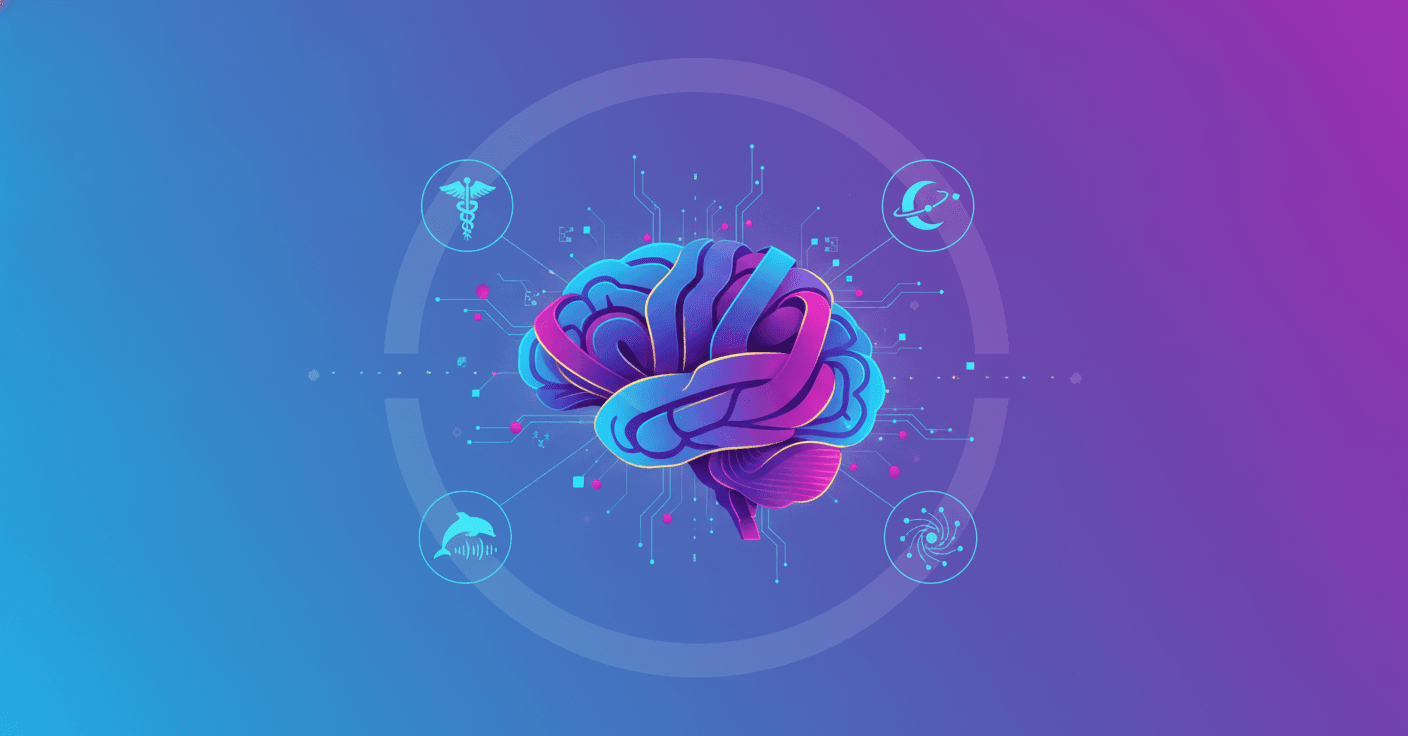
Gemma, Google’s family of open artificial intelligence models, has surpassed one billion downloads. But the most interesting figure isn’t just how many times they’ve been downloaded—it’s everything that developers, researchers, and organizations are building with them.
Over the past two years, the community has published more than 100,000 Gemma model variants and created an ecosystem that Google calls the Gemmaverse. Its applications range from healthcare and education to data analysis in space and research into animal communication.
Gemma reaches space
The Gemma family is already being used beyond Earth. Teams from NASA, Satlyt, and Starcloud are running these models directly in orbit to analyze images, reduce the amount of data that needs to be sent back to Earth, and help manage communications between satellites.
Why does this matter? In space, connectivity is limited and computing resources are scarce. Processing information directly on the satellite can save time, bandwidth, and energy.
This example shows that AI models don’t always need to run in large data centers. They can also be adapted to local devices and extreme environments, as long as they’re optimized for those conditions.
Digital healthcare for millions of people in India
In India, the National Health Authority integrated Gemma 4 and Google’s open-source medical data kit into Aarogya Setu 2.0, an application with more than 100 million downloads on Android.
The tool uses Gemma 4 to transform complex medical reports into standardized digital formats. This allows people to manage and share their health data more securely among different providers.
The idea may sound simple, but solving this problem at scale requires AI to interpret a wide range of documents and convert the information into consistent data. It’s a clear example of how open models can be integrated into public services used by millions of people.
New advances in medical research
Researchers from Yale and Google developed C2S-Scale, a Gemma-based model designed to interpret the behavior of individual cells. The system identified a possible therapeutic pathway for cancer that was later verified in living cells.
Google presents this result as the first time an AI system generated new therapeutic pathways whose mechanisms were tested in a real biological environment. This doesn’t mean AI replaced scientists. Instead, it helped propose a hypothesis that still had to be validated through experimental research.
There’s also MedGemma, a model specialized in healthcare. Organizations in different countries are using it to create applications that support consultation management, communication with patients, and clinical decision-making.
Examples mentioned include support for outpatient triage at the All India Institute of Medical Science and tools for healthcare workers in rural areas of Uganda.
AI can speed up medical work, but its results still require professional oversight, clinical validation, and safety controls.
An AI that studies dolphin language
The Gemma ecosystem has also reached the underwater world. In collaboration with Georgia Tech and the Wild Dolphin Project, researchers developed DolphinGemma, a model designed to analyze dolphin vocalizations and predict possible sequences of sounds.
Understanding communication between species is a huge challenge. It isn’t simply a matter of translating words, because we still don’t know for certain what structure, intention, or context many of these sounds have.
DolphinGemma is a first step toward analyzing large amounts of recordings and detecting patterns that researchers might otherwise miss. The project is still under development, so there’s much more to discover beneath the water.
Open models for solving real-world problems
Google says Gemma’s goal has always been to enable developers to create responsible and useful AI applications in different environments. The community has already applied these models to assistants for people with visual impairments, offline educational centers, and other initiatives with social impact.
That momentum was also reflected in Kaggle’s recent Gemma Challenge, which received more than 1,600 projects focused on solving real-world problems. The winners will be announced soon.
The variety of initiatives reveals something important: there isn’t just one way to use AI. The same model can power a healthcare application, an internet-free education system, or a space research tool, depending on how each team adapts it.
Google introduces the Awesome Gemma repository
To make discovery and collaboration easier, Google launched the Awesome Gemma repository on GitHub. It will serve as an official directory of projects related to the Gemmaverse ecosystem.
The repository will bring together community projects, fine-tuned versions of the models, tutorials, and tools for developers. The goal is for both beginners and experienced teams to find resources that help them move faster.
Do you want to experiment with AI but don’t know where to start? A repository like this can serve as a map: it lets you review existing examples, understand how applications are built, and find ideas you can later adapt to your own needs.
The one-billion-download milestone confirms the interest in Gemma, but its impact will depend on what happens next. The ecosystem’s true measure will be whether these models continue becoming reliable, accessible, and useful tools for people inside and outside the technology industry.
Original source
https://blog.google/innovation-and-ai/technology/developers-tools/gemma-one-billion-downloads