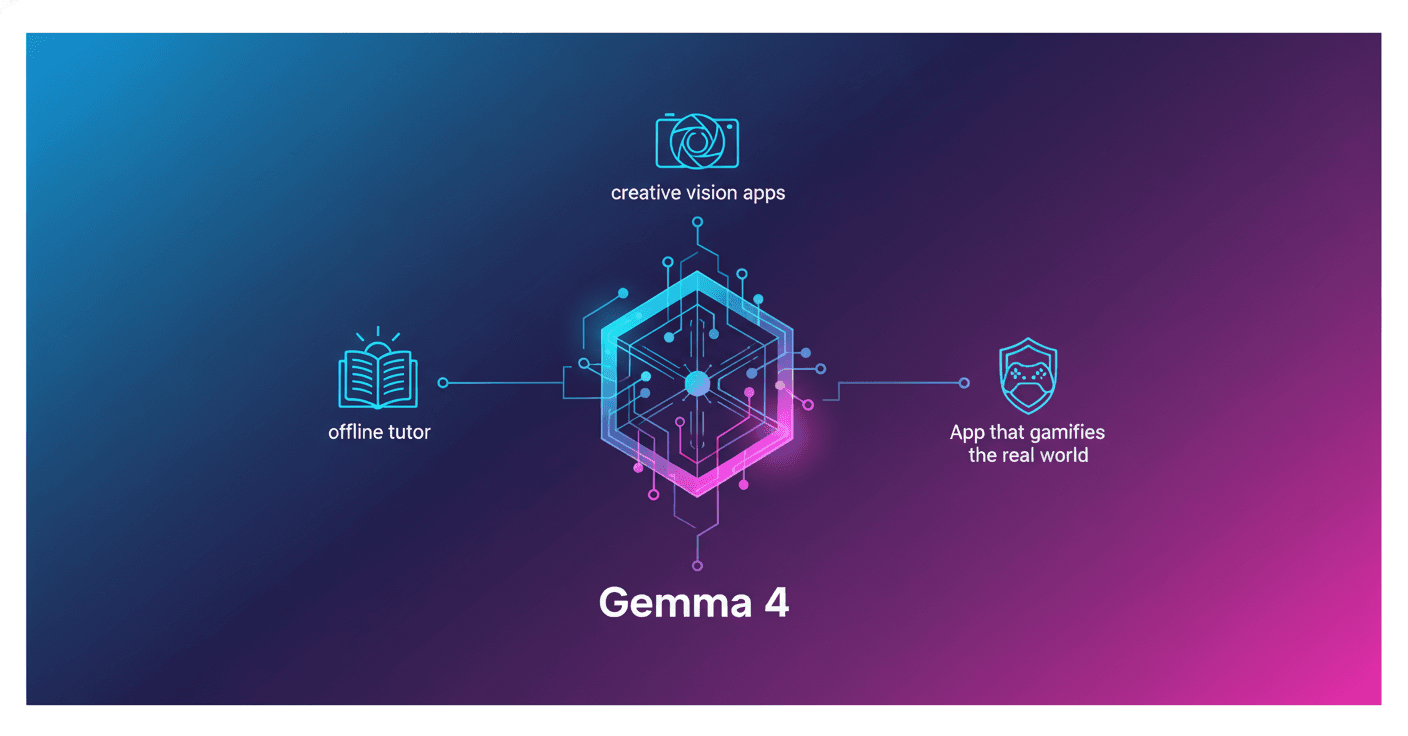
Google introduced Gemma 4, its most capable family of open models to date, and since then they've been downloaded more than 150 million times. What does that mean for people who build products and for you as a user? Basically: faster, more flexible models ready to run from your phone to local servers.
What Gemma 4 brings and why it matters
Gemma 4 isn't just another large model. Google added improvements like Multi-Token Prediction (MTP) to speed up inference, released a unified 12B version, and checkpoints geared for Quantization-Aware-Training (QAT). On top of that, the models are published under the Apache 2.0 license, which gives companies and developers freedom to adapt, fine-tune, and deploy without as many barriers.
Why should you care? Because these improvements aren't theoretical: they let AI run fast, privately, and even offline — something users and privacy rules increasingly demand.
Three projects that show what Gemma 4 enables
1) Language tutors that work offline
The HubX team built BetterSpeak, an English tutoring platform that runs completely offline. They used the edge-optimized version Gemma 4 E2B (effectively 2B parameters) as the on-device reasoning engine. To fit mobile hardware limits, they deployed the 4-bit quantized version released by Google.
And the result? Private, low-latency tutoring that analyzes pronunciation, explains grammar, and tracks progress in multiple languages — all processed on the device. Lower cost, more privacy, and a smooth experience even when you're offline.
2) Creativity with vision and personality
Gemma 4 handles vision-language tasks like object detection, VQA (visual question answering), captioning, and cross-image reasoning. A creator known as @measure_plan on X used this to give the model a medieval bard personality while answering questions about a real scene.
The outcome was both playful and useful: the model identified objects with imaginative descriptions (for example, a goblet of amber liquid or shelves of bound tomes) without losing accuracy. An assistant that replies with style and stays correct? Yes — and it's a nice example of how multimodal AI can be fun and practical.
3) Gamifying the real world with extended memory
For projects that need to remember lots of context, Gemma 4 offers very large context windows (up to 256K in the largest models). @GOROman on X built an app that turns the real world into a video-game adventure: the app keeps a long history of events and reacts like a game master.
In games and interactive experiences, remembering what happened many interactions ago changes immersion completely. That extended memory makes it possible without fragmenting the conversation.
What this means for developers and entrepreneurs
- Privacy and latency: you can move inference to the device and reduce cloud dependence. Ideal for education, healthcare, and apps that need immediate responses.
- Flexibility: the Apache 2.0 license and checkpoints like
QATlet you experiment with fine-tuning and deploy in constrained environments. - Multimodal creativity: native audio, vision, and text together enable richer products (voice tutoring, visual assistants, playful experiences).
Do you need to sacrifice accuracy to run on a phone? Sometimes there are trade-offs, but quantization (shrinking models with techniques like 4-bit) and optimizations like MTP narrow that gap.
Final reflection
We're seeing that AI isn't just for massive data centers. Gemma 4 is accelerating a clear trend: open, capable, and optimized models that enable real, private, and creative experiences on everyday devices. If you're a developer, entrepreneur, or curious user, this means more tools to build with — without asking permission from a tech giant.
Original source
https://blog.google/innovation-and-ai/technology/developers-tools/gemma-4-builders