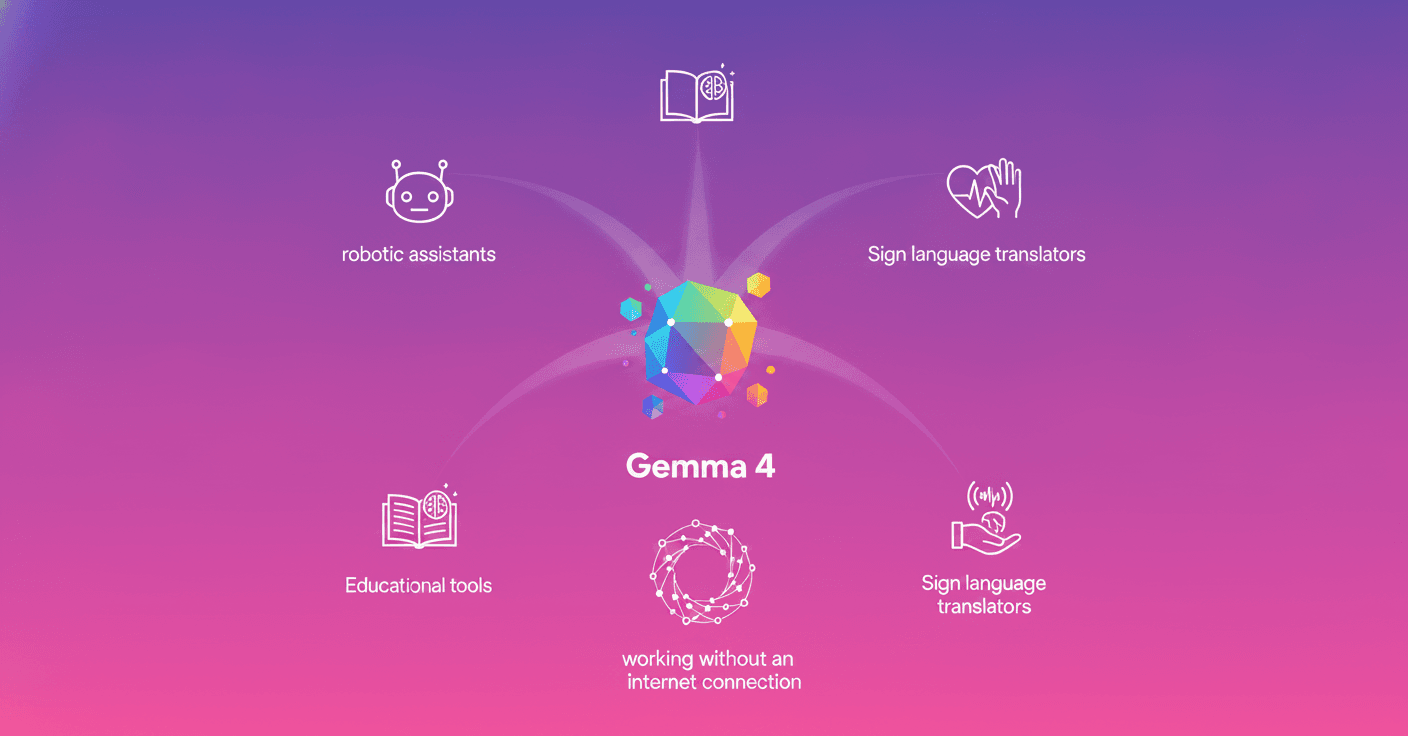
Artificial intelligence doesn’t always need a permanent internet connection, a massive data center, or a specialized team to be useful. The Gemma 4 Good Challenge proves it. This Kaggle competition was created to develop socially impactful solutions using open Gemma 4 models.
Over six weeks, more than 1,600 projects were submitted. Many were designed to run directly on phones, affordable computers, or devices such as Raspberry Pi—a decision that can make a real difference in schools, clinics, and communities with limited connectivity.
Practical AI for Real-World Needs
Participants combined Gemma 4 with tools such as LiteRT, Cactus, Ollama, llama.cpp, and Unsloth. Although their names may sound technical, the idea is simple: make capable AI models run quickly, privately, and efficiently on everyday devices.
What does that mean in practice? An application can analyze images, interpret speech, or answer questions without sending all the data to the cloud. For someone with a disability, a researcher in a remote area, or a patient at a rural clinic, that difference can be enormous.
The Winning Projects
First Place: GEM-4
GEM-4 is a robotic assistant designed to help older adults and people with disabilities with everyday tasks. It uses a 31B Gemma 4 model to label training videos and a lighter Gemma 4 E2B model to turn instructions and visual observations into physical movements.
The project stood out for its vision-language-action architecture, known as VLA. In other words, the system observes what is happening, understands an instruction, and acts on the real world. Its learning cycle also allows it to improve with new usage data.
Second Place: Trido
Trido turns a digital whiteboard into a voice-controlled tool for teachers, especially those with physical disabilities. Its local model can create mind maps, quizzes, and visual elements in real time.
One of its greatest strengths is that it can keep working offline on affordable computers. That way, technology doesn’t depend on having perfect infrastructure to be useful in the classroom.
Third Place: PenguinAgent
PenguinAgent was created for ecologists working on remote expeditions. It analyzes videos, movement data, and scientific documents stored locally to study the behavior of birds and other animals.
The project uses retrieval-augmented generation, or RAG, a technique that allows the system to consult specific documents before producing an answer. Because it runs on the device, it protects the privacy of scientific data—even in places without internet access.
Fourth Place: DEMENTOR
DEMENTOR combines cameras, sensors, and haptic feedback, such as vibrations or physical signals, to support people with dementia and their caregivers.
The system helps identify behavior patterns and retrieve information related to everyday tasks. Its design focuses on two sensitive issues: user safety and the protection of health data.
Special Awards with Global Impact
In addition to the top places, the competition recognized projects addressing specific problems in different regions of the world.
- Acuífero·Vigía, Global Resilience Award: an early-warning system for floods in South America. It combines sensor data, volunteer descriptions, and river cameras to generate local predictions and safety instructions.
- TrueVoice, Trust and Safety Award: a detector for scams based on voice cloning. It analyzes vocal anomalies, emotional tone, and subtle voice characteristics to identify possible fraud.
- Gem-Care, Digital Equity and Inclusion Award: adapts speech recognition for people with dysarthria and other speech disabilities. It reduced the word error rate from 32.7% to 19% compared with the base model.
- CodeBuddy, Future of Education Award: allows students in Indonesia to write Python code on paper, take a photo, and receive transcription, compilation, and corrections offline.
- Project Rosie, Health and Science Award: an assistant for veterinarians that helps interpret clinical information and design personalized cancer vaccines for dogs.
When AI Works Without the Internet
The technical awards reveal another important part of this competition. Gilbeot created a navigation assistant for older adults that translates difficult-to-understand coordinates into human directions, such as turning after a specific sign. It runs on Android through LiteRT-LM and doesn’t require cellular service.
PreVillage, the winner of the llama.cpp award, helps rural citizens in Nepal navigate public services through WhatsApp and voice commands. The system uses a local information database and can run on a Raspberry Pi 5, with an approximate response rate of 7.5 tokens per second.
PathOS developed a support tool to detect possible cases of cancer in tissue samples at rural clinics. MindBridge, meanwhile, helps community workers conduct mental health assessments in regional Hindi dialects.
KawanIsyarat facilitates communication between deaf people or those with hearing difficulties who use Indonesian Sign Language, BISINDO. The application translates signs captured by the camera into sentences and simplifies spoken audio directly on mid-range Android phones.
What the Challenge Reveals About the Future of AI
These projects share a powerful idea: artificial intelligence doesn’t have to be centralized to be advanced. In many cases, running the model locally improves privacy, reduces dependence on the internet, and makes it possible to serve communities that are often left out of major digital platforms.
They also show that the model alone isn’t enough. Engineering, data, experience design, and an understanding of the problem are just as important. A good AI system isn’t the one that gives the most impressive answer; it’s the one that solves a specific need without creating new risks.
True innovation isn’t only about making bigger models. It’s also about making them more useful, accessible, and responsible in the real world.
With more than 1,600 submissions and one billion Gemma downloads, Google presents this challenge as an example of what developers can build with open models. The next step will be seeing how these ideas evolve and how much impact they achieve beyond the competition.