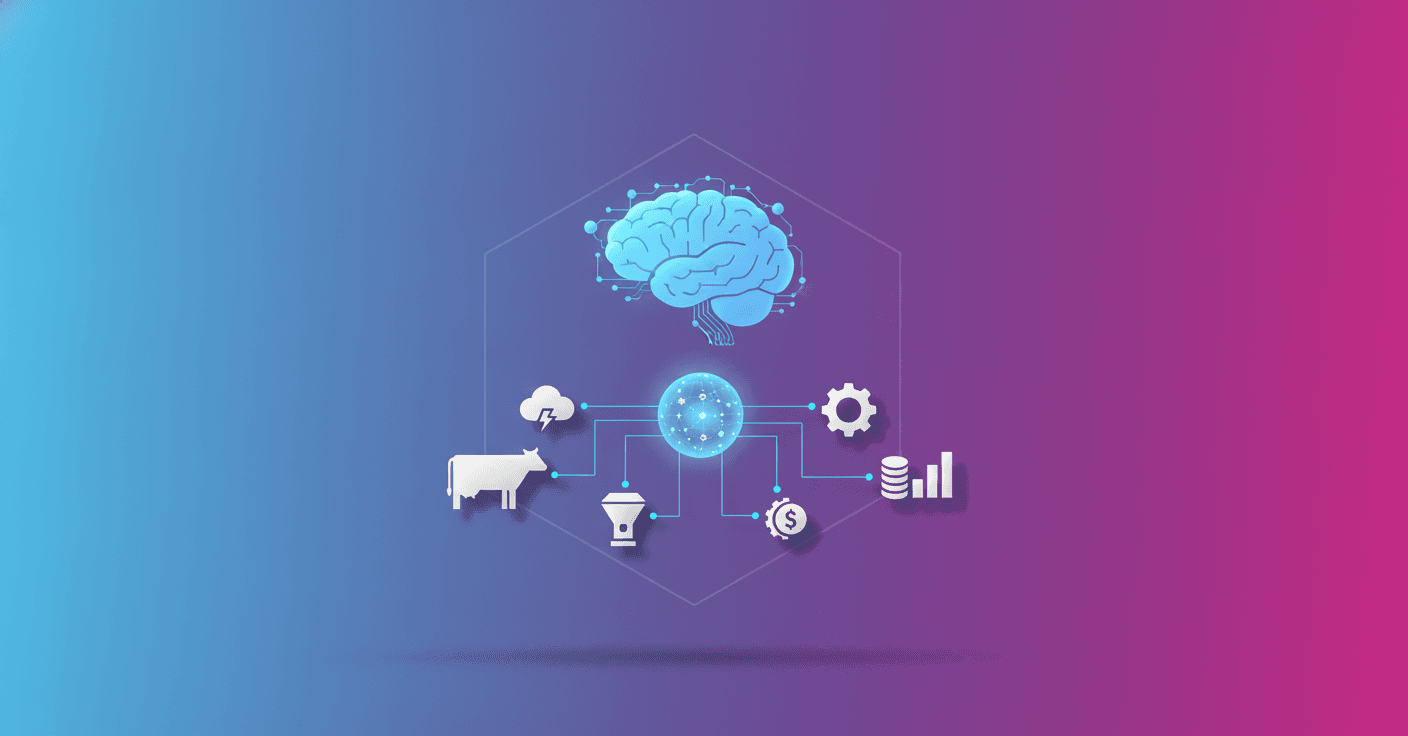
At a dairy farm in Michigan, artificial intelligence is not replacing the farmer: it is taking hours of administrative work off his plate. Paul Windemuller uses agents powered by Gemini 3.6 Flash to combine data from sensors, weather, feed, milk quality and invoices, and turn it into operational decisions.
What is the goal? To let the owner spend less time downloading files and cross-referencing spreadsheets, and more time caring for his cows and growing the business.
From 30 cows to an automated operation
Paul and Brittany Windemuller founded Dream Winds Dairy in Michigan in 2014, with just 30 leased cows. Twelve years later, the farm has an automated facility that milks 260 Holstein cows.
The operation constantly produces information. Sensor-equipped collars monitor each animal, a weather station records environmental conditions, and an online portal stores data on milk quality, production and shipments.
The problem was not a lack of data. It was that each system worked separately. Every morning, Paul had to download files, combine spreadsheets and manually calculate the performance of the business. On a farm with tight margins, that delay can affect important decisions.
A multi-agent architecture to organize the data
To solve this, Paul created a local artificial intelligence system with several specialized agents. The solution uses Gemini 3.6 Flash within Google Antigravity and works with a local-folder-based interface.
Instead of relying on APIs or web extraction techniques, the system monitors a folder. When Paul saves CSV files, photos of receipts, invoices or PDF documents there, the agents process the information and integrate it into a shared analysis.
This approach has two practical advantages: it accepts numerical and visual data, and it keeps sensitive information within the farm’s infrastructure.
What each agent does
The architecture divides the work into specific functions:
- Orchestrator agent: coordinates the daily workflow and decides which tasks should be executed.
- Ingestion agents: clean and standardize files from milking robots, feed records and other sources.
- Analysis agent: studies the relationship between biological performance, weather and farm operations.
- Reporting agent: turns the results into written explanations that a person can read quickly.
This separation avoids relying on a single massive prompt. Each agent has a defined responsibility, while the orchestrator connects the stages—a strategy that can improve traceability and make the system easier to maintain.
Why Gemini Flash lowers the cost of agents
Agentic workflows often require several rounds of reasoning, file reading, tool use and result generation. For a small business, running that cycle every day can become too expensive.
According to Google, Gemini 3.6 Flash is designed for advanced reasoning, tool use and programming. It also offers a 1-million-token context window and a maximum output of 64,000 tokens.
The company says the model produces approximately 17% fewer output tokens than Gemini 3.5 Flash and has a lower cost per generated token. In practice, that can reduce the cost of running agentic loops continuously.
Why does that matter? Because an AI solution is not truly useful to a business if it works in a demonstration but is too expensive to operate every day.
The metric guiding decisions: SVM
The system does not simply summarize data. It is designed around a metric Paul considers more useful for his operation: Static Variable Margin, or daily static variable margin.
Traditional metrics such as income over feed cost can change because of volatility in milk and feed prices. SVM tries to isolate those market effects by using fixed prices and focusing on biological and operational efficiency.
The calculation follows several stages:
- Biological performance: analyzes milk production, fat and protein levels, somatic cell count and feed intake.
- Static income: applies fixed prices based on historical standards, including January prices from Federal Order 33, to the solids produced.
- Static feed cost: uses fixed prices for ingredients and measures changes in the amount actually consumed.
- Static income over feed cost: subtracts static feed cost from static income.
- Variable costs: deducts per-cow expenses such as replacements, reproduction and veterinary supplies.
The calculation excludes general costs such as labor, utilities and depreciation. That way, a change in SVM primarily reflects herd health, feeding and operational efficiency—not market fluctuations.
From a spreadsheet to a report for the farm manager
Calculating the margin is only one part of the process. The real value appears when the results are turned into a useful explanation that can be understood quickly.
The reporting agent generates a daily report called Farm CEO Briefing. Instead of displaying an extensive table, it identifies the factors that drove the day’s result.
For example, a $0.15 decline per cow could be explained like this:
- Dry matter intake: down $0.08 because moisture reduced feed consumption.
- Somatic cell count: down $0.04 because of a slight increase that could indicate health problems.
- Discarded milk: down $0.03 because two cows entered the treatment area.
The report also suggests actions. In a heat-stress scenario, it might recommend adjusting ventilation. The AI does not simply say that the result got worse: it connects the data with possible causes and next steps.
The difference between automating a report and supporting a decision lies in explaining what changed, why it changed and what should be reviewed next.
A model for small businesses
The experience of Dream Winds Dairy shows a concrete application for AI agents. This is not a futuristic farm disconnected from reality, but a business that already had sensors, files and separate systems—and needed a more efficient way to use them.
The approach also has limitations. The quality of the recommendations depends on the files being complete, the metrics being well defined and the reference prices being appropriate. In addition, any decision related to animal health must be validated with professionals and the farmer’s own experience.
Even so, the principle can be applied to other industries. A restaurant could combine inventory, sales and invoices. A repair shop could cross-reference work orders, spare parts and repair times. A store could analyze sales, purchases and margins without forcing its owner to review several spreadsheets every morning.
The important thing is not to attach the AI label to a task. It is to design a workflow in which data enters in an orderly way, agents handle specific jobs and the result arrives as an actionable explanation.
For Paul, the main benefit is recovering time without losing control over the information. For other independent businesses, his system raises an interesting possibility: building an intelligent operational layer over the tools they already use, without having to turn the entire company into a technology lab.
Original source
https://blog.google/innovation-and-ai/models-and-research/gemini-models/using-gemini-to-manage-farm