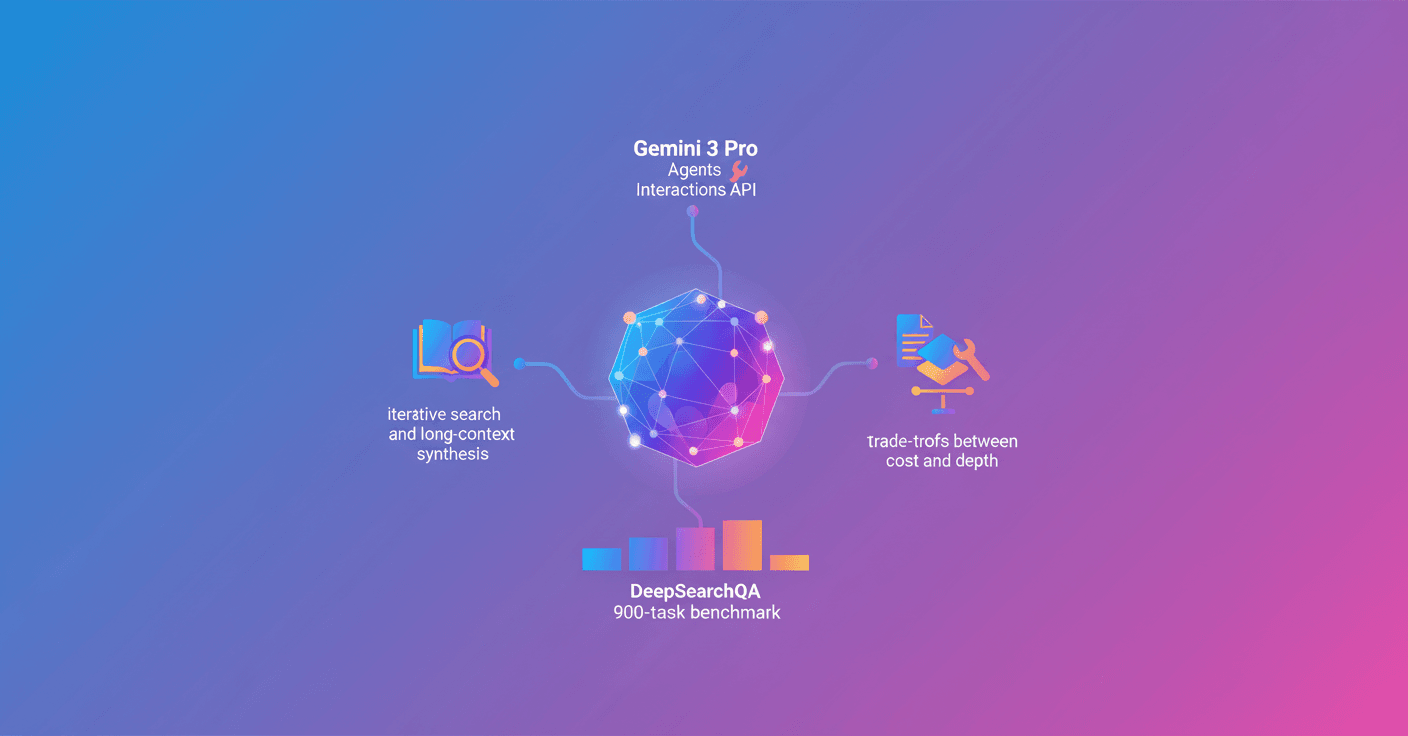
Google announces a powerful research agent you can now integrate into your apps. Gemini Deep Research promises deep searches, long-context synthesis and more reliable reports, and it ships with an open benchmark to measure how complete agents are on real web-research tasks.
What is Gemini Deep Research
Gemini Deep Research is an agent optimized for long-running collection and context-synthesis tasks. Its reasoning core uses Gemini 3 Pro, a model tuned to minimize hallucinations and improve report quality during complex processes.
Technically, Google scales multi-step reinforcement learning over the search layer so the agent plans iteratively: it crafts queries, reads results, spots knowledge gaps and searches again. The result is autonomous navigation across complex information landscapes, with improved ability to dig deeply into specific sites.
Gemini Deep Research improves web exploration, generates structured reports and provides granular citations to verify sources.
DeepSearchQA: a benchmark for deep research
Google also releases DeepSearchQA, a benchmark designed to measure thoroughness and retrieval in multi-step research tasks. It contains 900 tasks built with causal chains across 17 domains, where each step depends on the previous analysis.
Unlike tests that focus only on isolated facts, DeepSearchQA demands exhaustive answer sets. It also includes diagnostic tools that show the benefit of "thinking time": allowing more searches and reasoning steps improves performance.
In numbers, Gemini Deep Research reaches 46.4% on Humanity's Last Exam (HLE), 66.1% on DeepSearchQA and 59.2% on BrowseComp. Google also shows pass@8 vs. pass@1 comparisons on a subset of 200 prompts to illustrate the advantage of exploring multiple parallel trajectories.
Real-world applications and examples
What can you use this for today? There are already concrete cases: financial firms automate early due-diligence stages by aggregating market signals, competitor analysis and compliance risks from the web and proprietary sources.
In biotech, for example, Axiom Bio reports that the agent added depth and granularity to biomedical literature review, accelerating early drug-discovery stages. Other verticals mentioned include market research and financial analysis.
What it offers developers
If you build automated research tools, this will interest you:
- Integration via
Interactions APIwith yourGemini APIkey from Google AI Studio. - Document handling: analysis of PDFs, CSVs and docs with
File UploadandFile Search Tool. - Controllable outputs: lets you define report structure, headings, tables and formatting through prompt engineering.
- Detailed citations to verify sources and
JSON schemafor structured outputs your apps can parse automatically.
Google also announces upcoming improvements: native chart generation for analytical reports and greater connectivity via Model Context Protocol (MCP) to access your own data sources. Enterprise support via Vertex AI is planned as well.
Practical recommendations to get started
- Try the starter Colab and read the Technical Report to understand methodology and limitations.
- Start with structured prompts that guide report shape and ask for outputs in
JSON schemato integrate them into pipelines. - Evaluate the trade-off between cost and depth: allowing more trajectories (pass@8) improves veracity but increases calls and latency.
Technical considerations and best practices
- Iterative thinking: let the agent perform multiple searches and reasoning steps if your case requires exhaustiveness.
- Verification: use pass@k (k>1) when you need to contrast hypotheses in parallel and reduce error risk.
- Context handling: Deep Research supports large contexts, but design prompts that prioritize sources and avoid noise.
- Costs and latency: pro models with RL can be more expensive; optimize how much "research time" you allow based on the report's value.
Final reflection
The novelty isn't just a more powerful model: it's a combination of iterative reasoning, data-ingestion tools and open metrics to measure thoroughness. What does that mean for your project? It means you now have a technical piece to automate investigative phases with greater rigor—provided you tune prompts, verify sources and control costs.
Original source
https://blog.google/technology/developers/deep-research-agent-gemini-api