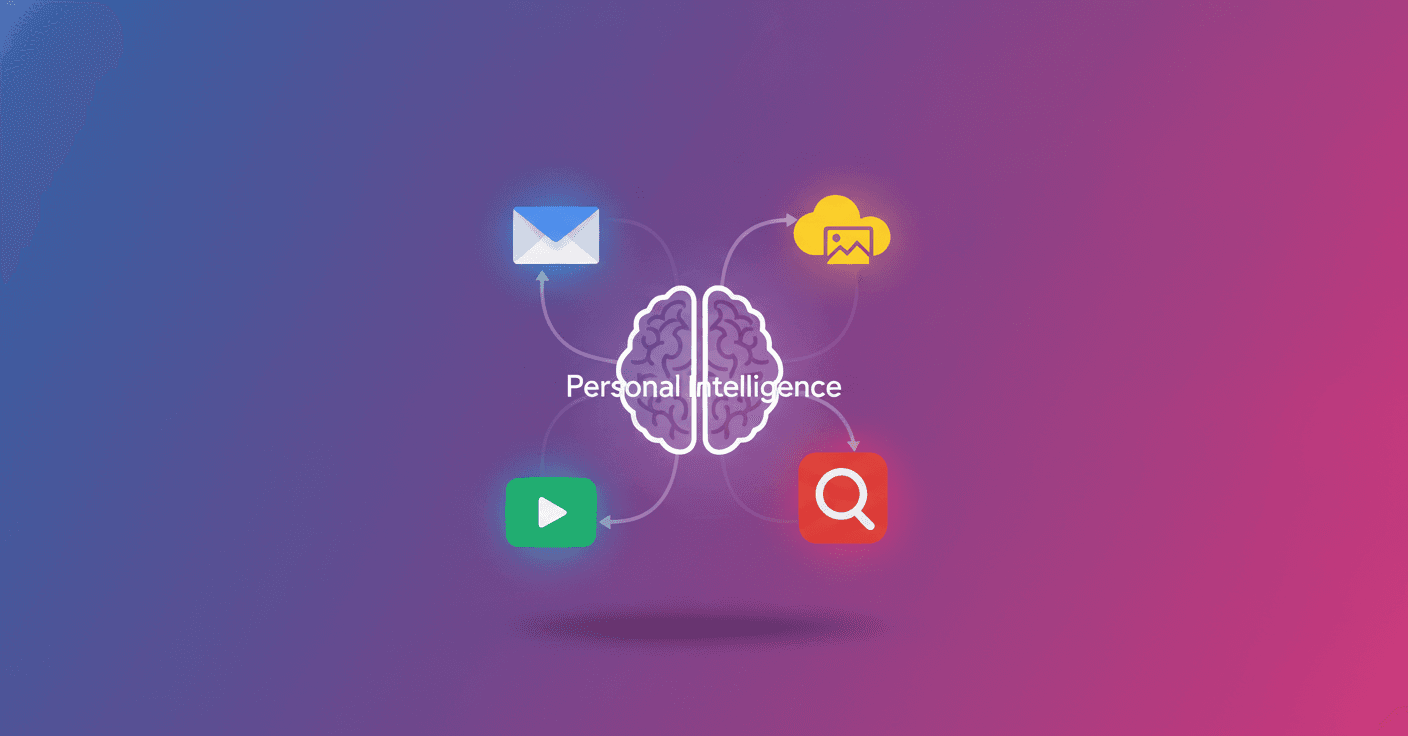
Gemini has just taken a step toward more personal answers. Google introduced Personal Intelligence, a beta feature that connects Gmail, Google Photos, YouTube, and Search so the assistant can better understand your context and help you with everyday decisions.
For now, the tool is beginning to roll out in the United States for Google AI Pro and AI Ultra subscribers. The company plans to bring it to more countries and, over time, to the free tier as well.
Gemini can now understand your context
The idea is simple: instead of responding only with general information, Gemini can check data you already have in your Google apps, as long as you authorize the connection.
Do you need to remember your vehicle’s tire size? Find a license plate saved in a photo? Plan a trip while taking your previous preferences into account? Personal Intelligence aims to combine information from emails, images, videos, and searches to offer an answer that better fits your situation.
Google explains the case of someone who needed to buy tires for their minivan. Gemini was able to check vehicle details in Gmail, review photos from family trips, and suggest suitable options for different climates, along with comparing ratings and prices.
It can also help with more personal recommendations, such as books, shows, clothing, or travel destinations. Instead of suggesting the most popular places, the assistant tries to consider your interests and past experiences.
The difference isn’t just that Gemini knows more. It’s that it can connect information that already exists in your digital life.
Privacy and data control
The connection between apps is turned off by default. You decide which services to link, you can disconnect them at any time, and you also have the option to use temporary chats or regenerate an answer without personalization.
Google says Gemini does not directly train its models with your Gmail inbox or your entire Google Photos library. That data is used to answer specific requests, not to teach the model license plate numbers or details about your life.
The company says it may use limited information, such as certain messages sent to Gemini and its responses, to improve the service. Before that process, it says it applies measures to filter or hide personal data.
In addition, Gemini will try to show or explain which connected sources it used to obtain the information. This makes it easier to verify an answer and spot errors. If something isn’t correct, you can correct it directly—for example: “Remember that I prefer window seats.”
Google has also added limits for sensitive topics. Gemini aims to avoid making automatic conclusions about matters such as health, although it can discuss that information if you ask explicitly.
The risk of AI drawing the wrong conclusions
Personalization can be useful, but it isn’t infallible. Google acknowledges that the beta version may provide incorrect answers or fall into what’s known as overpersonalization: connecting data that actually has nothing to do with each other.
One example makes this clear. If Gemini finds many photos of you on a golf course, it might conclude that you love the sport. But perhaps you were only there to accompany your child. AI sees patterns, but it doesn’t always understand the story behind them.
That’s why the company asks users to rate problematic answers negatively. You can also correct the assistant’s preferences to help it interpret your context more accurately.
How to try Personal Intelligence
Access will roll out during the week following the announcement for eligible personal Google AI Pro and AI Ultra accounts in the United States. The feature will be available on the web, Android, and iOS, and will work with the models available in Gemini’s model selector.
To activate it, Google provides these steps:
- Open Gemini and go to Settings.
- Tap Personal Intelligence.
- Select Connected Apps to choose Gmail, Photos, or other applications.
The feature is not currently available for business, education, or Google Workspace accounts. Google also plans to integrate it soon into AI Mode within Search.
Personal Intelligence shows where AI assistants are headed: fewer generic answers and more help based on your reality. But the more a tool knows about you, the more important it becomes to review its permissions, verify its conclusions, and stay in control of the information you share.
Original source
https://blog.google/innovation-and-ai/products/gemini-app/personal-intelligence