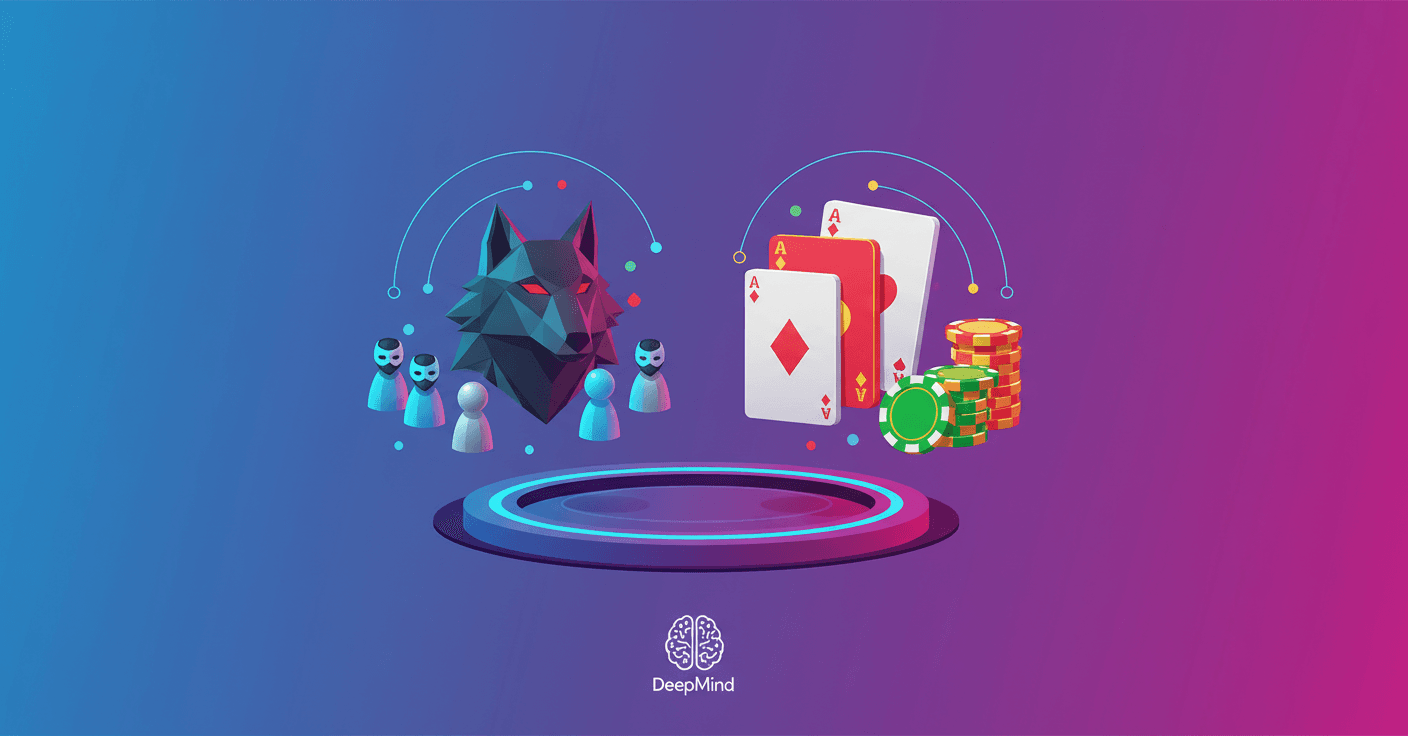
Google DeepMind and Kaggle expand the evaluation lab for AI models: Game Arena is no longer just chess. Why does that matter to you? Because moving from perfect-information games to uncertainty-filled scenarios brings us closer to real-world challenges.
What Kaggle Game Arena is and why it matters
Game Arena is a public, independent platform to compare AI models in strategic games. It started with chess to measure long-term reasoning and planning, but the new wave adds Werewolf (social deduction) and poker (risk management). What do we gain from that? A more varied test set that measures different cognitive skills: calculation, communication, negotiation, and handling uncertainty.
As a researcher or developer, a useful benchmark must be reproducible, public and—very importantly—diverse enough to reveal a model’s strengths and weaknesses. Games deliver that: they’re controlled environments where you can observe complex behavior without exposing real people to risk.
Chess: reasoning beyond brute force
Chess remains the classic test: head-to-head games, a transparent board and fixed rules. Traditionally, engines like Stockfish hit the ceiling with brute force and deep position search. Large language models don’t compete that way; they use pattern recognition and heuristics that drastically shrink the search space, mimicking human intuition.
On the updated leaderboard, Gemini 3 Pro and Gemini 3 Flash top the table with high Elo scores. That reflects progress in strategic reasoning: concepts like piece mobility, pawn structure and king safety show up in internal chains of thought. Game Arena lets you follow that evolution generation after generation.
Werewolf: social deduction and agentic safety
Werewolf (also known as Mafia) brings natural language communication and teams into play. Here information is imperfect and distributed among players. Models must converse, spot contradictions, form consensus and, in some roles, deceive effectively but in a controlled way. Sounds a lot like the challenges of an assistant that works with humans, right?
Technically, evaluating Werewolf uses metrics more complex than Elo: win rates by role, accuracy in spotting deception, consistency of beliefs across rounds and skill at building coalitions. It’s also a proving ground for agentic safety: you can practice red-teaming (having the model play deceptive roles) while measuring its ability to detect manipulation without putting real users at risk.
Gemini 3 Pro and Gemini 3 Flash lead here too, showing that state-of-the-art models can reason about statements, cross-reference voting information and adapt collaborative strategies. Want a deeper technical dive on metrics and methodology for Werewolf? Check the Kaggle blog (link below).
Poker: uncertainty and risk management
Poker adds another dimension: quantifying uncertainty and managing expected value. In Heads-Up No-Limit Texas Hold'em models must not only infer the opponent’s hand distribution, but also adapt bet sizing, exploit tendencies and protect themselves from being exploited.
Historically, techniques like Counterfactual Regret Minimization (CFR) have been key in competitive poker. Modern language models and agents can combine reinforcement learning, opponent modeling and decision-making based on expected value (EV) to choose actions. Typical metrics include EV per hand, showdown win rate and exploitability.
DeepMind and Kaggle organized a poker tournament that culminated in a final leaderboard (Heads-Up No-Limit Texas Hold'em). The results were published after the finals and help compare strategies in real uncertainty scenarios.
Live events and how to follow them
To celebrate these updates there were three live broadcasts with expert commentators:
- Monday, Feb 2: poker tournament with the top eight models.
- Tuesday, Feb 3: poker semifinals and highlights from Werewolf and chess.
- Wednesday, Feb 4: poker final and full leaderboard release; plus a chess match between Gemini 3 Pro and Gemini 3 Flash and Werewolf highlights.
The streams featured Hikaru Nakamura in chess and poker legends like Nick Schulman, Doug Polk and Liv Boeree. Want to watch games and analysis? Tune in at kaggle.com/game-arena.
What this means for practical AI
Does this mean models are ready for production in every social or financial context? Not exactly. Games are proxies: controlled and repeatable, but simplified. Still, expanding benchmarks toward social interaction and uncertainty improves how we measure robustness, alignment and safety.
For entrepreneurs and product teams, the takeaway is simple: evaluate models in scenarios that reflect your real risks. If your app needs negotiation or handling incomplete information, tests like Werewolf and poker are more relevant than evaluations based only on language tasks or classification.
Exploring Game Arena lets you see not just who wins, but how they win: strategies, failures and emergent behaviors that will help you design safer, more useful systems.
Original source
https://blog.google/innovation-and-ai/models-and-research/google-deepmind/kaggle-game-arena-updates