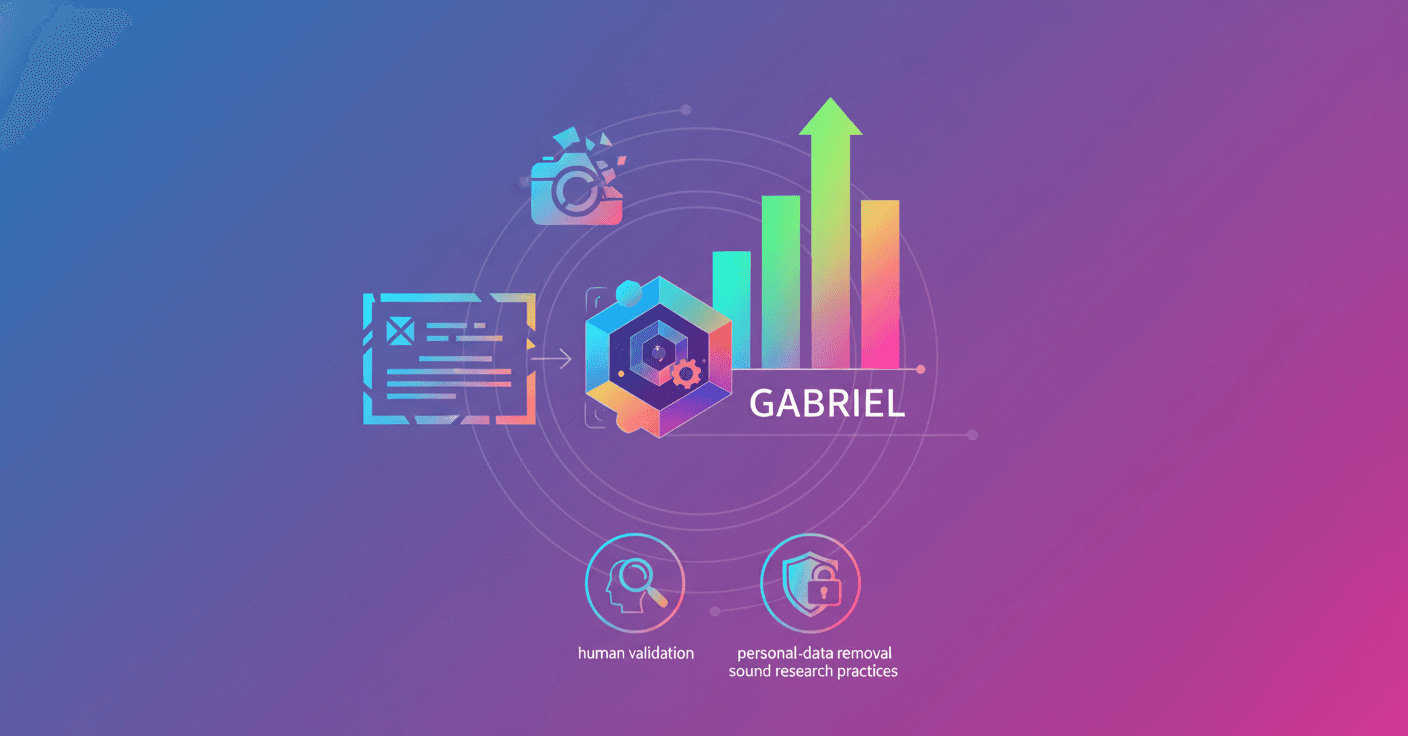
OpenAI introduces GABRIEL, a tool designed so you, a researcher or a curious person, can transform texts and images into numbers that actually help analyze social phenomena. Can you imagine turning piles of interviews, course syllabi, or reviews into data ready for statistics without spending months labeling by hand? That's exactly what it aims to make easier.
What is GABRIEL
GABRIEL is an open source toolkit that uses GPT models to turn unstructured qualitative data into quantitative measurements. It's aimed at economists, social scientists, and data scientists, but it's built to require little technical expertise. Instead of writing complex rules, you describe what you want to measure in everyday language—for example, "how family-friendly is this job ad?"—and GABRIEL scores each document consistently.
The central idea is simple: the richness of qualitative sources (interviews, photos, syllabi, social media) often gets left out of large studies because converting them to data is so laborious. GABRIEL wants to open that path so you can study larger scales with less repetitive effort.
Practical examples
-
Review hundreds of academic articles to identify which methods are used and how they change over time.
-
Analyze syllabi to measure how much certain topics or skills are being taught.
-
Extract structured historical details from local sources or scan customer reviews to see what people value most.
Besides automatic labeling, GABRIEL includes practical utilities like merging datasets with different columns, detecting duplicates, coding passages, helping generate hypotheses, and removing personal information to protect privacy.
How reliable is it?
OpenAI reports that, on benchmarks, GPT is highly accurate at labeling qualitative data in many use cases. Does that mean you skip human checks? Not at all. The tool is meant for researchers to define what to measure, verify results, and adjust when needed. Why? Because expert judgment remains key to interpreting measurements and avoiding bias.
How to get started
GABRIEL is available now as an open source library in Python and comes with a tutorial notebook to get you started step by step. If you have text or image data you can: describe the variable you want, run the processing at scale, and review the generated labels. The workflow lets you focus on the open questions and validation instead of the repetitive work of labeling.
If you're a teacher or researcher with limited resources, this can mean opening projects that used to be unviable because of time costs. If you work in public policy or product, it lets you incorporate the human voice in measurable ways into evidence-based decisions.
Impact and warnings
GABRIEL has the potential to democratize access to large-scale qualitative analysis, but it's not a magic wand. You need to:
- Define clearly what you're going to measure.
- Validate labels with a human sample.
- Be careful with privacy and data representation.
The tool speeds up processes, but good research practices remain essential to avoid wrong conclusions.
GABRIEL is also a community experiment: its development will continue with feedback from academics and users.
For you who work with text, images, or interviews, this can cut weeks or months of repetitive work and let you spend more time on interpretation, testing theories, and designing better policies or products.