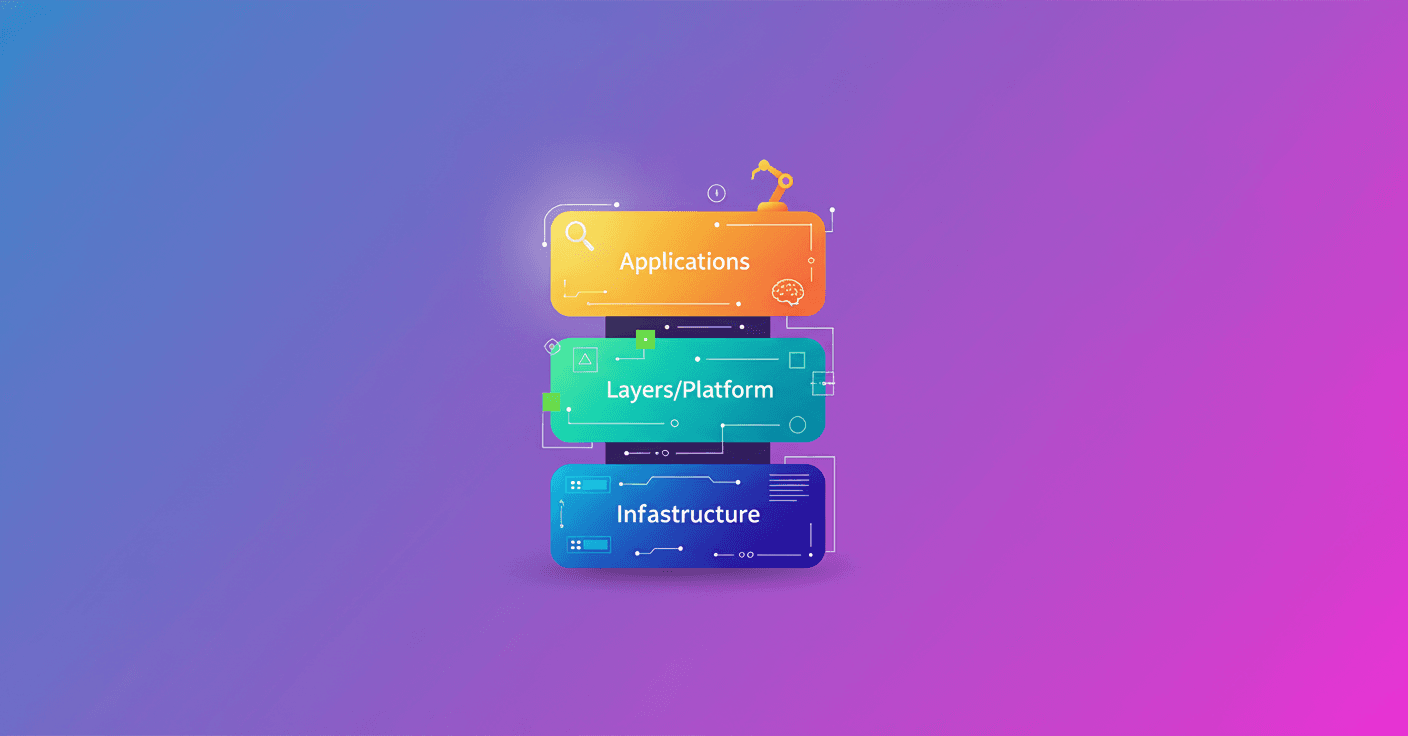
If you’ve seen news or tried AI tools lately, you’ve probably run into the term full-stack. Sounds technical? Yes, but it’s not magic: it’s simply the idea of covering the whole path, from infrastructure to the experience people actually use.
Where does the term come from and what does it mean today?
Originally, full-stack described developers who could build a complete app: the interface (front-end), server logic (back-end) and the database. What's the advantage? Fewer handoffs between teams and more autonomy to take an idea to production.
With the arrival of AI, the same principle applies: instead of cobbling together loose parts from many vendors, a full-stack approach offers an integrated stack that includes hardware, models, orchestration and the interfaces people use.
What layers make up an AI full stack?
Think of layers that work together to solve a problem with AI:
- Compute infrastructure: chips and specialized servers like
TPUthat speed up calculations. - AI models: trained networks, like Google’s Gemini family.
- Orchestration platform: services that manage deployment, scaling and security for agents and apps.
- User interfaces: the apps and tools people use, like Gmail or Maps, or creative products like Google AI Studio.
Putting all this together saves you hours integrating incompatible pieces or paying middlemen.
Clear benefits, and some reasonable concerns
Why prefer a full stack? There are three concrete benefits:
- Simplicity: everything comes ready to use, which speeds up prototypes and rollouts.
- Reliability: if a layer fails, the stack owner can detect and mitigate the issue faster.
- Cost savings: fewer external vendors means fewer charges passed on to the user.
Does that mean you’re trapped in a closed ecosystem? Not necessarily. According to Google, their platform is "opinionated but extensible": you can connect external models or services if you prefer. It’s an invitation to use what works, not a trap.
How do you start if you want to use a Google full stack?
It depends on your goal and experience:
- If you want to prototype a website quickly, try Google AI Studio and deploy to
Cloud Runwith one click. - If you want to automate tasks without code, the Gemini Enterprise Platform lets you build flows to clean emails or process spreadsheets.
- If you need to orchestrate agents and complex systems, the Antigravity platform offers rich surfaces to build without being a programming expert.
Got an idea and don’t know where to start? Pick the door that matches your level: prototype, automation or orchestration.
Final thought
The full-stack approach in AI tries to lower the friction between technical possibility and real utility. It’s not about hiding complexity forever, but about cutting time and cost so more people — from entrepreneurs to large teams — can turn ideas into useful tools.
Original source
https://blog.google/innovation-and-ai/technology/ai/full-stack-ai-explainer