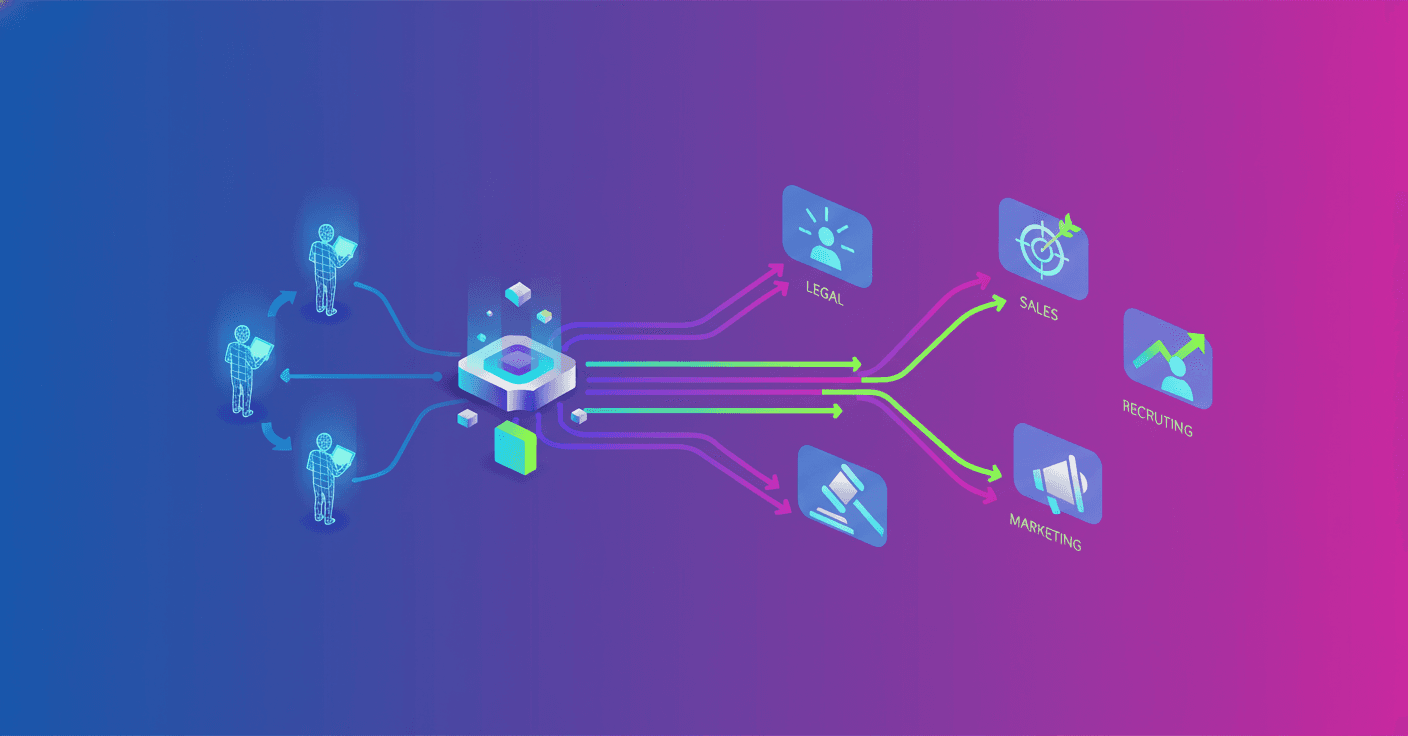
Enterprise artificial intelligence is changing its role. It is no longer limited to answering questions or suggesting ideas: more and more organizations are connecting it to their data, tools, and processes so it can complete tasks from start to finish, always with human review.
Two new reports from OpenAI show how this transformation is advancing and why some companies are making much more of AI than others. The difference does not seem to be only about having access to the same models, but also about how those models are integrated into daily work.
From Answering Questions to Completing Work
An assistant can help you think through how to prepare a presentation. An AI agent can go further: gather information from different sources, organize it, create a draft, and leave it ready for you to review.
That change is central. AI goes from being a reference tool to becoming an active part of a workflow. It can use tools, create files, and work with company-specific information instead of offering isolated answers.
The difference between assistance and execution lies in connecting AI to the context and tools it needs to do real work.
According to OpenAI’s data, in June Codex generated 64% of the tokens produced by Codex and ChatGPT among its enterprise customers. The figure serves as a sign of the growth in longer, delegated tasks, which tend to require more steps and generate more content.
The Gap Between Leading Companies and the Rest Is Growing
Each month, OpenAI ranks its enterprise customers according to the number of tokens generated per active user. Companies in the top 10% are considered frontier organizations, while typical companies sit around the median.
In June, frontier companies generated 8.3 times more tokens per active user than typical organizations. In January, the difference was 2.6 times. This suggests that the distance between experimenting with AI and using it intensively is increasing.
The gap appears across different industries and company sizes. It is not simply an advantage held by technology companies. One organization can have access to the same model as another and still get very different results if it lacks processes, training, data, and clear rules for use.
Access Does Not Guarantee Deep Adoption
The reports also point out that companies adopting AI tend to be larger, have more employees and assets, and invest more heavily in research and development. But access to the technology alone does not seem sufficient to expand its use.
Deep adoption requires complementary investments:
- Ongoing training for employees.
- Shared workflows that are easy to repeat.
- Organized data available to the right tools.
- Clear permissions defining what each agent can access or execute.
- Human review and governance mechanisms.
Agents Need Context, Tools, and Boundaries
AI can respond better when it knows the relevant information about a company. It can become even more useful when it also has controlled access to the applications that are part of everyday work.
OpenAI describes Plugins as packages that combine reusable instructions with applications and connections to data, tools, and actions. For example, a sales Plugin can integrate a team’s sales playbook with the company’s CRM. That way, an agent could look up a customer’s history and prepare a personalized response for review.
Among weekly active users at frontier companies, 21% used Plugins and 19% used skills. At typical companies, the figures were 9% and 3%, respectively.
The comparison with OpenAI shows that there is still room to grow: 95% of its active employees use Plugins every week. The lesson is not that every company should copy that percentage, but that agents reach their potential when they are integrated into concrete processes rather than isolated as simple chats.
AI Is Expanding Beyond Programming
Software development was one of the first areas where agents gained momentum. However, the fastest growth is now appearing in other areas of knowledge work.
Since February, the number of weekly enterprise users of Codex has grown as follows:
- 108 times in legal.
- 41 times in sales.
- 41 times in recruiting.
- 26 times in marketing.
- 5 times in engineering.
The numbers do not mean that all these areas use AI with the same intensity. They do show that its use is no longer exclusive to technical teams and is beginning to enter functions such as research, hiring, commercial analysis, and communications.
Virgin Atlantic offers a concrete example. Its engineering teams use Codex to refactor legacy code in about 30 minutes, a task that could previously take two weeks. Meanwhile, product teams use ChatGPT Work to complete competitive research in hours rather than weeks, with an impact on the airline’s five-year digital strategy.
Less Experienced Employees Use AI More
Another finding challenges a common assumption. Although many surveys show that leaders and executives say they use AI more, administrative data from millions of conversations points in the opposite direction.
Six months after adopting these tools, employees in the early stages of their careers sent 13 more messages per week than executives. This may indicate that people just starting their careers find more opportunities to incorporate AI into everyday tasks or have fewer established habits to change.
For leaders, the data presents a practical opportunity: identify the employees developing the best AI habits, document their methods, and turn them into shared practices. Why let a good workflow remain hidden on just one person’s computer?
What Companies Can Do Now
The transition from assistance to execution does not happen simply by activating an account. Organizations that want to move forward can start with concrete steps:
- Choose repetitive, valuable tasks that can be partially delegated to an agent.
- Connect the tool to the sources of information it actually needs.
- Define which actions AI can take and which require approval.
- Measure the time saved, the quality of the results, and the errors detected.
- Turn successful use cases into workflows available to the entire team.
- Train employees across different areas, not just technical departments.
The key is to move from individual experiments to repeatable work systems. Someone who uses AI for research can be productive on their own. A team that shares instructions, sources, permissions, and review criteria can multiply that benefit.
Companies are beginning to use AI to execute tasks, not just talk about them. The difference between organizations that move quickly and those that fall behind will lie in their ability to connect agents to the right context, establish reasonable boundaries, and turn strong individual results into collective habits.
AI does not automatically replace a way of working. First, it forces companies to decide what work they want to improve, which responsibilities they can delegate, and where human judgment must remain. That conversation, more than the novelty of the model, will determine the real impact.