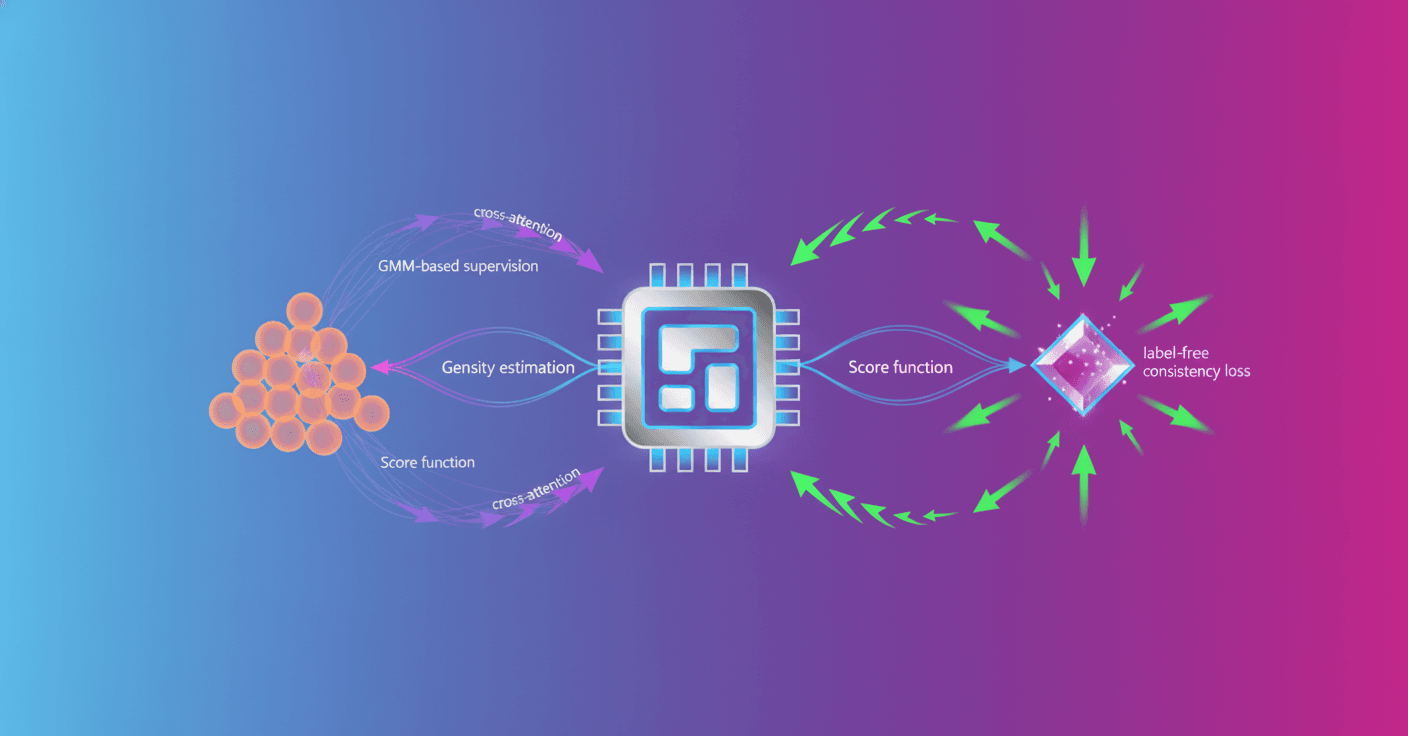
DiScoFormer proposes a simple, powerful idea: a single transformer that, given a set of points, estimates at the same time the density of the distribution and its score (the gradient of the log density). Why does this matter? Because the score is the direction that tells you how to move a point toward more probable regions, and it appears in generative models, Bayesian sampling, and scientific simulations.
What problem DiScoFormer solves
Many problems in machine learning and science boil down to recovering the distribution that generated a sample of data. Traditionally there are two families of solutions:
KDE(kernel density estimation): it needs no training and works on any distribution, but it fails when dimensionality grows.scoremodels trained with neural networks: they work in high dimension, but you need to train them from scratch for every new distribution.
DiScoFormer breaks that dilemma: a single model that, in one pass, estimates both density and score for arbitrary queries, without retraining per problem.
How it works (technical)
The architecture is a transformer that maps an entire sample to answers about density and score using stacked layers of blocks with cross-attention. This lets you evaluate both quantities at query points that don't have to coincide with where the data is.
Important: score and density are mathematically linked by score = ∇_x log p(x). DiScoFormer exploits that by creating a shared backbone and two output heads: one for density and one for score. That dependency becomes a label-free consistency loss: the score head must match the gradient of the log of the density head. That loss is used both during training and at inference.
Another elegant technical point: attention is a strict generalization of KDE. Analytically it is shown that the weights of an attention head are close to a Gaussian kernel over the data. With a single layer of cross-attention you can already reproduce the KDE estimate of density and score; with more layers the model learns multiple scales and adapts its kernels to the dataset.
Inference-time adaptation
The authors use the consistency loss at inference: keeping the context fixed, they take a few gradient steps on that loss to adapt DiScoFormer to out-of-distribution inputs, without having true density or score as supervision. It's a practical way to tune the estimator on the fly.
Training: why they used GMMs
They trained the model by sampling a new GMM (Gaussian Mixture Model) per batch. Reasons:
- GMMs are universal density approximators: with enough components they can approach any smooth distribution.
- GMMs have density and score in closed form, so there is always an exact target to supervise.
Training on millions of synthetic GMMs gives the model a very broad base to generalize to new real-world distributions.
Performance and limits
Results are clear: DiScoFormer outperforms KDE in both density and score estimation, and the gap grows in high dimension. Concrete examples:
- In 100 dimensions, compared to a hand-tuned KDE, it reduces the score error by about 6.5x and the density error by more than 37x.
- It keeps accuracy when the mixture has more modes than seen during training and works with non-Gaussian shapes (for example Laplace or Student-t).
KDE's advantages remain speed and simplicity when datasets are small; DiScoFormer shines when dimension and sample size grow.
Practical implications
Why should this interest you even if you're not pure research?
- Image generation by diffusion: models that turn noise into images use the
scoreto guide the process. A plug-and-play, pretrained estimator could speed up prototypes and cut domain-training costs. - Bayesian mechanisms and sampling: an accurate
scoreimproves sampling methods and posterior estimation in scientific and engineering problems. - Physical simulations: in particle or plasma dynamics, knowing the direction of increasing density helps integrators and correctors be more stable.
In short: having a general, reusable estimator of density and score is infrastructure that can lower costs and accelerate experimentation across many subfields.
Think of DiScoFormer as a tool that includes KDE as a special case but scales to where KDE becomes unusable.
Final reflection
DiScoFormer is not just another network learning what we already had: it's a conceptual redesign that connects a classical technique (KDE) with modern attention, mathematical supervision, and a training strategy that maximizes generalization. If you work with generative models, Bayesian sampling, or simulations, it's worth watching its evolution: a pretrained, adaptable score estimator can change your workflows and costs.