When Google launched Gemma 3n they wanted its multimodal, on-device capabilities to be used to solve real, everyday problems. Over 600 projects in the Gemma 3n Impact Challenge on Kaggle answered that call, and today we meet the winners: solutions ranging from assistance for people with visual impairments to local servers for disconnected areas. Want to see what they built?
Winners and standout projects
First place: Gemma Vision
Gemma Vision is an assistant for people with visual impairments, designed by someone who understood the problem from the inside: the developer's blind brother. The clever technical trick? Avoid relying on a phone in the hand.
- Visual capture from a phone camera mounted on the chest to keep hands free.
- Actions triggered by a
8BitDo Microor by voice commands, so you don't have to fumble through touch menus. - On-device deployment using
Gemma 3nwith the MediaPipe LLM Inference API and theflutter_gemmalibrary, taking advantage of streaming responses for a smooth experience.
Why does it matter? On-device reduces latency, protects privacy, and lets the system work without constant connectivity.
Second place: Vite Vere Offline
Vite Vere promotes independence for people with cognitive disabilities. The technical idea is simple and powerful: turn images into plain instructions that the device reads aloud.
- Originally it used the Gemini cloud API; with Gemma 3n it moved to an offline version.
- Image processing into instructions + local TTS, so the app runs without a network.
This shows how to bring multimodal assistants to places with limited connectivity.
Third place: 3VA
3VA focuses on personalizing augmentative communication. The team fine-tuned Gemma 3n locally with the Apple MLX framework to translate pictograms into rich expressions that reflect the voice of Eva, a graphic designer with cerebral palsy.
- Cost-effective approach to build personalized AAC technology.
- Local training to respect privacy and lower inference costs.
Fourth place: Sixth Sense for Security Guards
This project moves from motion detectors to human-level contextual understanding.
- First filter: a lightweight
YOLO-NASmodel detects initial movement. - Second step: send the scene to Gemma 3n to distinguish benign events from real threats.
- Performance: handles high-rate video (up to 360 fps and 16 cameras) in real time.
Clear strategy: use efficient models for filtering and reserve the LLM for contextual analysis, optimizing latency and bandwidth.
Unsloth Award: Dream Assistant
Voice assistants often fail with users who have non-standard speech patterns. That's where Unsloth, a library for efficient fine-tuning, comes in.
- Fine-tuning Gemma 3n with individual recordings to adapt recognition to the user's voice.
- Result: an assistant that understands unique patterns and enables reliable voice control.
Ollama Award: LENTERA
Lentera is a practical solution for disconnected areas.
- Turns affordable hardware into offline microservers.
- Creates a local WiFi hotspot and serves Gemma 3n via Ollama, allowing devices to connect to a local educational hub.
This reimagines delivering educational AI without relying on the internet.
LeRobot Award: Graph-based Cost Learning and Gemma 3n for Sensing
In robotics, sensing is often the bottleneck. The team built a "scanning-time-first" pipeline on LeRobot (a Hugging Face framework).
- An IGMC (inductive graph-based matrix completion) model predicts sensing latencies.
- Gemma 3n generates plans while IGMC estimates costs, improving exploration efficiency.
Here you see how predictive models and LLMs can combine for embodied robotics at the edge.
Jetson Award: My (Jetson) Gemma
Putting AI into physical environments requires energy efficiency and fast response.
- Hybrid CPU-GPU strategy on an NVIDIA Jetson Orin.
- Contextual voice interface showing useful deployment beyond the screen.
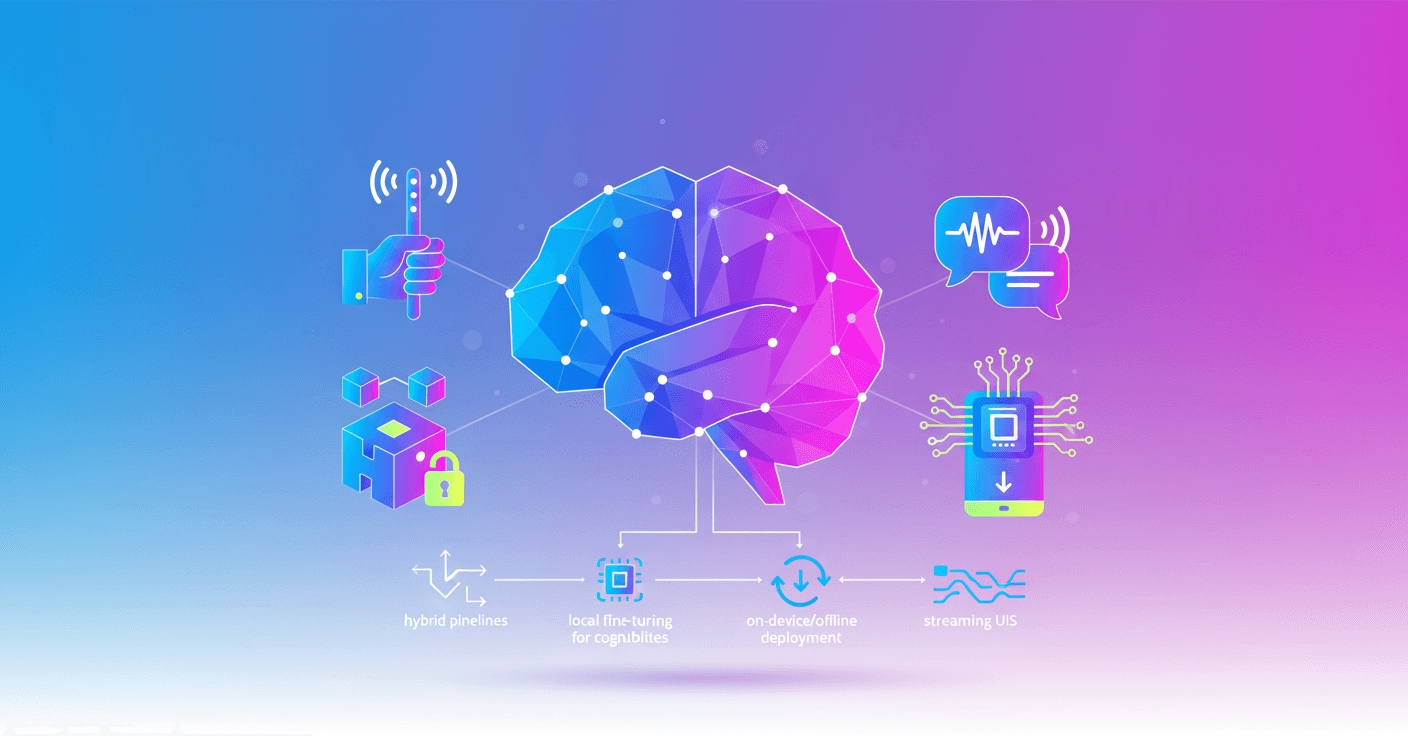
Technical lessons and recurring patterns
Want to take something like this to production? These patterns show up again and again:
- Hybrid pipeline: a lightweight detector (for example
YOLO-NAS) + an LLM for context reduces cost and latency. - On-device and offline: running Gemma 3n on-device or via Ollama protects privacy and enables operation without network.
- Local fine-tuning: tools like
UnslothorApple MLXenable efficient, low-cost personalization. - Streaming and UI: APIs that support streaming responses (MediaPipe,
flutter_gemma) improve real-world experience. - Hardware-aware: optimize deployments for CPU/GPU and use quantization or hybrid models on devices like Jetson Orin.
These projects not only prove technical feasibility but also show repeatable designs for developers.
Impact and why you should care
From visual-assistive tools to offline educational hubs, Gemma 3n is working as a practical tool for inclusion. Interested in building something yourself? Watch how teams combine lightweight models, focused fine-tuning, and on-device deployment to solve real-world constraints.
AI isn't just cloud horsepower: it's low latency, privacy, and presence in disconnected places. These projects are a living handbook on bringing AI into everyday life.
Original source
https://blog.google/technology/developers/developers-changing-lives-with-gemma-3n