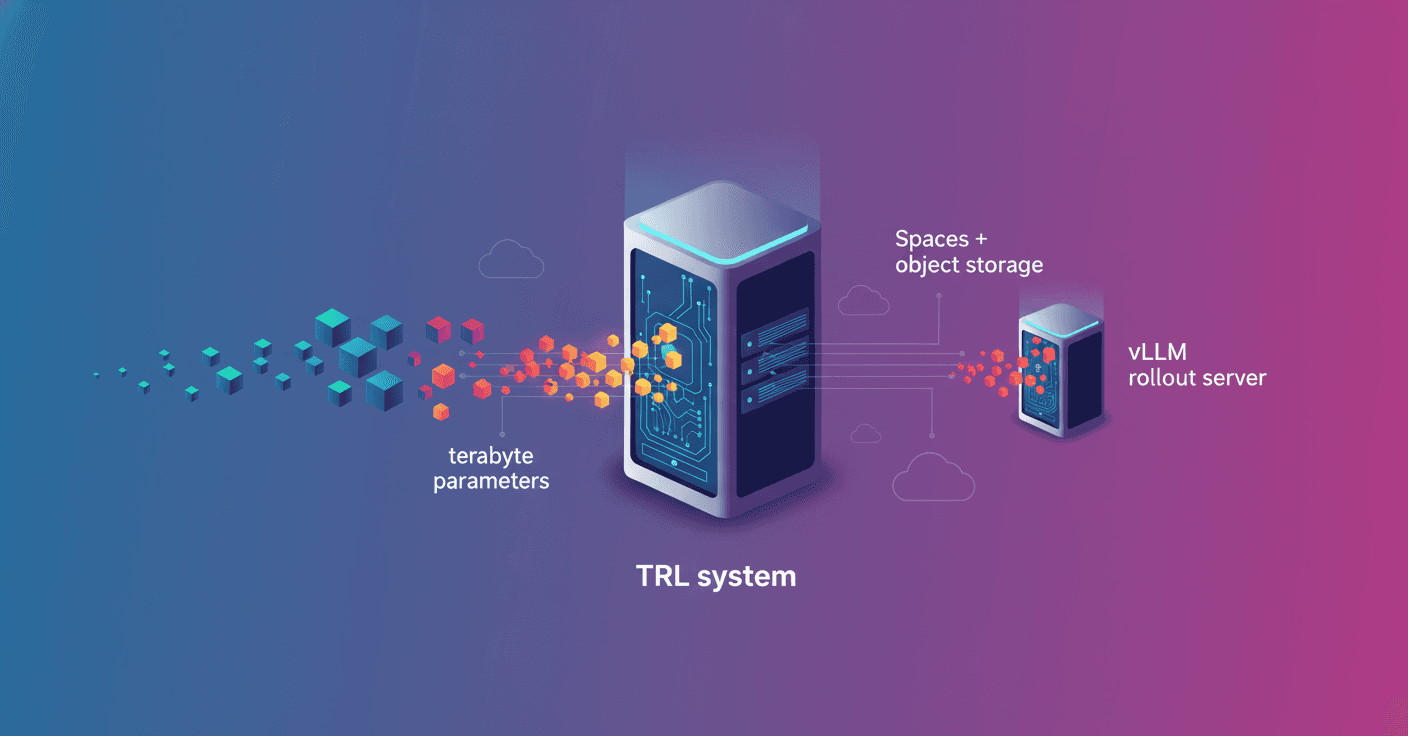
Async RL has an awkward secret: each training step usually sends the whole model to the inference engine. 14 GB per step for a 7B in bf16? Yes. And for a frontier 1T model? On the order of a terabyte per step. Horrible, and expensive.
TRL implements a simple, powerful idea: you don't need to send everything every time. Between two consecutive optimizer steps, more than 98% to 99% of the bf16 weights don't change at the byte level. The trick is to detect which bytes did change, pack them as a sparse safetensors, upload them to a Hub Bucket, and let the inference server (vLLM) download and apply them. Result: per-step payload drops from gigabytes to tens of megabytes for medium models, and the inference pause window shrinks to seconds.
¿Por qué funciona esto? Un poco de aritmética y sentido común
Does this sound too good to be true? It's not. It's a direct consequence of how bf16 works and the typical RL learning rates.
- A
bf16has 7 mantissa bits. Between powers of two there are 128 representable values. - The visibility of an update in
bf16depends on the update's relative size: if|Δw| < |w|/256, the update is lost to rounding and the byte doesn't change. - With RL learning rates (for example η ≈ 3e-6) and typical weight magnitudes (~1e-2 to 1e-1), most updates are smaller than that threshold. The arithmetic simply doesn't hear them.
Empirical observation (PULSE, Fireworks, Cursor) confirms this: per-step averages of ~99% identical elements between consecutive checkpoints. Not magic—numeric representation + optimizer.
¿No se puede predecir la máscara de cambio? Intentaron, y falló
Were attempts made to predict the change mask? Yes—people tried using Adam statistics (m and v). It works in theory, but in practice recall was ~30%, meaning you miss two-thirds of real updates. The robust practical solution is byte-wise comparison: snapshot bf16 before the step, snapshot after, diff. It's cheap and reliable.
Arquitectura práctica: Bucket + safetensors + vLLM
TRL delivers an implementation you can install with pip and use with three pieces and a shared bucket:
- Trainer: runs your optimizer and emits sparse deltas.
- HF Bucket: a repo like a "Bucket" on the Hub with chunk deduplication (Xet) and a simple API
batch_bucket_files/download_bucket_files. - vLLM rollout server: downloads anchors/deltas, applies patches and serves inference.
The flow is elegant: the trainer uploads a delta to the bucket while vLLM keeps generating, then does a short POST to signal "update ready", vLLM downloads, applies, and resumes. The upload happens in the background; the visible inference pause is only the apply step—typically ~1 second in experiments.
Formato en disco: safetensors esparso
- Anchors: full checkpoints every N steps (for example N=10),
bf16per tensor. - Deltas: for each parameter that changed, we store two tensors:
indices(int32) andvalues(bf16). In the metadata we marksparse=Trueandchanged_params.
This has practical advantages: you can open it in a notebook with safe_open(...), inspect sparsity, and mmap on the server to avoid unnecessary copies.
Implementación clave (resumen técnico)
-
BF16ChangeDetector: pre/post-step hook on the optimizer that does
to(torch.bfloat16).cpu().clone()before and after, producing a boolean mask of bytes that changed. -
Delta encoding: we serialize indices and values into
safetensorsand upload to the bucket. -
vLLM extension: we implemented
DeltaWeightTransferEnginethat downloads the file, readsmetadata(), and if it's sparse applies(indices, values)onto abf16snapshot kept on CPU, then passes the full tensors to vLLM viaload_weights. -
Deployment hook: no need to fork vLLM. Register the extension with
--worker-extension-clsand you're done.
Note: an ongoing vLLM optimization (PR #40096) will allow applying patches in-place on GPU without keeping the CPU snapshot in the rollout, reducing latency and memory.
Resultados y escalado
- On Qwen3-0.6B: per-step payload drops from ~1.2 GB to 20–35 MB.
- Distributed experiment: trainer on one box, vLLM on a Space with GPU, Wordle environment in another Space, and a Hub bucket in the middle. With no shared network or RDMA, training converged and inference paused ~1 s per sync.
Napkin scaling:
-
Llama-3.1-405B in bf16 ≈ 810 GB. With 99% sparsity, delta ~1% → ~6 GB per step. With NCCL inside a cluster (100 GB/s) a full sync would be ~8 s pause; delta reduces the pause to a couple seconds and cuts bytes on the wire by ~130×.
-
For TB-class models (1T), Fireworks measured ~20.3 GiB per delta vs 1024 GiB full, ~50×. With finer encoding (PULSE) you could approach ~15 GiB per delta.
Conclusion: even at frontier scale, the deltas+bucket approach turns hardcore infrastructure (mega-clusters, RDMA) into a practical option using object storage and Spaces.
Limitaciones actuales y trabajo pendiente
- Double
bf16snapshot: the trainer keeps one to detect changes and the rollout another to reconstruct tensors. The latter disappears when vLLM acceptssparse load_weightsin-place. - Fixed anchors every N steps: an adaptive policy (anchor when accumulated drift exceeds X) would reduce cost for long runs.
- FSDP2 multi-node: the current detector is designed for per-process hooks; it should be generalized and measured for multi-node.
- Additional compression: sparse
safetensors+ gzip per chunk hasn't been deeply explored. It could reduce bytes further, but gains aren't guaranteed.
¿Qué significa esto para ti (ingeniero, investigador o emprendedor)?
- If you have a single GPU and a Hugging Face account, you can now set up real distributed training: your trainer on a GPU, a fleet of rollouts in Spaces, the environment in another Space, weights moving through a bucket. That used to require clusters.
- Scaling inference replicas is trivial: multiple Spaces point to the same bucket; Xet deduplicates at the chunk level; the Hub edge cache makes repeated downloads cheap.
- The format is debuggable: a delta is a
safetensorsyou can inspect. End of story.
Interested in trying it right now? There are PRs and examples ready: the delta-weight-sync branch, a complete Wordle example, and Dockerfiles to deploy on Spaces. Full run logs and details are in the PR.
The idea isn't to remove large-scale engineering, but to offer a practical, open path so weight shipping stops being the bottleneck that forces proprietary architectures. In many cases the math and numeric representation do the work for you: optimizers whisper and bf16 doesn't hear them. Using deltas and buckets turns that inertia into an operational advantage.