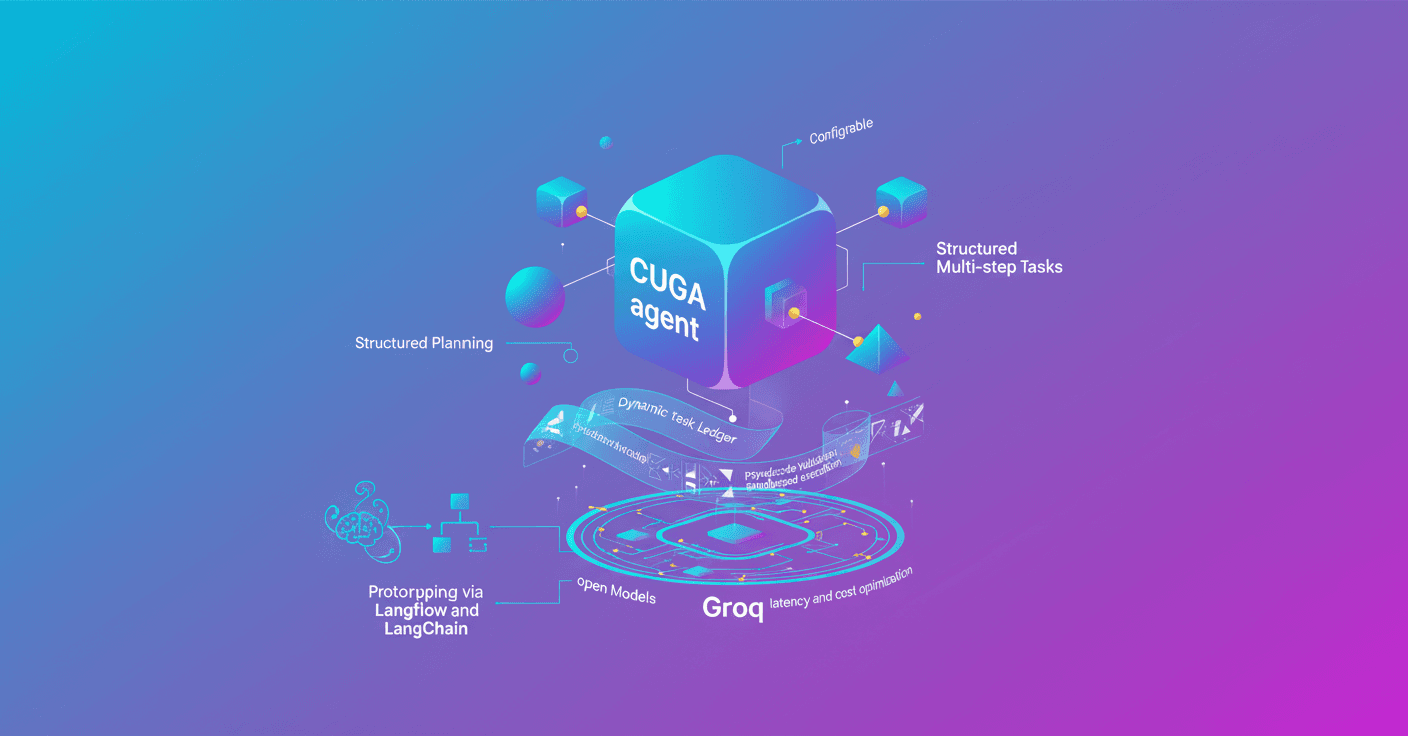
CUGA arrives on Hugging Face Spaces so you can try a configurable, open AI agent built for complex tasks. Are you interested in building agents that coordinate APIs, web interfaces and business logic without falling apart on the first tricky flow? This is for you.
What CUGA is and why it matters
CUGA (Configurable Generalist Agent) is an open-source agent under Apache 2.0 designed to handle multi-step tasks across web and API environments. It’s not just another wrapper around a model: it abstracts orchestration, planning and execution so you can focus on domain requirements.
Why does it matter? Because many current frameworks are brittle: they get confused by tools, hallucinate results or fail in long flows. CUGA combines proven agentic patterns like planner-executor and code-act with structured variable management and a dynamic task ledger to reduce those errors.
Architecture and how it avoids failures
The architecture starts from the user message in a chat layer that interprets intent and builds the goal. Then a planning-and-control component breaks the goal into subtasks and records them in a dynamic task ledger.
That ledger lets the system replan when something goes wrong. Subtasks are delegated to specialized agents (for example, the API agent). The API agent runs an internal reasoning loop that generates pseudocode before executing in a safe sandbox. This validates intent and reduces the chance of erroneous calls.
Orchestration relies on a tool registry that goes beyond MCP to parse tool capabilities (OpenAPI, MCP servers, Python functions). The result: better accuracy when deciding which tool to use and how to use it.
Key points: structured planning, dynamic ledger, validation via pseudocode and sandboxed execution. That’s what makes the difference in complex flows.
Reasoning modes, policies and reuse
CUGA is configurable in reasoning modes: from quick heuristics to deep planning. That lets you balance latency, cost and accuracy. It also includes policy instructions and support for human-in-the-loop, useful in enterprise settings where alignment and safety are critical.
Plus, it offers save-and-reuse capabilities: it captures plans, code and successful trajectories so you can reuse them for repeated tasks. Can you imagine cutting time and variability in recurring processes? Here it’s possible.
Performance and benchmarks
CUGA has scaled on demanding benchmarks:
- First place on AppWorld: 750 real tasks and 457 APIs.
- Top performance on WebArena and especially strong in computer-usage capabilities (web autonomy).
A technical detail worth noting: CUGA performs much better with fast inference. When each call takes seconds, delays add up and you have to trade capability for user experience. This is where Groq comes in: using open models on optimized LPUs reduces latency and cost.
In tests, open models like gpt-oss-120b and Llama-4-Maverick-17B-128E-Instruct-fp8 (hosted on Groq) provide fast responses. According to the team, open models are roughly 80–90% cheaper than closed alternatives, making production feasible on tight budgets.
Integrations and deployment (LangChain, Langflow and Spaces)
CUGA integrates common tools:
- Connection to
OpenAPI,MCP serversandLangChainto link REST, custom protocols and Python functions. - It can be exposed as a tool to other agents, enabling nested reasoning and multi-agent collaboration.
- Integration with Langflow (widget included since version 1.7.0) offers a low-code experience to design workflows with drag-and-drop.
There’s also a demo on Hugging Face Spaces that shows a small CRM with 20 preconfigured tools and access to workspace files and predefined policies. It’s a practical way to experiment without deploying the whole infrastructure.
Practical recommendations for developers and teams
- Start in Langflow to prototype visually before deploying code.
- If your app needs many internal inferences (planning, execution, validation), prioritize low-latency inference platforms like Groq.
- Define policies and human intervention points from the start; human-in-the-loop prevents sensitive decisions from being fully automated.
- Use the save-and-reuse feature to stabilize behavior in repetitive tasks.
- Test several open models and measure latency, cost and error rate; CUGA is model-agnostic and lets you switch providers.
Who is CUGA for today?
- Product teams that need robust agents to orchestrate APIs and UIs.
- Researchers who want to experiment with agentic patterns at scale.
- Companies seeking an open, cheaper alternative to closed solutions, with control over policies and deployment.
Trying the demo on Hugging Face Spaces or deploying your own instance from the repo will give you a clear idea of what CUGA can do for your case.
CUGA brings flexibility, control and performance to agent building. It’s not a futuristic promise: it’s a practical toolbox to solve real flows today, with the openness you need to adapt the agent to your rules, models and costs.
Original source
https://huggingface.co/blog/ibm-research/cuga-on-hugging-face