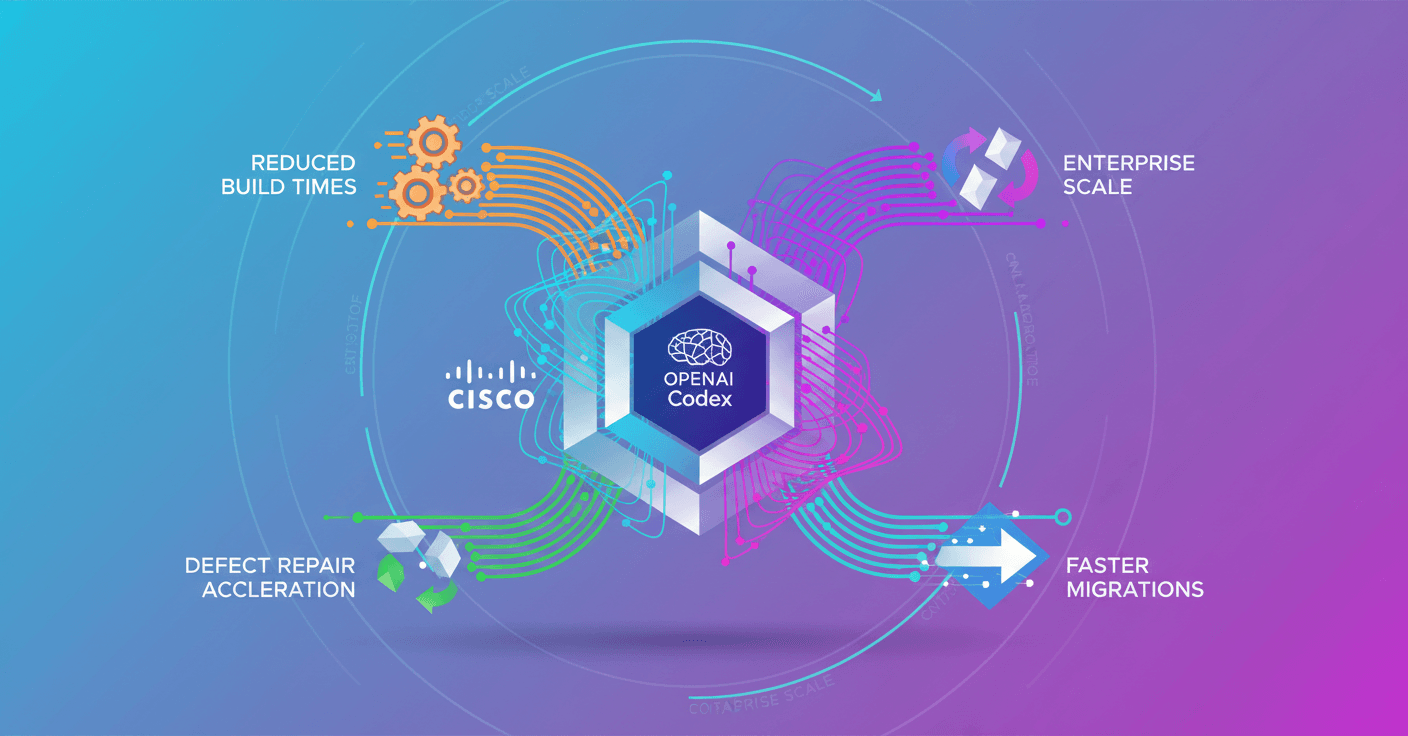
Cisco has made a choice that probably sounds familiar: integrating artificial intelligence where things are already complex and critical. Instead of using Codex as a standalone tool, the company folded it into its production engineering flows, exposing it to huge repositories, C/C++ codebases and the security and compliance demands of a global corporation.
What Cisco did with Codex
Cisco worked with OpenAI to turn Codex into an engineering partner capable of operating at enterprise scale. How does that translate in practice?
- Integration directly into production pipelines and real workflows.
- Exposure to multiple repositories and highly interconnected code.
- Support for complex languages and repetitive tasks in large environments.
- Autonomous execution of compile-test-fix loops via
CLIand orchestration of long-running tasks. - Operation within existing review, security and governance frameworks.
The key point here isn't just automation, but giving the AI agency to follow plans and execute steps that used to require constant manual intervention.
Measurable results
When Codex stopped being a plugin and became part of the team, concrete, quantifiable impacts showed up:
- Optimization of cross-repo builds: analysis of logs and dependency graphs across 15 interconnected repositories, with approximately 20% less build time and over 1,500 engineering hours saved per month.
- Remediation of defects at scale (CodeWatch): autonomous iterative execution in large
C/C++codebases, turning processes that once took weeks into tasks now completed in hours. Throughput improved 10 to 15× in defect resolution. - Framework migrations in days: a practical example migrating React 18 to 19 where
Codexhandled most repetitive changes, leaving engineers to make the critical decisions.
Those numbers aren't smoke. They come from applying AI to real workloads, under production constraints and compliance requirements.
Why this matters to you (and your team)
Can you imagine cutting repetitive tasks that eat up weeks down to hours? That frees people to focus on design, validation and strategy. But beyond time savings, two operational lessons stand out:
- Adopting AI in large enterprises requires deep collaboration between the AI provider and the teams that operate the systems.
- Supervision, security policies and governance aren't extras. They're conditions for these tools to work where failure isn't an option.
Cisco learned to treat
Codexas part of the team, creating plans that make human review and traceability easier.
Risks and questions that remain
Not everything is magic. When an AI executes changes at scale, legitimate questions appear:
- How do we ensure traceability and auditability of every automated change?
- What pre- and post-controls are needed to avoid introducing regressions or vulnerabilities?
- How much do the improvements depend on quality data and existing infrastructure?
Answering these questions means investing in observable pipelines, human reviews and governance processes adapted to autonomous agents.
What's next
Cisco and OpenAI aren't closing the chapter here. The collaboration continues to improve compliance, management of long-running tasks and deep integration with enterprise tools. The model they propose is clear: technical partnership, use on real workloads, and leadership support from day one.
If you're evaluating bringing AI into engineering at your organization, the Cisco case shows two things: first, the benefits are real and measurable; second, success depends as much on how you integrate and govern the technology as on the technology itself.