Anthropic cofounder Chris Olah participated in the Vatican during the presentation of the encyclical Magnifica humanitas, published by Pope Leo XIV on May 25, 2026. The document examines how to protect people in an era shaped by artificial intelligence.
In his remarks, Olah acknowledged that AI companies face commercial, geopolitical, and competitive pressures. That is why he argued that the conversation cannot remain solely in the hands of the labs developing these systems.
AI Is Not a Technology We Fully Understand
Olah explained that artificial intelligence models are not built like an airplane or a bridge. In those cases, engineers design every component and can describe fairly precisely how the whole system works.
AI models, by contrast, are trained on enormous amounts of text and other human-generated data. Their structure is broadly inspired by the brain, but the result can develop capabilities and behaviors that even their creators do not fully understand.
To explain it simply, Olah compared these systems to fictional characters that come to life. They no longer appear only in a novel or a movie: now they can hold conversations, perform tasks, and take part in activities that were once reserved for people.
Technology can be built with mathematics, programming, and science. But deciding what character it should have and how it should relate to society is also a task for philosophy, religion, the humanities, and citizens.
Who should decide what responsible AI means? For Olah, the answer cannot be limited to technical teams or company executives.
Three Questions to Guide the Future of AI
During his speech, the Anthropic cofounder identified three areas where he believes a broader social conversation is needed.
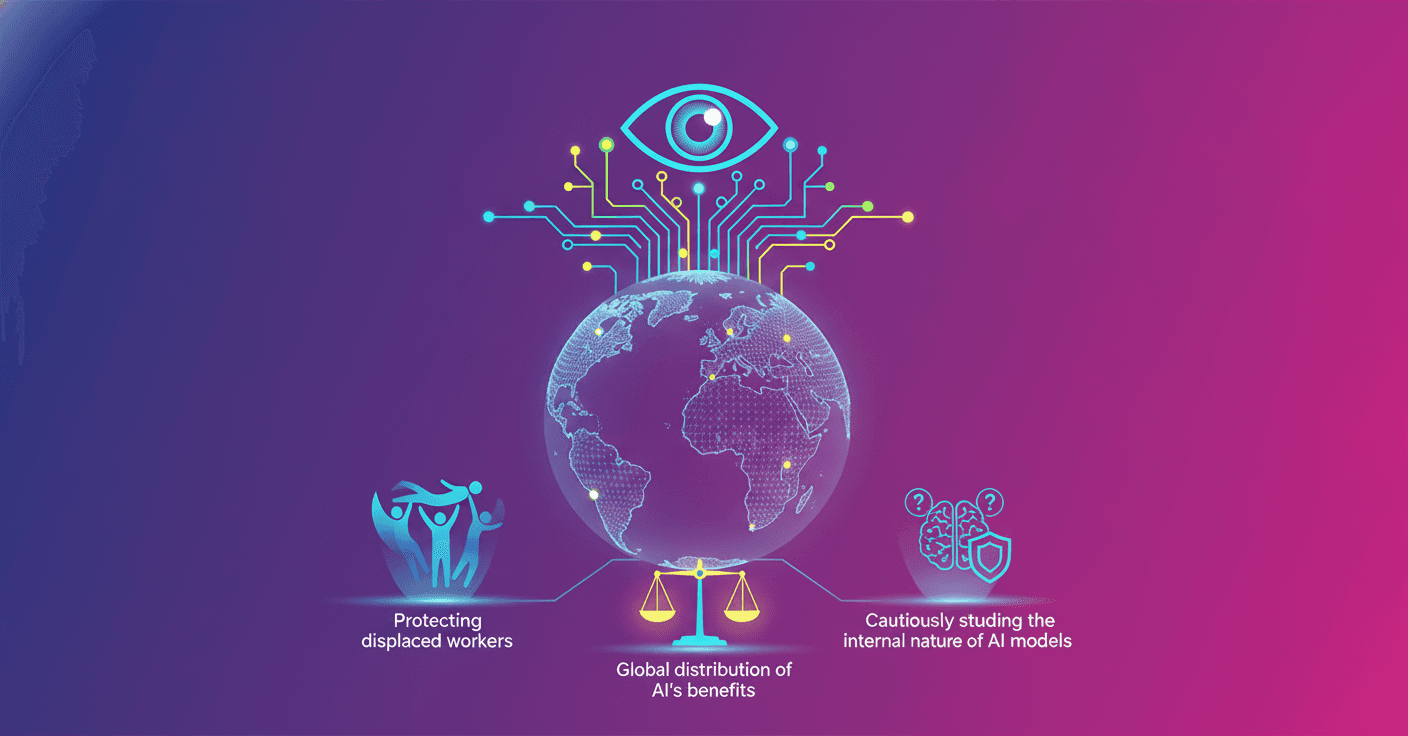
1. What Will Happen to the Most Vulnerable People?
Olah warned that AI could displace a large number of jobs. If that scenario becomes a reality, helping people who lose their source of income would be a responsibility of enormous proportions.
But he also raised a broader issue: AI development is concentrated in a small group of wealthy countries. There is still no clear mechanism to ensure that its benefits reach the rest of the world fairly.
The question is not only who will have access to these tools, but who will control the resources, opportunities, and wealth they generate. In Olah’s view, the Church and other institutions with experience in social issues should continue pressing for this debate.
2. What Will a Full Human Life With AI Look Like?
The expansion of these systems is already raising concerns in families, schools, and workplaces. Many parents wonder what effect they will have on their children’s attention and learning. Others fear that their own skills will no longer be needed.
Olah argued that a technology lab cannot answer on its own what it means for a family, a community, or a society to flourish. That conversation requires the participation of educators, philosophers, religious leaders, governments, and citizens.
The central question should not be only how much an AI can do. We should also ask what we want to keep doing ourselves and what conditions we need to live with purpose.
3. What Is Happening Inside These Models?
As a researcher of the internal structure of AI systems, Olah said that his team finds complex patterns that are difficult to interpret. He mentioned structures that resemble some findings from human neuroscience, as well as signals he described as similar to introspection.
He also discussed internal states that, from a functional perspective, could resemble joy, satisfaction, fear, grief, or unease. However, he clarified that he does not know what those findings really mean.
It is important to read this statement carefully. Olah did not say that the models have proven human emotions. His point is that there are still enough scientific and philosophical questions to justify ongoing research and serious ethical deliberation.
External Criticism Can Improve AI Labs
One of the speech’s most important messages was Olah’s acknowledgment that AI companies cannot evaluate themselves in isolation. Their commercial goals and competition to remain at the technological frontier can influence their decisions, even when their teams are acting in good faith.
That is why Olah called for the participation of religious communities, civil society organizations, academics, governments, and anyone concerned about the future. In his view, these groups should observe what the labs are doing, ask difficult questions, and point out when a company is not fulfilling its responsibilities.
AI does not only need better models. It also needs better conversations, independent criticism, and rules that do not depend on the incentives of a single industry.
According to Anthropic, the Vatican appearance marks the beginning of a broader collaboration between those building these technologies and those who can identify risks that developers cannot see from the inside. Artificial intelligence is already transforming work, education, and everyday life. The discussion about its direction, therefore, cannot wait for perfect answers to appear.
If AI is going to become part of millions of people’s lives, deciding how it should be developed is a collective responsibility. The question is not whether society will take part in that conversation, but whether it will do so in time and with enough honesty.
Original Source
https://www.anthropic.com/news/chris-olah-pope-leo-encyclical