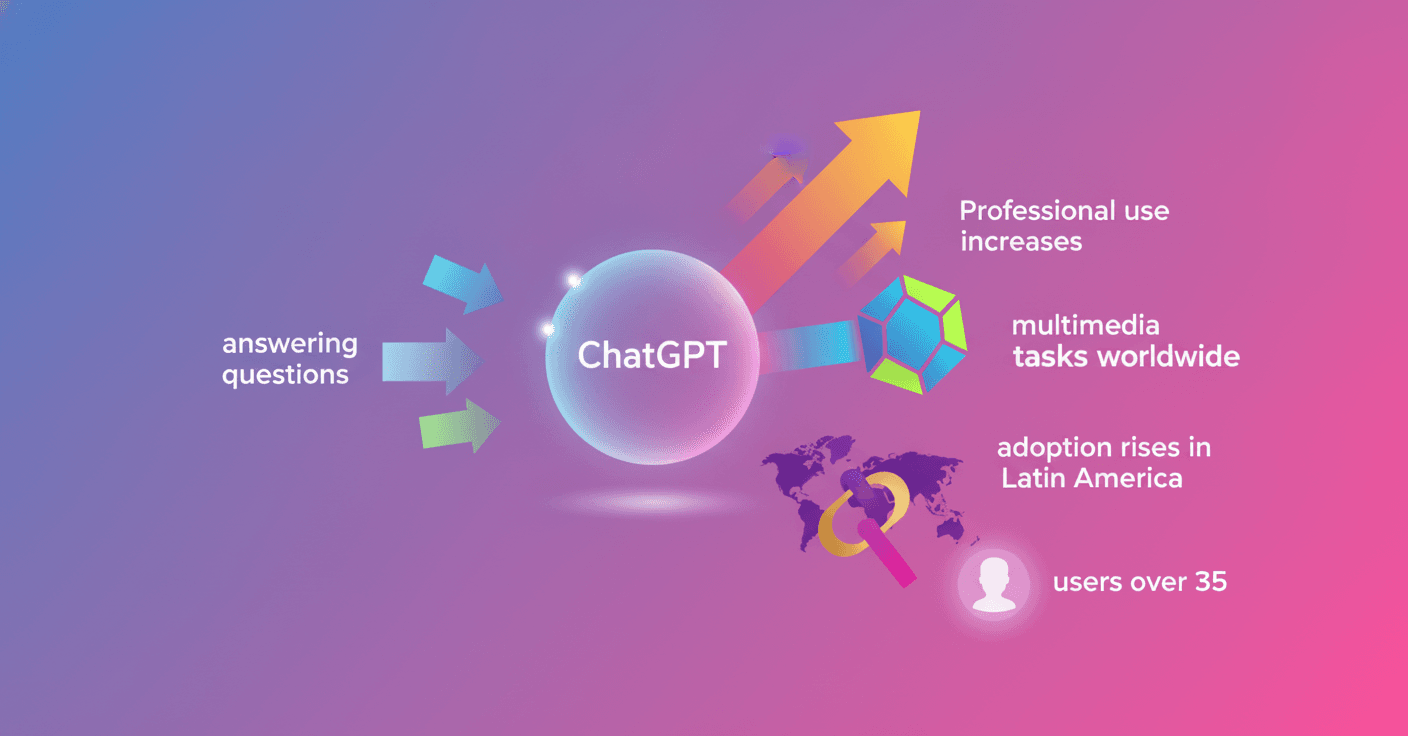
OpenAI publishes country-by-country data that show something simple and powerful: artificial intelligence stops being just for asking questions and starts being used to execute real tasks. What does that mean for you, your job, or your business? I'll explain it clearly and practically.
The essentials of the report
The data, updated through Q2 2026 and published in OpenAI Signals, show several important changes in how people use ChatGPT:
-
From asking to doing: at work, people are more than twice as likely to use
ChatGPTto complete tasks or create outputs (writing, coding, analyzing) than outside work. At home people tend to explore and ask for information; at work it’s used to produce results. -
More global adoption: countries in Latin America, Africa and Oceania are closing the gap with early adopters. In Q2 2026, Peru, Uruguay and Costa Rica climbed notably in the per-capita ranking.
-
Beyond text: multimedia use is the fastest-growing category, representing 7.8% of global messages. In countries like Brazil and Colombia, more than 1 in 10 messages is multimedia.
-
Older users are using the tool more: the share of messages sent by people over 35 increased in almost every country, with rises of more than 10 percentage points in places like France and Czechia.
Together, the data paint a transition: ChatGPT is no longer just a box of answers; it’s a tool that helps more people, in more places, do concrete tasks.
Concrete examples of use (and why they matter)
-
Fast writing and editing: from summarizing reports to polishing professional emails. It’s the difference between researching and delivering something ready to send.
-
Code and analysis: developers and analysts use
ChatGPTto write functions, debug snippets and prepare visualizations. You save time on repetition and focus on the logic. -
Multimedia: designers and creators generate images, edits and multimodal searches more often. If you manage social media or marketing materials, this speeds up visual prototyping.
-
Administrative tasks: automating templates, generating minutes, summarizing meetings. Work that used to take hours can be done in minutes.
See the difference? Before you asked “how do I do X?”. Now you ask “do X” and you get a usable result.
What does this mean for companies and public officials?
-
For SMEs and entrepreneurs: it’s a signal to start integrating AI into workflows, not as an experiment but as a daily tool. Small process adjustments can multiply productivity.
-
For governments and regulators: country-level data help understand real adoption and design training, access and security policies that reflect regional and age differences.
-
For educators: there’s a growing need to teach not just basic use, but good practices to validate outputs, handle privacy and avoid bias.
How to access the data and why to explore it
OpenAI Signals publishes these statistics by country, with the option to view and download datasets and review the methodology. If you work in research, public policy or product strategy, these data let you observe local trends and compare adoption by age cohorts and use cases.
What you can do right now
- Try integrating
ChatGPTinto a repetitive task at work and measure the time saved. - Notice whether your team uses the tool more to explore or to produce results; that will tell you where to push adoption.
- If you’re responsible for public decisions, download the dataset to see how adoption and uses are evolving in your country.
The signal is clear: AI isn’t a standalone tech curiosity. It’s entering people’s everyday lives—in offices, studios and creative projects. That changes expectations, opportunities and responsibilities for you and your organization.
Source original
https://openai.com/index/how-the-world-is-putting-chatgpt-to-work