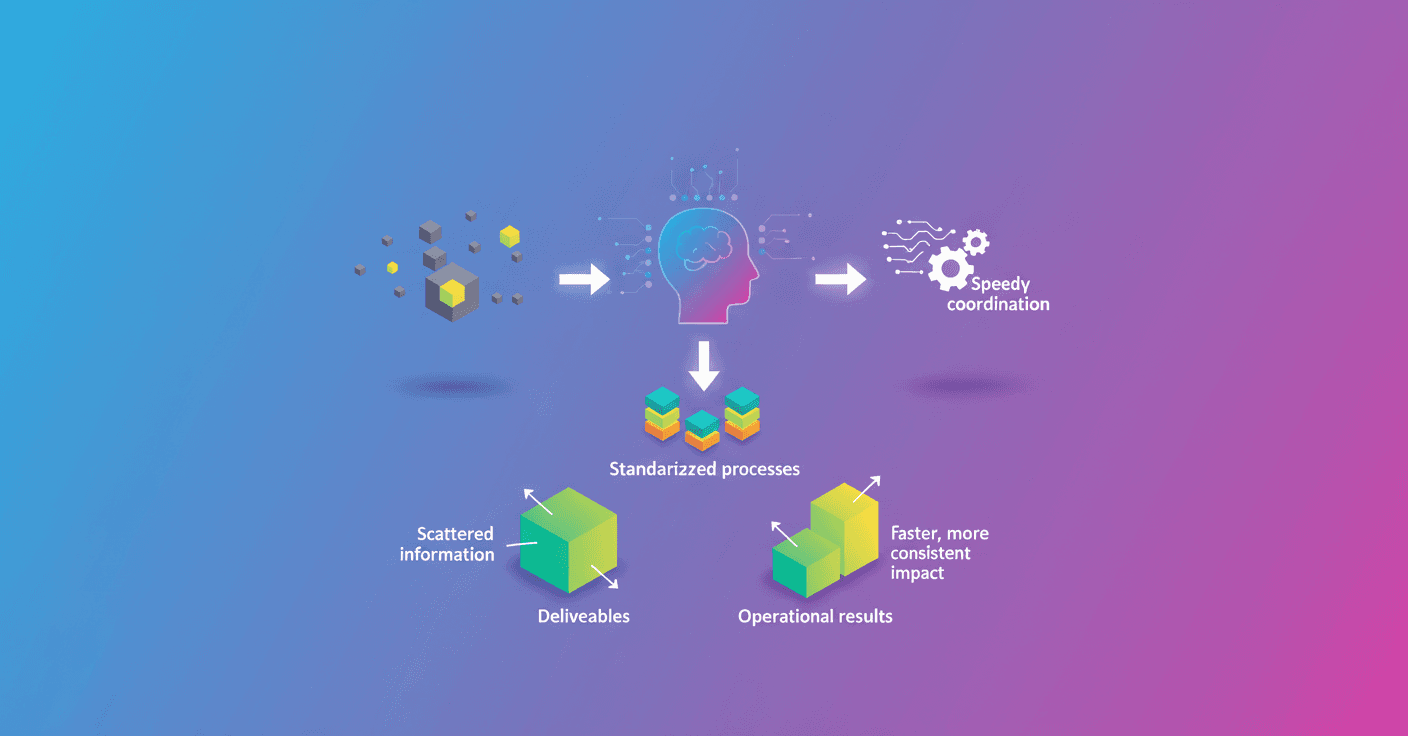
ChatGPT can act like an always-available operations manager: it organizes scattered information, generates clear updates and turns decisions into reusable documents. Can you imagine spending less time copying and pasting notes and more time executing? That’s exactly what this tool offers when you feed it context and real materials.
What ChatGPT brings to operations teams
Operations usually live at the intersection of information and execution. ChatGPT helps reduce coordination friction by turning fragmented inputs into decision-ready summaries, documenting outcomes as reusable SOPs, and keeping the operational pace with consistent deliverables.
The result? Less time stitching pieces together and more time moving execution forward.
- Converts scattered inputs (notes, trackers, messages) into a clear plan: what’s known, what’s not, what needs a decision and who’s responsible.
- Produces status updates that answer the key questions: what changed, what’s blocked and what each person needs to do.
- Standardizes recurring work (weekly reports, handoffs, escalations), so you don’t rebuild documents every week.
Concrete use cases
Here are common areas and what ChatGPT can deliver to make your day-to-day simpler.
-
Operational cadence and reporting:
WBR/MBR, KPI tracking and leadership reports. Deliverables: structured weekly summaries, executive summaries, decision logs and lists of risks and blockers. -
Processes and handoffs: workflow design, SLAs, QA in transfers. Deliverables: SOP drafts, handoff checklists, RACI drafts and steps to handle exceptions.
-
Incidents and escalations: triage, coordination and follow-up. Deliverables: internal/external incident updates, timelines, postmortem outlines and action trackers.
-
Vendors and partners: onboarding, reviews, renewals. Deliverables: vendor scorecards, meeting agendas, follow-up emails and issue lists with due owners.
-
Capacity and planning: staff planning, prioritization and throughput management. Deliverables: simple capacity models, prioritization frameworks, scenario options and assumption lists.
-
Metrics and data hygiene: KPI definition and verification. Deliverables: KPI definition pages, QA checklists, discrepancy hypotheses and validation steps.
How to get more out of it (best practices)
ChatGPT performs better when you give clear operational context: your objective, stakeholders, timeline, constraints and source materials. It’s not magic: it’s structure applied to your inputs.
- Bring real documents: trackers, meeting notes, spreadsheets and previous outputs.
- Define the audience for the output: is it for leadership, the support team or a vendor?
- Request standard formats: fixed headers, owners, deadlines and next steps.
Example of a simple prompt you can use:
Summarize these incident notes into a 5-point update: what happened, impact, current status, due owners and next steps.
Small repeated prompts and templates generate consistency: turn each summary into an SOP or checklist that you can reuse next time.
How to measure impact
You don’t need exotic metrics to evaluate if it’s working. Measure speed and execution quality:
- Less time to produce recurring deliverables (status, minutes, SOPs).
- Reduced response time between teams and faster coordination turnaround.
- Greater consistency in documentation: fewer repeated questions in updates.
- Downstream results: fewer bottlenecks, shorter cycles and better action follow-up.
For leaders, the clearest signal is that the team moves from "pasting information" to "executing with clarity and alignment."
Risks and limits to consider
ChatGPT doesn’t replace human judgment or data without reliable sources. Its outputs depend on input quality and it can make statements that need verification.
- Always verify critical decisions and numbers against original sources.
- Use the tool to structure and propose, not to delegate final responsibility.
- Keep control over access to sensitive documents and define privacy policies for the tool.
Final reflection
If you work in operations, ChatGPT is a lever to raise consistency and operational speed. It’s not a team replacement, but an assistant that organizes, summarizes and documents so your team can focus on what really creates value: making decisions and executing.