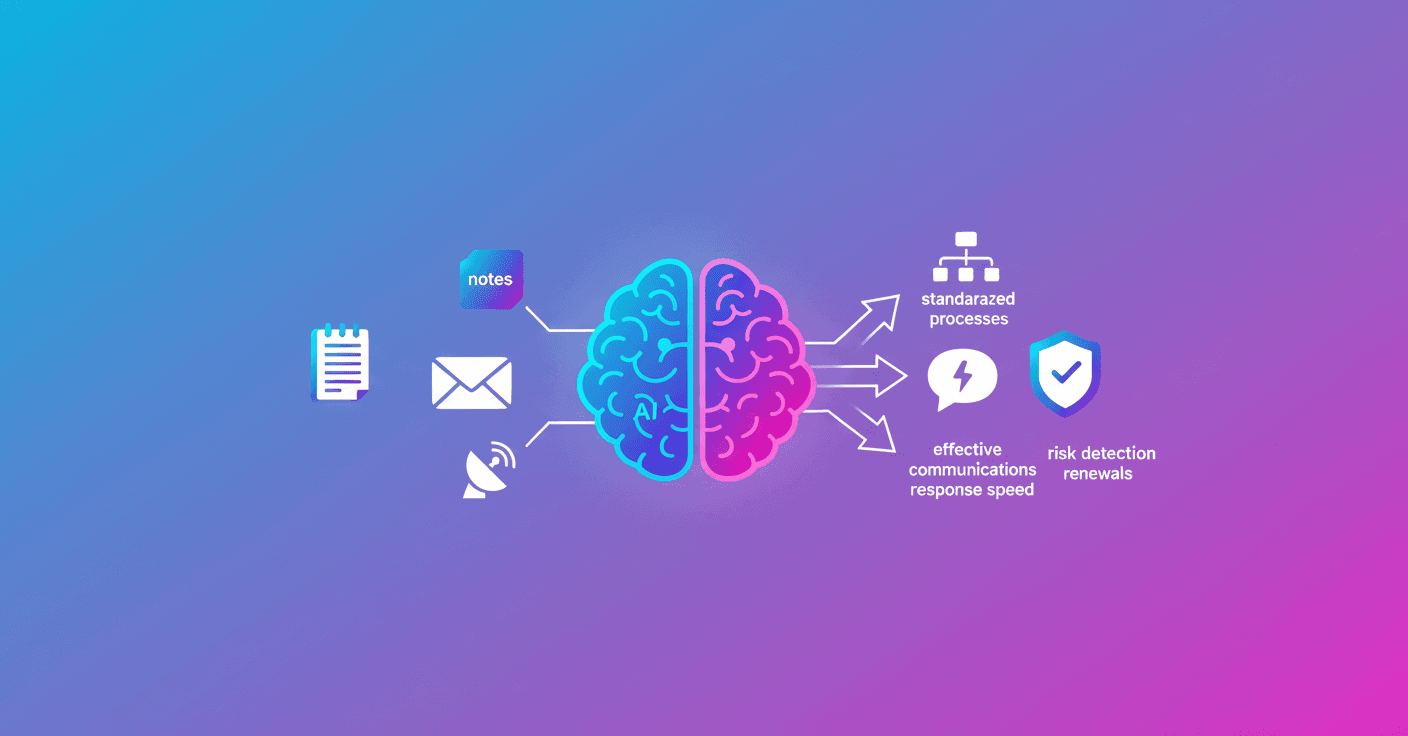
How much time does it take you to gather context, write follow-ups and build clear plans for your accounts? If you work in Customer Success, you know much of the value lies in the relationship, but the biggest load is usually coordination: scattered notes, tickets, calls and a lot to sort out.
What ChatGPT brings to Customer Success
ChatGPT doesn't replace the human relationship; it speeds it up. It turns scattered inputs into structured outputs so your team can spend less time organizing and more time with the customer.
-
Synthesizes context into a clear plan. If you have meeting notes, emails and product signals, ChatGPT can summarize status, goals, risks and an action plan ready to share.
-
Makes communication more effective. Need to follow up with a customer, escalate an issue or prepare a QBR? ChatGPT drafts the first version: concise, actionable and aligned to outcomes. You validate, not format.
-
Standardizes operational cadence. Onboardings, health reviews and renewals repeat. With consistent templates and formats, the customer experience becomes more uniform and predictable.
The best part: it cuts coordination work without removing ownership from CSMs. It helps them focus on decisions, not on piecing things together.
Concrete examples (so you can picture the flow)
-
You have six calls, three tickets and a usage report: ask ChatGPT for an executive summary with risks and next steps before the executive meeting.
-
You need a follow-up email after an onboarding: give it the notes and get a clear email that lists tasks, owners and dates.
-
Preparing QBRs: turn meeting minutes into a value narrative for executives and an action list for the technical team.
Common cases and practical outputs
- Onboarding and launch: launch plans, timelines, success criteria and owner assignments.
- Adoption and enablement: enablement summaries, training agendas, step-by-step guides and FAQs.
- Account health and risk: health summaries, risk logs and mitigation plans.
- Meeting preparation and follow-up: briefs, agendas, call summaries and action lists.
- Cross-functional coordination: escalation write-ups, decision logs and internal updates.
- Renewals and expansion: renewal plans, value summaries and stakeholder maps.
- Voice of the customer: thematic analysis of feedback, prioritization and request write-ups.
Use these outputs as drafts that the CSM adjusts with human nuance and sensitive context.
How to get more value today
-
Gather context before asking for results: notes, tickets, product signals and emails. The more coherent the inputs, the better the synthesis.
-
Set templates: create standard prompts for onboarding, QBR or risk. That saves time and keeps consistency.
-
Integrate operational data: when possible, connect spreadsheets or reports so summaries include concrete metrics.
-
Use the tool in two phases: research (understand account status) and content creation (communications and plans).
-
Review and validate: ChatGPT speeds up drafting, but final decisions and the customer relationship remain human responsibilities.
Expected impact on operations and outcomes
- Faster responses and follow-ups.
- Earlier identification of risks and expansion opportunities.
- More consistent account documentation.
- Less time gluing context across tools, more time executing strategy.
If you're a CS leader, you'll notice it in the team's rhythm: more uniform recaps, shorter response turns and better summaries for renewals.
For teams that already use product data and repeatable processes, ChatGPT accelerates operational transformation. The key? Use it to amplify the team's intelligence, not to replace human decisions.