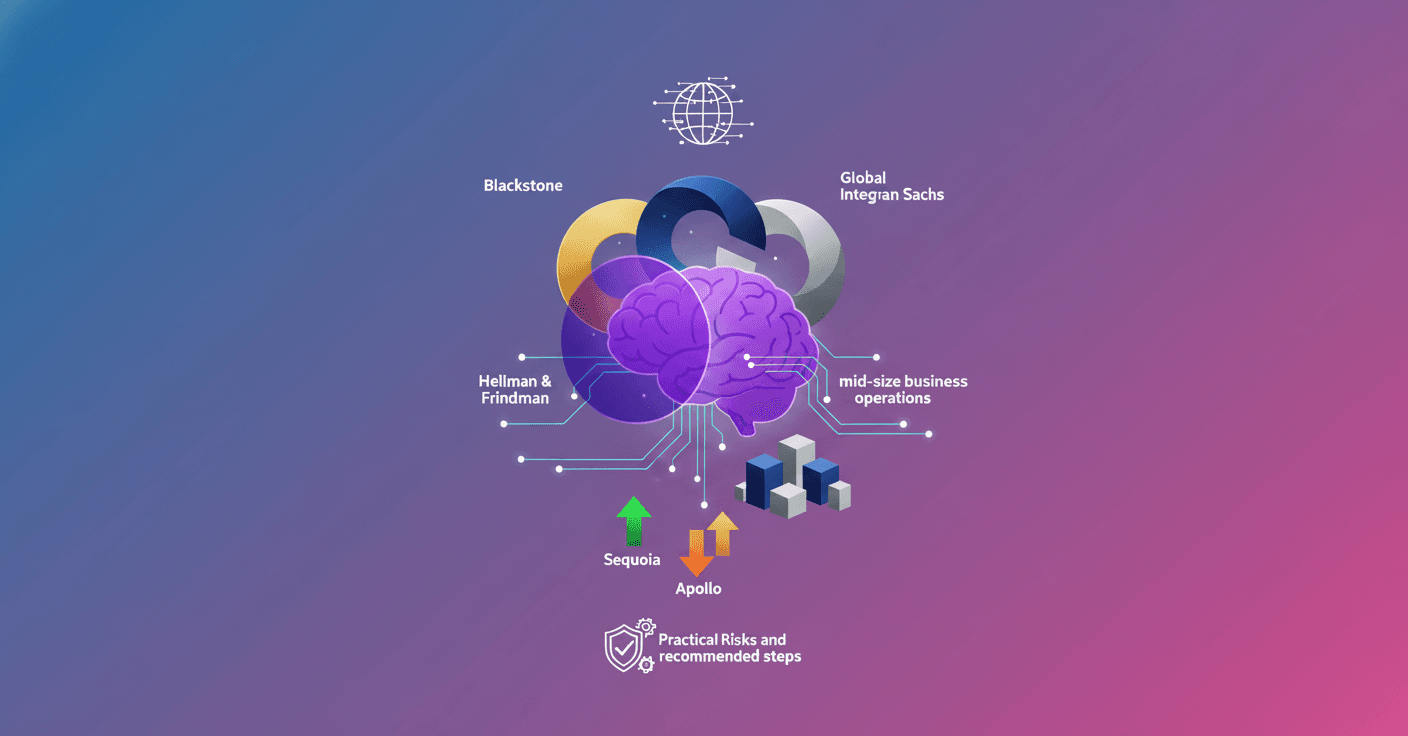
Anthropic, together with Blackstone, Hellman & Friedman and Goldman Sachs, announced a new company dedicated to bringing artificial intelligence into real operations at mid-size businesses. Can you imagine Claude working inside the day-to-day of a regional bank or a network of clinics? That's exactly what they propose: client-facing applied engineering, tailored solutions, and long-term support.
What they announced and who’s involved
The new company will be a provider of enterprise AI services that integrates Anthropic's applied engineers with engineering teams from client companies. In addition to the founding partners, the project is backed by a consortium of alternative asset managers: General Atlantic, Leonard Green, Apollo Global Management, GIC, and Sequoia Capital.
Why does this matter? Because it combines Claude's technology with capital and operational capacity to deploy solutions in organizations that don't have internal AI teams.
Why they are building it
Putting Claude inside critical processes requires hands-on work: understanding how each business operates, what data exists, and how to fit a solution without breaking existing workflows. Anthropic already works with large integrators (Accenture, Deloitte, PwC) for the biggest companies. This new firm aims to extend that capability to mid-size businesses: community banks, local manufacturers, and regional health systems.
"Enterprise demand for Claude is significantly outpacing any single delivery model." — Krishna Rao, CFO of Anthropic
The idea is simple and ambitious at the same time: it's not enough to sell an API or a license; you need teams that design, integrate, and maintain applications that actually change daily work.
How projects will look in practice
A typical engagement starts with a small team that immerses itself in the client's operation to identify where Claude delivers the most value. Then engineers from the new company and Anthropic specialists develop bespoke systems, integrated into the tools people already use.
Concrete example: a network of medical clinics struggling with documentation and coding. Instead of imposing a new app, the team sits with doctors and the IT staff to understand where time is lost and what quality care requires. From there comes a solution that speeds up documentation and prior authorization, leaving more time for patients.
What it means for customers and the ecosystem
For mid-size companies: more direct access to advanced AI implementations, with technical support and capital behind them. For Anthropic: scaling Claude adoption without relying only on big integrators. For the market: more competition in integration services and a practical route to democratize enterprise AI.
Risks and points to evaluate
Not everything is automatic. Before you embark on an implementation like this, it's worth asking yourself:
- Are your data organized and clean enough to train or fine-tune models?
- How will you protect privacy and comply with regulations (health, finance, etc.)?
- What productivity gains do you expect and in what timeframe? (ensure a clear ROI)
- Are you avoiding excessive dependence on a single vendor or model?
These questions aren't meant to scare you, but to make sure the technology genuinely helps the people doing the work.
What an interested company should do
- Map critical processes where time is lost or errors are frequent.
- Review regulatory requirements and data security needs.
- Plan short pilot projects with clear metrics (time saved, errors reduced, user satisfaction).
- Assess internal capabilities and define the role the new AI partner will play.
A well-designed pilot tells you more in weeks than a sales presentation does in months.
Anthropic and its partners are betting on taking AI from demos into the operations room of many mid-size companies. If you work in an organization that wants to leverage AI without reinventing the wheel, this can be a practical option: capital, engineering, and support to build solutions that fit the real rhythm of work.
Original source
https://www.anthropic.com/news/enterprise-ai-services-company