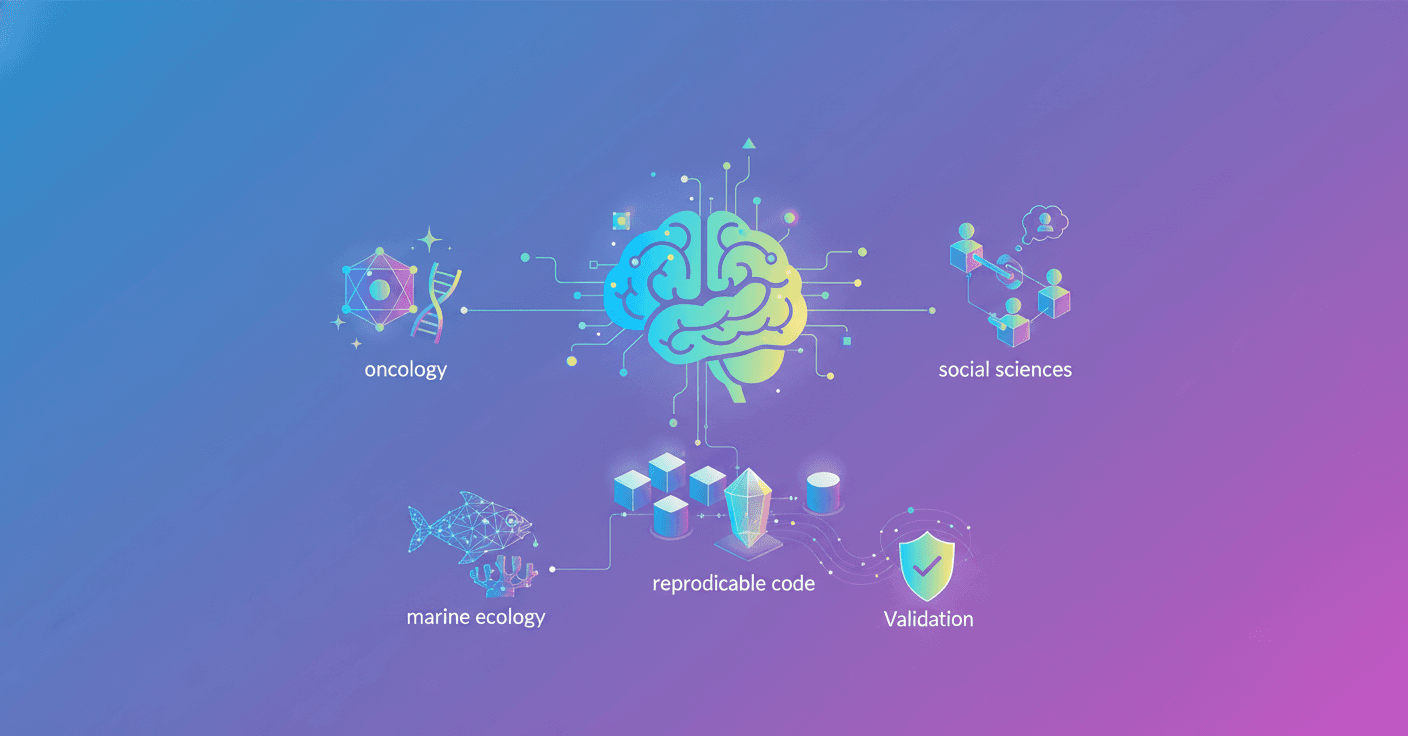
AutoDiscovery arrives as a tool that autonomously explores your datasets and gives you reproducible hypotheses, code, and statistical results ready for deeper investigation. Can you imagine letting the tool run while you rest and waking up to a list of research directions you might not have thought of? That’s exactly what it proposes.
What is AutoDiscovery and why it matters
AutoDiscovery is an experimental feature in AstaLabs designed to explore structured datasets without a prior question. Unlike most AI tools for science that expect an initial hypothesis, AutoDiscovery performs a broad search across hypothesis space: it proposes ideas, designs and runs statistical experiments, and returns findings with reproducible code.
This changes the classic research flow: you no longer only answer questions you already had; the tool helps you find questions. For researchers with large amounts of data — genomics, clinical trials, ecological monitoring, economic surveys — this can speed up the discovery phase and suggest directions you wouldn’t have guessed.
Concrete examples in research
- In oncology, Dr. Kelly Paulson’s team used AutoDiscovery on clinical and genomic cancer datasets for breast cancer and melanoma. The tool confirmed expected findings (for example, relevant immune activity in melanoma and the PI3K pathway in breast cancer) and also suggested new associations — like signals tied to very strong immune responses or correlations with risk of spread to lymph nodes — which are now being validated in follow-up studies.
"AutoDiscovery reveals discoveries that might be in plain sight but unexplored," says Paulson.
-
In marine ecology, researchers at Scripps used more than 20 years of rocky reef monitoring data. AutoDiscovery helped move from global patterns (marine heatwaves affect fish populations) to mechanistic hypotheses about productivity across trophic levels, findings that would have required many manual iterations.
-
In social sciences, economist Sanchaita Hazra found with AutoDiscovery an unexpected effect: education level influenced how authors edit AI-generated text. Findings like this, which would have taken weeks of manual testing, appeared in a few hours and were then independently confirmed.
How it works technically (summary for those who want details)
-
Exploratory pipeline: AutoDiscovery takes a structured dataset, identifies relevant variables, and automatically defines hypothesis spaces (group comparisons, interactions, nonlinear effects, time series, etc.).
-
Experiment design and execution: it generates statistical tests, estimates effect sizes, computes confidence intervals, and runs robustness checks. It delivers results with quantitative metrics and reproducible code (notebooks or scripts) for each finding.
-
Reproducibility and transparency: users can inspect data transformations, model specifications, and analytical steps. That visibility is key to trusting automated discoveries.
-
Open origins: AutoDiscovery began as a research project with open source code, and its integration into AstaLabs keeps that reproducibility-first philosophy so analyses can be audited and repeated.
Risks, limitations and good practices
AutoDiscovery is powerful, but not infallible. Here are some technical and ethical recommendations to use it properly:
-
Exploratory vs confirmatory: treat the outputs as automatically generated hypotheses. They require confirmation with preregistration, independent cohorts, or controlled experiments.
-
Multiple testing correction: the broad search explores many hypotheses. Make sure to apply corrections (for example
Bonferroni,Benjamini-Hochberg) and report effect sizes and confidence bounds in addition to p-values. -
Confounder control and alternative specifications: validate findings with models that include plausible covariates, cross-validation, or external cohorts.
-
Transparency and audit: review the produced notebooks/scripts. The ability to inspect analytical steps is what lets you trust the results.
-
Collaborate with domain experts: interpretation needs specialized knowledge. Involve clinicians, ecologists, or economists to prioritize useful and plausible findings.
How you can integrate it into your workflow
-
Prepare clean data and document variables (metadata). AutoDiscovery does a lot, but input quality matters.
-
Use AutoDiscovery as a hypothesis generator: let it explore, then pick promising findings for manual validation.
-
Automate validations: integrate tests into reproducible pipelines (CI for notebooks, hold-out validations, preregistration of confirmatory analyses).
-
Keep an audit trail: save notebooks, transformations, and the decisions you make when following a lead suggested by the tool.
Final reflection
AutoDiscovery doesn’t aim to replace human intuition or experience; it helps you find hidden questions in your data and prioritize where to focus effort. For science with more data than time, that’s a real advantage: it speeds exploration, proposes non-obvious directions, and delivers reproducible artifacts so serious work can continue. Ready to let an AI point out what deserves a human experiment behind it?