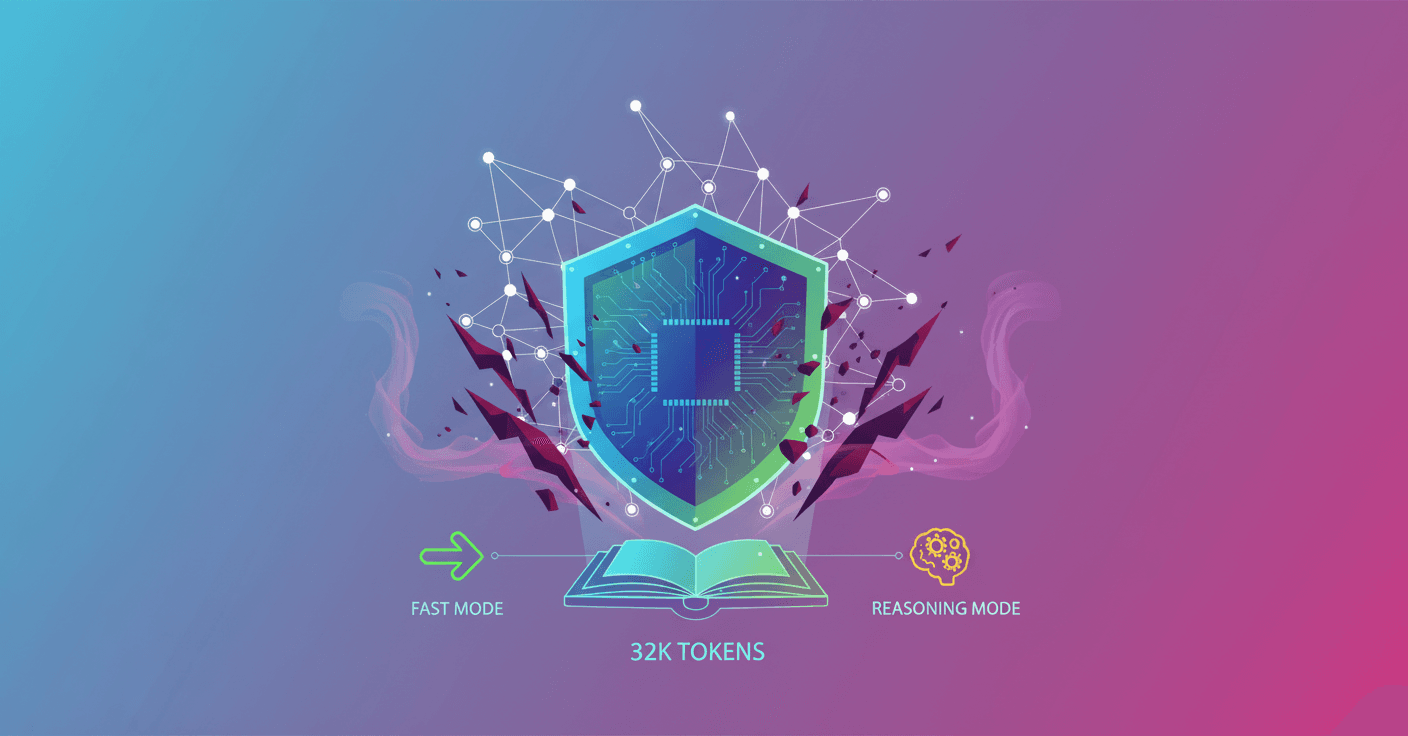
Large language models are no longer just text assistants: they act as agents, call tools, keep memory, and reason in multiple steps. What happens when someone tries to manipulate that flow? AprielGuard arrives as a unified guardrail to detect both security/content risks and complex adversarial attacks in those agentic systems.
What is AprielGuard and why it matters
AprielGuard is an 8B-parameter security and adversarial robustness model designed to operate as a “guardian” in modern LLM deployments. It detects 16 risk categories (toxicity, sexual content, misinformation, privacy violations, security threats, fraud, illegal activity, and more) and a wide set of adversarial attacks: prompt injections, jailbreaks, corruption of chains of thought, memory poisoning, and multi-agent exploitation sequences.
Why does this change the game? Because many traditional classifiers work with short messages and isolated labels. Today problems show up in long conversations, reasoning traces, tool invocations, and memory. The answer isn’t more rules or regex; it’s a model that understands the whole flow.
Architecture, modes and input/output
- Base: Apriel-1.5 Thinker Base variant reduced to
8Bparameters. - Type: causal decoder-only transformer.
- Precision and training: uses
bfloat16, batch 1 with grad-accumulation 8, LR 2e-4, Adam, 3 epochs, sequences up to 32k tokens. - Modes of operation:
- Reasoning Mode: emits structured explanations (useful for auditability and traceability).
- Fast Mode: classification-only output, lower latency for production.
Supported inputs:
- Standalone prompt.
- Multi-turn conversation.
- Agentic workflow that includes tool calls, reasoning traces, memory states and system context.
Outputs:
- Security classification and list of violated categories following a unified 16-class taxonomy.
- Binary adversarial attack classification (adversarial / non_adversarial).
- Optionally, structured reasoning explaining the decision.
Synthetic data and training process
The team generated most of the dataset synthetically to cover taxonomy subtopics and attack diversity. Key tools and techniques:
- Generation of unsafe content with
Mixtral-8x7Band internal uncensored models, using high temperatures to vary outputs. - Careful prompt templates to guide example creation.
- NVIDIA NeMo Curator to create multi-turn conversations with iterative attacks and context shifts.
- SyGra for dedicated synthetic generation of harmful prompts.
- Data augmentations: character-level noise, leetspeak, typos, paraphrasing and syntactic reordering.
They also simulated full agentic workflows: tool definitions, invocation logs, memory slots, agent roles and execution traces. For adversarial cases they corrupted specific segments (for example, tool outputs or memory states) to reflect realistic attacks.
Evaluation and metrics (the essentials)
AprielGuard was tested on public security and adversarial benchmarks, plus internal benchmarks for agentic workflows and long-context cases (up to 32k tokens). Some highlighted results:
-
On long-context security risk tests:
AprielGuard-8Bwithout reasoning: Precision 0.99, Recall 0.96, F1 0.97, FPR 0.01.- With reasoning: Precision 0.92, Recall 0.98, F1 0.95, FPR 0.11.
-
On adversarial attack detection (long context):
- Without reasoning: Precision 1.00, Recall 0.78, F1 0.88, FPR 0.00.
- With reasoning: Precision 0.93, Recall 0.94, F1 0.94, FPR 0.10.
-
Public benchmarks show strong performance on many tasks, though there are weaker spots: for example,
toxic-chatand some prompt injection tests show lower precision/recall compared to other datasets.
What do these numbers tell us? AprielGuard achieves very good precision at identifying risks and attacks, but enabling explanations (reasoning) increases latency and can slightly change sensitivity. In some adversarial benchmark cases recall drops, which means sophisticated attacks can still slip through.
Practical limitations and recommendations for production
Some important limitations the creators exposed:
- Limited multilingualism: although tested in 8 languages and working reasonably, additional calibration is recommended before production use outside English.
- Vulnerability to unseen adversarial strategies: training with synthetic attacks helps, but doesn’t guarantee full coverage.
- Domain sensitivity: it may perform worse in technical niches like legal or medical.
- Latency-explainability trade-off: reasoning mode adds transparency but penalizes latency.
- Occasional inconsistencies between inference modes.
Practical recommendations if you plan to implement it:
- Use
Fast Modefor online classification when latency is critical. - Enable
Reasoning Modefor post-hoc audits and human triage in incidents. - Add cascaded pipelines: AprielGuard + domain-specific rules + human review to minimize false negatives.
- Calibrate and re-train (or fine-tune) with real examples from your domain, especially in other languages.
- Monitor source drift and adversarial drift: attackers evolve, you must too.
How it integrates with real agentic flows
Think of an agent that queries a knowledge base, calls APIs and keeps memory. AprielGuard can ingest that entire trace —prompts, tool responses, memory states— and signal if at any point there’s a risk or an attack. That’s super useful to spot “needle-in-a-haystack” attacks that only appear after several interactions or inside metadata.
Concrete example: a support assistant that runs scripts on demand. An attacker could graft a malicious instruction inside a long conversation thread or in a response from an external tool. AprielGuard would search that full context for manipulation and flag the anomaly for blocking or review.
Final balance and future direction
AprielGuard represents a practical step toward integrated guardrails for agentic ecosystems. It’s not a magic bullet: it reduces complexity, unifies taxonomies and improves coverage, but it requires calibration, observability and complementary human strategies. Good news? It offers practical modes for production and traceability for forensic research.
Teams operating agentic LLMs should see it as part of a defense-in-depth strategy: a guardian able to understand long flows and creative attacks, but one that needs support —real data, business rules and human review— to be truly safe in production.