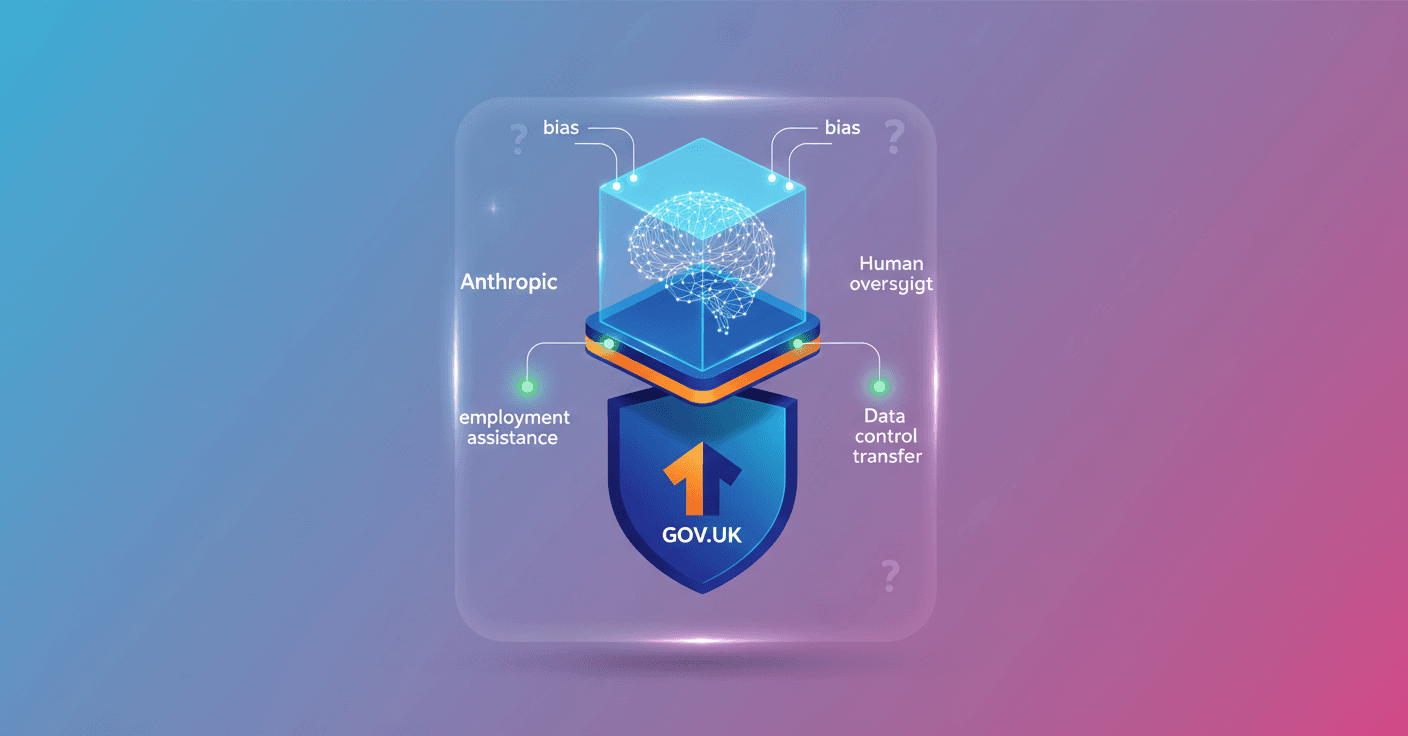
Anthropic and the UK government have announced a trial to add an AI assistant to GOV.UK that helps citizens navigate public services. The first focus will be employment: finding work, accessing training and understanding available support, with personalized answers and memory across queries.
Do you ever wish a government site could remember your case so you don’t repeat yourself? That’s exactly the kind of convenience this pilot aims for.
What Anthropic and the government announced
The UK Department for Science, Innovation and Technology (DSIT) chose Anthropic to build and pilot a dedicated AI assistant for GOV.UK, powered by Claude. This follows the Memorandum of Understanding signed in February 2025 and is part of the government’s plan to explore how AI can transform public services.
It’s important: the first phase focuses on employment, but the architecture is meant to scale to other procedures and government processes if the trials succeed.
How it will work on GOV.UK
-
The assistant won’t just answer questions: it will guide people step by step through administrative processes and keep contextual memory between interactions, so you don’t have to explain everything from scratch each time.
-
It will offer personalized advice on CVs, training, job-search routes and which benefits you might be eligible for based on your situation.
-
Users will retain control over their data: you’ll be able to see what the tool remembers and choose to delete or not save information. Everything is promised to comply with UK data protection law.
Can you picture returning to an application and the assistant remembering your case without you repeating everything? That’s the idea behind the contextual memory.
Focus on safety and capability transfer
The collaboration follows DSIT’s “Scan, Pilot, Scale” philosophy: test small, learn, and then expand. Anthropic stresses safety as a priority: engineers will work alongside civil servants and Government Digital Service developers so the administration can maintain and oversee the system independently.
Pip White, Anthropic’s regional lead, frames it as part of their mission to deploy frontier AI safely for public benefit. There’s also cooperation with the UK AI Safety Institute to evaluate models and safeguards.
What this means for jobseekers
In practice, you could use GOV.UK to:
- Get job and training recommendations relevant to your profile.
- Receive help preparing documents like CVs or cover letters.
- Be directed to local services or specific benefits based on your family, health or financial situation.
That cuts down time and frustration—especially if you need clear guidance without jumping between multiple pages or helplines. Imagine getting a tailored CV tip for a hospitality role or being pointed to a nearby training course that fits your schedule.
International context and long-term commitment
Anthropic already works with institutions in several countries: collaboration with LSE for students, an educational pilot in Iceland and training projects in Rwanda. Their London team is growing in research, product and policy, which explains their bet on the UK as a strategic partner.
The stated goal is also to transfer knowledge: so the UK government gains technical and safety experience to manage these tools itself.
Risks, doubts and open questions
Sounds perfect? Not quite. There are legitimate questions that need answering:
- Bias and accuracy: how will errors or incomplete answers that affect life decisions be mitigated?
- Human oversight: what controls will exist when the assistant suggests critical routes like benefits or sanctions?
- Data protection: even if control options are promised, concrete implementation and audits will be key.
These concerns don’t invalidate the project, but they explain why trial phases and transparency are essential.
The government and Anthropic seem aware: the collaboration includes external evaluation and joint capacity building to avoid unmanaged technological dependency.
Final reflection
This pilot is a good example of how AI can be integrated into public services with a pragmatic approach: start with a concrete case, measure and adjust. If it works, it could simplify everyday procedures for millions, but success will depend as much on governance, transparency and public-sector training as on the technology itself.