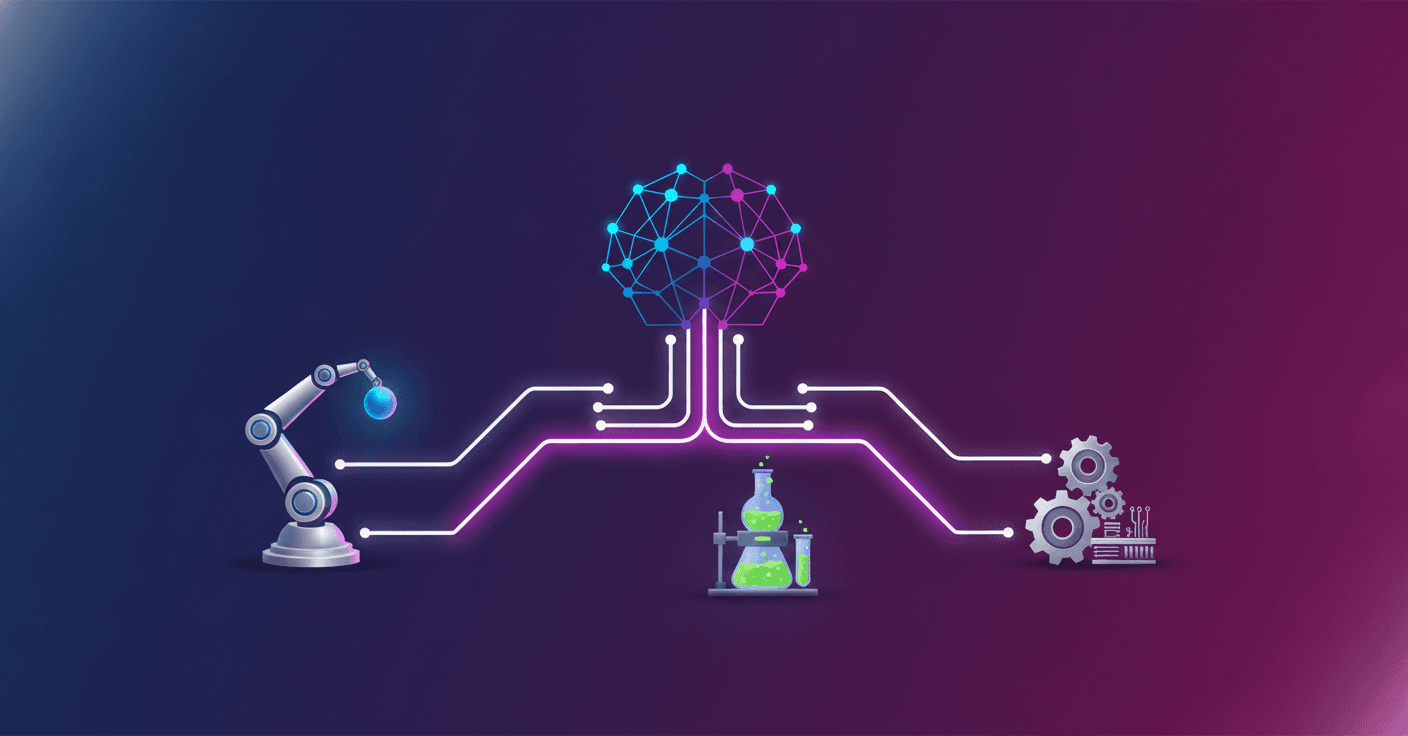
Anthropic opened a research preview of the Model Hardware Standard (MHS), a specification designed to let AI agents operate physical equipment in laboratories, factories, and research centers. The proposal aims to solve a very specific problem: getting instruments made by different manufacturers to work together without months of custom integrations.
Can you imagine asking an agent to coordinate a microscope, a robotic arm, and a liquid handler as if they were parts of the same system? That is what Anthropic is beginning to test with scientific laboratories and advanced manufacturers.
A common language for machines
Today, many scientific and manufacturing devices have their own software, interfaces, and ways of communicating. Integrating them often requires specialists to build custom connections for every combination of equipment.
MHS introduces a standardized controller, known as a driver, that works as a translator between the operating system and the device. Instead of learning a completely different interface for every machine, the agent can use common operations such as reading a piece of data or writing a setting.
For example, an instruction could check an instrument’s temperature or change a motor’s speed. The standard also makes it possible to describe each device’s capabilities, characteristics, and safety limits in a format the agent can interpret.
MHS’s central promise is to reduce integrations that normally take weeks or months to processes that could be completed in hours or minutes.
How an agent works with hardware
MHS allows devices to be discoverable on a network and gives an agent access to information that does not always appear in the code. A robotic arm’s weight, its range-of-motion limits, or the maximum amount it can handle are essential data for operating it safely.
That information can be registered through labels written in natural language. A user can enter it directly or talk with an agent to document the equipment’s configuration. The controller then generates a reference file with details about what the device can measure, adjust, and execute, along with the limits that must be respected.
To control equipment, MHS uses three main mechanisms:
- Model Context Protocol (MCP), to connect agents with tools and devices.
- The command line, useful for executing operations directly.
- Code files or APIs, which make it possible to chain instructions together and automate complete processes.
With these pieces in place, an agent can coordinate several devices, observe their results, change parameters in real time, and monitor lengthy experiments. For repetitive tasks, it can also turn what it has learned into a deterministic script that runs without reasoning through every step from scratch.
Anthropic describes, for example, tests in which Claude adjusted a laser, used a camera to observe how the beam changed, and repeated the process until it understood the sequence. It then turned that learning into a code file capable of aligning the laser with a single command.
Early experiments in laboratories and robotics
The preview includes collaborations in biotechnology, robotics, microscopy, quantum computing, and manufacturing. Some initial results shared by participants include:
- Genentech coordinated a liquid handler, a robotic arm, and a plate reader to automate a protein concentration test.
- The University of Washington and Carnegie Mellon University used MHS to monitor qPCR experiments, coordinate plate deliveries, and run dose-response tests more quickly.
- HHMI Janelia used the standard to unify a microscopy system that depended on seven programs from different manufacturers.
- QuEra Computing allowed an agent to control part of the laser system in its quantum computers. According to Anthropic, the agent restored the laser’s frequency lock 99.3% of the time without human intervention.
- Tetsuwan Scientific integrated MHS into an automated biology platform to run qPCR related to local contamination analysis.
Companies such as AWS, Automata, Danaher, Doosan Robotics, MBF Bioscience, QIAGEN, Tecan, and Universal Robots are also participating. Several are developing controllers so their instruments can be discovered and operated by AI agents.
In the open ecosystem, Hugging Face is working on integration with LeRobot, its robotics library, while Raspberry Pi is testing MHS connections with some of its products through a controller for cameras.
Physical autonomy still needs supervision
Although the results are striking, Anthropic acknowledges that a language agent does not understand the physical world the way an expert would. Claude learns mainly from text and images, so it may struggle to interpret mechanical, spatial, or material causes.
In a test involving protein samples, Genentech researchers had to help the agent distinguish between a software error and a physical problem caused by foam in the samples. The solution was not to change the code, but to apply the appropriate physical correction.
MHS also does not yet work with equipment that lacks a programmable interface. That is why Anthropic is working with manufacturers to add these controllers and expand the number of compatible devices.
The company plans to use this research stage to develop safety evaluations, define best practices, and strengthen its protections against potential misuse of AI in the physical world. The goal is to release MHS as open-source software after analyzing the results obtained with its initial partners.
The idea is not for agents to immediately replace scientists, engineers, or technicians. Rather, it is about letting them coordinate instruments, detect failures, and run repetitive cycles while people continue supervising important decisions.
If MHS manages to become a widely adopted standard, connecting equipment from different brands could stop being one of the main obstacles to automating laboratories and factories. The question will be whether the industry can agree on something as important as how an AI should touch, move, and control the real world.
Original source
https://www.anthropic.com/news/model-hardware-standard-research-preview