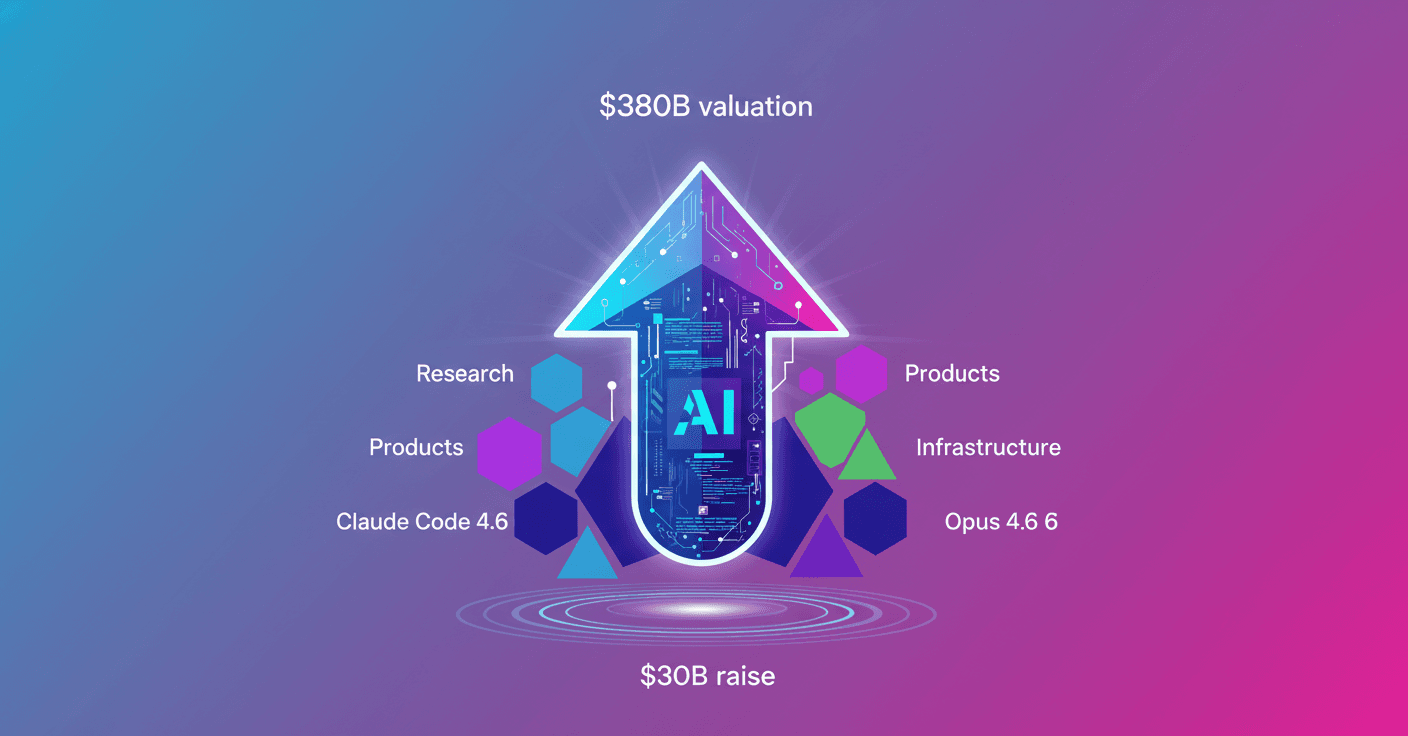
Anthropic announces one of the largest funding rounds in the sector: $30 billion in Series G that place the company at a $380 billion post-money valuation. What does this mean for the competition, for companies already using Claude, and for the direction of enterprise AI? Let’s break it down.
The round, the money and why it matters
The investment was led by GIC and Coatue, with co-leads D. E. Shaw Ventures, Dragoneer, Founders Fund, ICONIQ and MGX. The participant list includes big, well-known funds: Accel, Sequoia, Temasek, Baillie Gifford, BlackRock, Fidelity, JPMorgan Chase, Morgan Stanley, TPG and many more. It also includes parts of prior investments announced by Microsoft and NVIDIA.
Why does it matter so much? Because it’s not just the amount: it’s a clear signal that large capital managers believe Anthropic and its assistant Claude will remain key pieces in enterprise AI adoption. The money will go to cutting-edge research, product development and infrastructure to scale operations.
Krishna Rao, Anthropic’s CFO, highlights that enterprise demand makes Claude a critical part of daily work and that this investment will fund enterprise-grade products and models.
Real growth: numbers that back the bet
Anthropic says it took less than three years from the first dollar of revenue to today, when its revenue run-rate reaches $14 billion. According to the company, that revenue grew more than 10x annually over the past three years.
Some concrete milestones they mention:
- Customers spending more than $100,000 annually on Claude grew 7x in the last year.
- More than 500 customers now pay over $1 million a year (versus a dozen two years ago).
- Eight of the ten Fortune companies already use Claude.
If those numbers are close to reality, they explain why institutional investors are betting big: there’s sustained demand for AI solutions that work at enterprise scale.
Claude Code, Opus 4.6 and new products
A substantial part of this growth comes from Claude Code, Anthropic’s AI-assisted programming offering. Data provided by the firm:
- Claude Code has a run-rate of over $2.5 billion and its revenue doubled since the start of 2026.
- Weekly active users of Claude Code also doubled since January 2026.
- An analysis cited by Anthropic estimates Claude Code accounts for roughly 4% of all public commits on GitHub, a figure that doubled in one month.
Anthropic recently launched its Opus 4.6 model, designed to power agents capable of generating documents, spreadsheets and presentations with professional quality. The company says Opus 4.6 leads the GDPval-AA metric, which measures performance on high economic-value tasks like finance and legal work.
In January they released more than thirty products and features, including Cowork, which brings Claude Code capabilities to broader knowledge tasks via open-source plugins specialized for sales, legal, finance and more. They’re also advancing in health and life sciences, with Claude for Enterprise compatible with organizations under HIPAA.
Infrastructure, multi-cloud and resilience
Anthropic emphasizes a strategy of cloud and hardware diversity: Claude is available on AWS (Bedrock), Google Cloud (Vertex AI) and Microsoft Azure (Foundry), and is trained/run on AWS Trainium, Google TPU and NVIDIA GPUs. The logic is simple: match workloads to the chip and cloud that give the best performance and resilience for enterprise customers.
That delivers two clear advantages for companies: better performance on critical tasks and lower risk by not relying on a single infrastructure provider.
What this means for the ecosystem and for you
For companies: more money for Anthropic points to more integrated products, enterprise support and models that can handle real workloads in finance, legal, healthcare and software development.
For developers and product teams: Claude Code and Opus 4.6 promise faster development cycles and automation of complex tasks. But watch out: real adoption requires governance, security controls and process adaptation. Have you thought about who will review outputs, how to handle sensitive data, or how to track model behavior over time?
For the AI market: a $380 billion valuation and the entry of so many well-known investors consolidate Anthropic as a major player alongside other big model companies. That pushes competition, investment in agent-style models and the race for enterprise-grade capabilities and safety.
Final reflection
This is not just a spectacular number: it’s a signal that enterprise-purpose AI is entering a phase of massive scale with models that already generate significant revenue and with infrastructure and product offerings ready for companies. The lesson? If you work in product, engineering or management, it’s time to practically evaluate how to integrate these capabilities without losing control over security, privacy and governance.