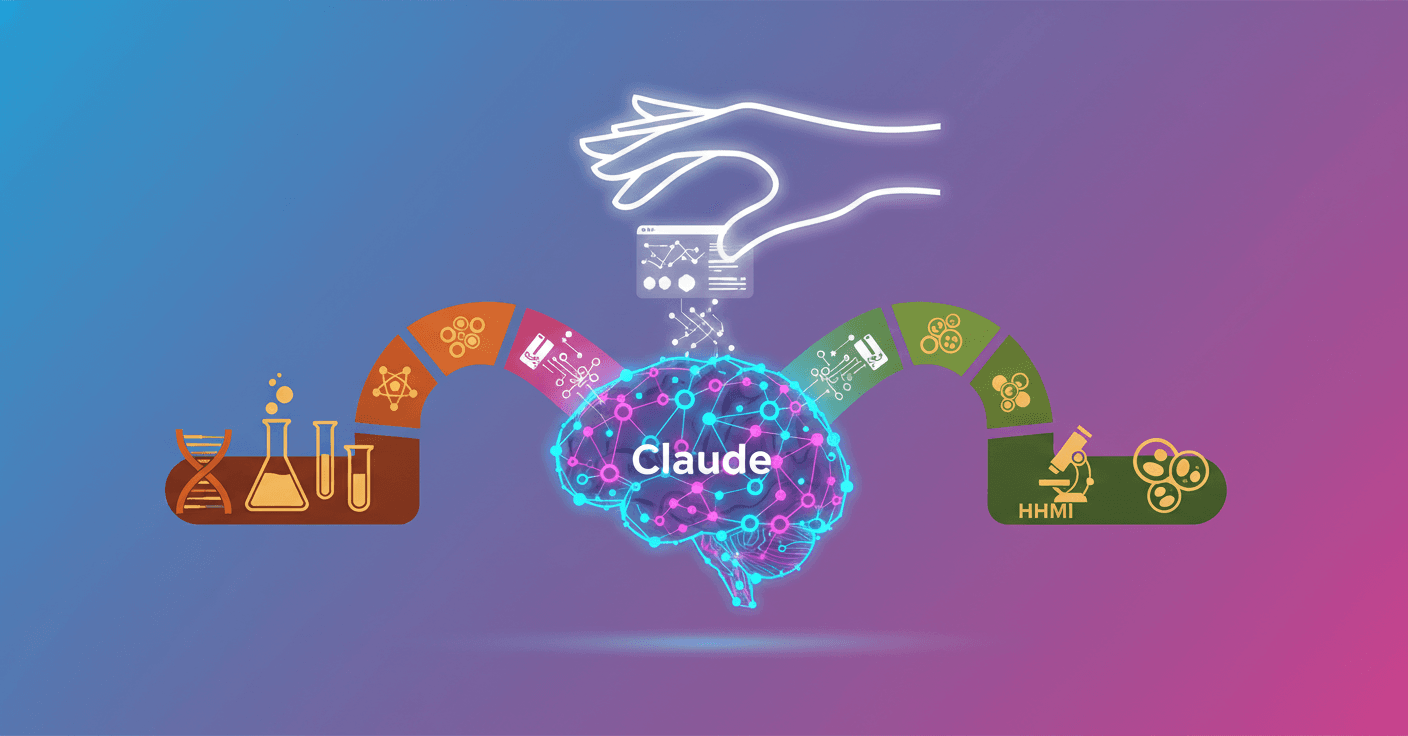
Anthropic announced two partnerships with the Allen Institute and the Howard Hughes Medical Institute (HHMI) to bring Claude into the heart of experimental biology work. The idea is to close the gap between the enormous amount of data modern research produces and our human capacity to turn that data into hypotheses and reproducible results.
What they announced
The three organizations will work together to integrate advanced language models and agent systems into real scientific workflows. Each partnership will have complementary goals:
- HHMI will focus on building the infrastructure and specialized agents that interact with instruments and experimental pipelines at sites like the Janelia campus.
- The Allen Institute will explore multi-agent systems to integrate and analyze multimodal data (for example, multi-omics and connectomics) and speed up mechanistic discovery.
The emphasis isn't on automating science without oversight, but on giving teams tools that amplify their judgment and speed up tasks that today take weeks or months.
HHMI: infrastructure for AI-assisted discovery
HHMI already has a history of creating technologies to understand the brain and the cell. With Anthropic, that expertise is used to design agents that know lab protocols, handle experimental data, and suggest next steps with traceability.
Think of an assistant that helps you design a protein engineering experiment, that combines simulation results, suggests controls, and documents verifiable reasoning. That's what they're after: models that evolve alongside the real needs of the lab.
Allen Institute: multi-agent systems for mechanistic discoveries
The Allen Institute's approach is to coordinate several specialized agents: one to integrate multi-omic data, another to manage knowledge graphs, another to model temporal dynamics, and so on. When they work together, these agents can compress months of analysis into hours and reveal unexpected patterns.
The key here is that agents don't replace the scientist's intuition. Instead, they take on computational complexity and leave conceptual direction in human hands.
Why this matters for you and for science
Biological research produces data at a scale that's impossible to handle with manual work alone. If Claude and these agents deliver on their promise, you'll see benefits like:
- Faster generation and prioritization of hypotheses.
- Automatic integration of heterogeneous data (sequencing, imaging, proteomics).
- Documentation of reasoning that makes reproducibility easier.
For a biotech entrepreneur, that means shorter development cycles. For a researcher, less time cleaning data and more time running creative experiments.
Transparency, safety and human control
All three institutions emphasize transparency and that AI must be interpretable to scientists. A prediction alone isn't enough; researchers need to be able to evaluate, trace, and trust the reasoning behind it.
In simple terms: the AI has to explain the how and the why, not just give answers.
Anthropic and its partners will also use day-to-day lab feedback to uncover failures that don't show up in controlled tests. That's crucial: models can perform well on benchmarks but fail in real workflows.
Possible challenges and open questions
- How will the validity of AI suggestions be verified in critical experiments?
- What safety and bioethics measures will accompany these agents?
- How will overfitting to a single lab's data be prevented?
Answering these questions will be as important as developing the technical capabilities.
What's next
These collaborations will feed the development of Claude in life sciences and generate lessons about how AI can be integrated into different research contexts. If they work, we could see a transformation in scientific routines: less time wasted on administrative work and more focus on questions that actually move knowledge forward.
The news reminds us of something that's sometimes forgotten: AI isn't a magical black box, but a tool that, well designed and supervised, can extend our intellectual abilities.