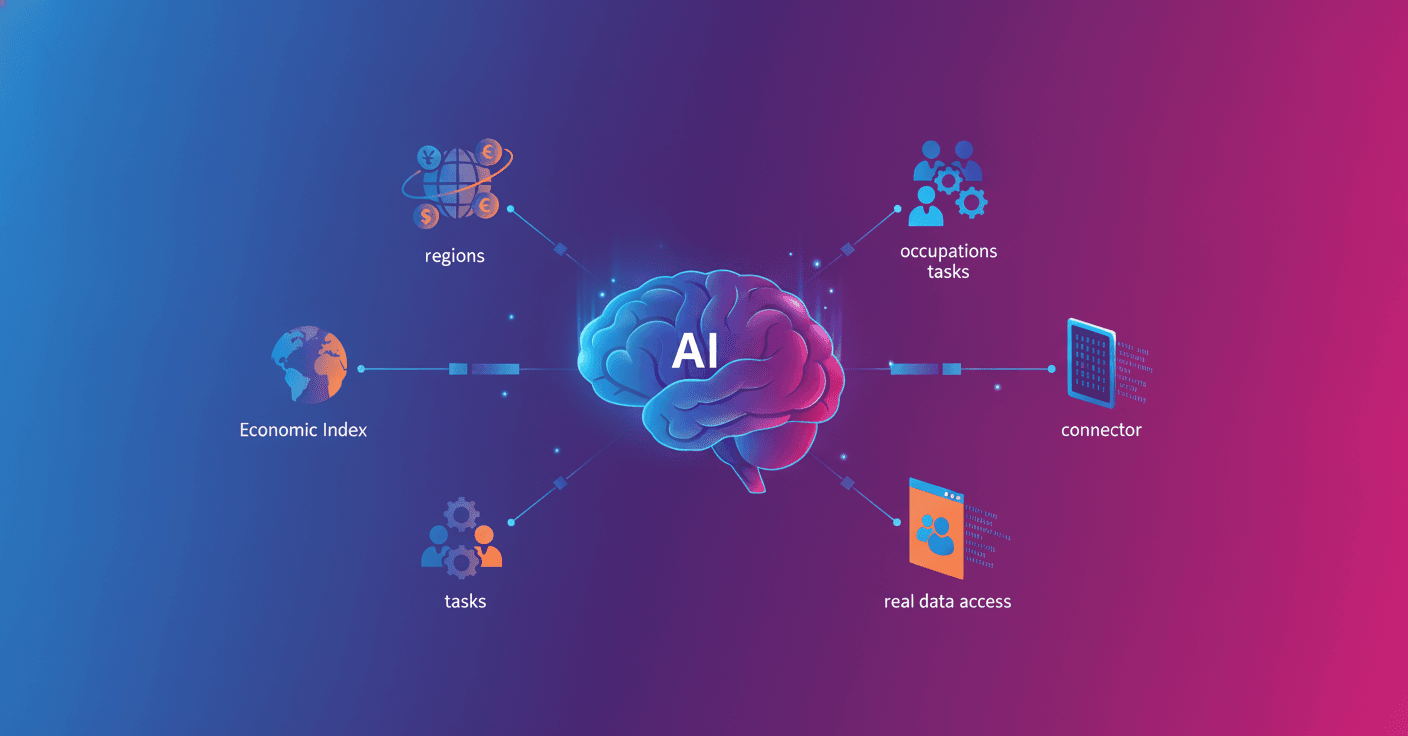
Anthropic has just opened a door so anyone can explore how AI is used at work: the Anthropic Economic Index connector for Claude. Do you want to know which tasks are being automated in your profession or which occupations use AI the most? Now you can ask Claude and get answers based on real data.
What is the Anthropic Economic Index and why it matters
The Anthropic Economic Index measures how AI is used in the economy by observing the real behavior of Claude users. It’s not a futuristic forecast or a vague survey: it’s a record of usage patterns that helps answer concrete questions about tasks, occupations, and regions.
Who is this for? Journalists, researchers, policymakers, and you—if you’re wondering how AI might affect your daily work. Imagine a teacher wanting to know what tasks other educators delegate to Claude, or an entrepreneur in Colorado curious about local applications: this index gives you evidence, not just opinions.
How to use the connector in Claude (it’s very quick)
- Go to claude.ai.
- Open the connectors menu and look for "Anthropic Economic Index" in the directory.
- Activate it: you don’t need to install anything and it will work in any conversation with any Claude model.
- Ask as if you were talking to a colleague: start broad and then dig deeper.
Examples you can try:
- "What occupations use AI most frequently?"
- "How do people in Colorado use Claude?"
- "What tasks do teachers use Claude for and how did that change in the last year?"
- "What types of tasks are being automated in finance?"
Claude will respond with conclusions supported by the Index and, when relevant, show the underlying data so you can verify it.
What to expect from the answers and their limitations
The Index reflects patterns in the use of Claude, not the labor market as a whole. That means it shows where questions and tasks are moving within the Claude ecosystem, but it doesn’t replace a broad employment study.
Claude will point out those limitations and return links or references to the datasets when possible. That transparency is useful: it lets you use the observations as initial evidence and then decide if you need additional sources to make wider decisions.
Good practices for exploring the data
- Start with general questions and then ask to see the figures or time series.
- Request comparisons by region, by occupation, or by type of task.
- If you’re going to use the results in an article or report, cite that the data come from the Anthropic Economic Index and specify that they reflect Claude usage.
Why this changes access to evidence about AI
Before, many of these data only reached researchers or journalists with resources. Putting them a click away inside Claude democratizes exploration: anyone can see trends and build hypotheses based on real data.
Does this mean AI already tells us everything about the future of work? No. Does it mean you now have a practical tool to ask and check? Yes.
Original source
https://www.anthropic.com/news/anthropic-economic-index-connector