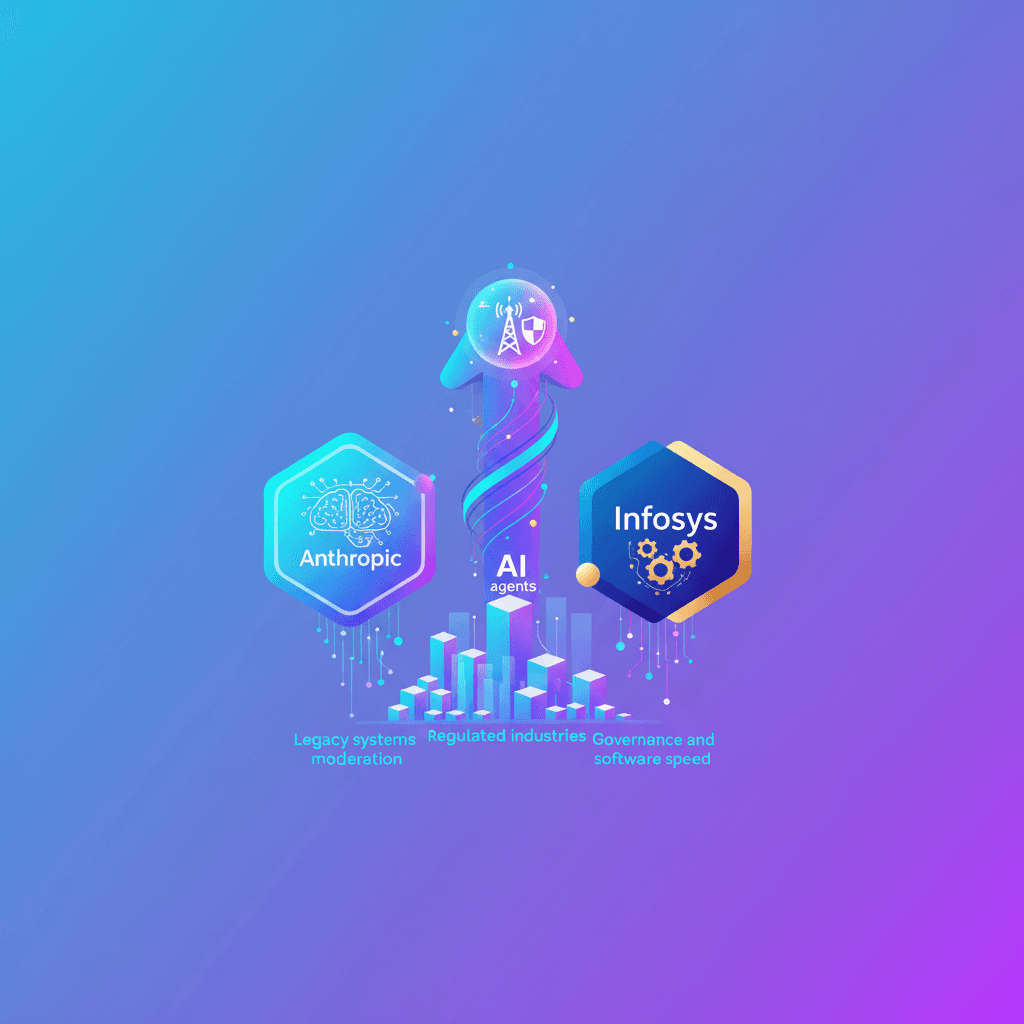
Anthropic and Infosys announce an alliance to bring artificial intelligence agents to regulated industries like telecommunications, financial services, manufacturing, and software development. What does this mean for companies — and for you if you work in those sectors? In short: smarter automation with a focus on governance and compliance.
What the collaboration offers
The integration pairs Anthropic's models (Claude, Claude Code) with Infosys' AI-first platform and services (Infosys Topaz). The goal is to speed up software development, modernize legacy systems, and deploy AI agents that can carry out complex, ongoing tasks while respecting regulatory rules and controls.
Why does that matter? Because many AI demos look great in a lab but fall short when auditors ask for traceability, accuracy, and accountability. Infosys brings industry expertise; Anthropic brings the models and tools to build agents that meet those real-world demands.
Agents that do more than answer questions
The central bet is on agentic AI: systems that don’t just reply, they execute multi-step processes on their own. Think of an agent that processes an insurance claim, writes and tests snippets of code, or manages compliance reviews without constant human intervention.
To make this work they’ll use tools like the Claude Agent SDK. They’ll also combine Infosys Topaz with Claude to ease migrations from older systems and cut both costs and upgrade times.
Persistent, contextual agents: the idea is that they work on long, complex tasks, not just one-off queries.
Practical cases by industry
-
Telecom: modernize network operations, simplify customer lifecycle management, and improve service delivery. This is handy in heavily regulated networks where consistency and traceability matter.
-
Financial services: faster risk detection and assessment, automated compliance reporting, and personalized support that uses the full account history and market conditions.
-
Manufacturing and engineering: speed up product design and simulation, shorten R&D cycles, and test more iterations before building physical prototypes.
-
Software development:
Claude Codewill help write, test, and debug, shrinking the gap between design and production. -
Business operations: with
Claude Coworkyou can automate routine tasks like document summaries, status reports, and review cycles.
And in India? A key market
India is the second-largest market for Claude.ai, with a developer community using the tool not just to experiment but to build production apps and modernize systems. Infosys shows up as one of Anthropic’s early partners in India — which makes sense given the technical talent and high adoption there.
How to start if you're a company or developer
If you want to explore this for your organization, the collaboration suggests two paths: adopt agents already integrated by Infosys, or build custom solutions using Claude and the Claude Agent SDK. Anthropic also reminds that Claude is available on major cloud platforms: Amazon Bedrock, Google Cloud Vertex AI, and Microsoft Azure.
If you’re on a product or tech team, start with two questions: what process do you want to automate, and what governance/audit metrics do you need? With those answers you can decide whether a packaged solution or a custom integration makes more sense.
Critical and practical view
This isn’t instant magic. Deploying agents in regulated environments requires testing, validation, and clear accountability frameworks. But pairing a model developer with an integrator that knows the sector is a sensible way to close the gap between demo and production.
For founders and engineering teams it means opportunities: faster delivery, lower maintenance costs, and the chance to focus your best people on strategic problems rather than repetitive tasks.