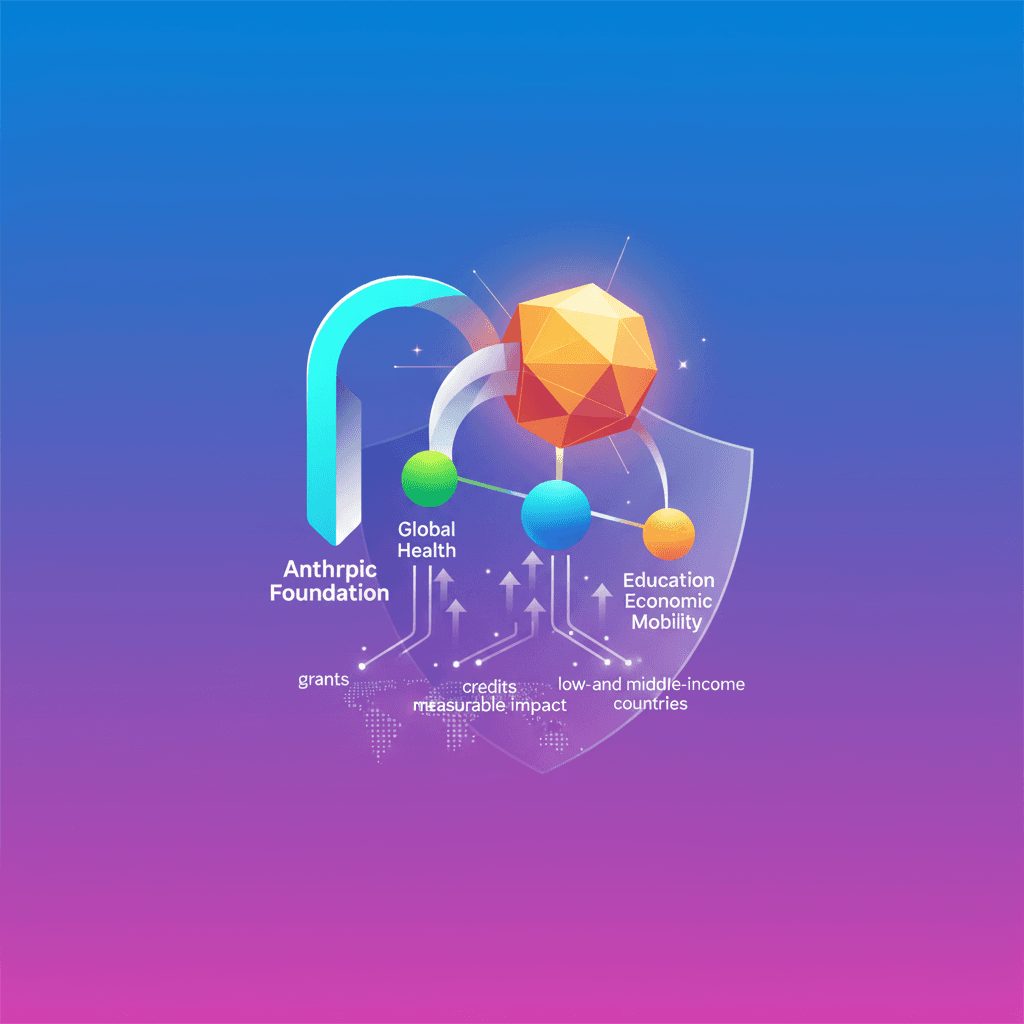
Anthropic announced on May 14, 2026 a partnership with the Gates Foundation to dedicate $200 million in grants, Claude usage credits, and technical support over the next four years. What's the goal? To bring practical AI to global health, life sciences, education, and economic mobility — in places where the market alone doesn't reach.
What was announced
The partnership mixes grant money, credits to use Claude, and engineering support. Much of the work will be run by Anthropic's Beneficial Deployments team, which already provides credits and support to nonprofits and educational organizations. They'll also build AI public goods — like datasets and benchmarks — and offer discounted access to institutions.
The initiative will be rolled out with partners in the United States and other regions around the world over the next four years.
What the $200 million will be invested in
Global health and life sciences
The largest share will aim to improve health outcomes in low- and middle-income countries, where millions lack access to essential services. Concrete actions include:
- Creating
connectorsthat let Claude interact with health platforms and tools. - Developing benchmarks and evaluation frameworks to measure how models perform on health tasks.
- Supporting health ministries in staffing deployment decisions, supply management, and outbreak detection.
- Using Claude to accelerate research on high-burden and neglected diseases, starting with polio, HPV, and eclampsia/preeclampsia.
Imagine a research team using Claude to computationally filter vaccine candidates before preclinical trials: that can shorten early stages of development. Sounds useful, right?
Anthropic will also work with the Institute for Disease Modeling to integrate Claude into predictive models and make them more accessible to people who aren't modeling specialists.
Education
The partnership will co-develop tools to improve K-12 learning in the U.S., sub-Saharan Africa, and India. They plan to create public goods like benchmarks, datasets, and knowledge graphs to evaluate tutoring in math, college guidance, and curriculum design.
In practice: Claude will power evidence-based tutoring apps, career guidance, and literacy and numeracy apps for low-resource contexts. The first public dataset will be released this year.
Economic mobility
Here the goal is to increase job opportunities and agricultural productivity. Specific actions:
- Improvements to Claude for agricultural apps, local crop datasets, and benchmarks to validate performance.
- Create portable records of skills and certifications so a person can carry them between schools and jobs.
- Tools for reliable career guidance and better links between training programs and job outcomes.
Think of a smallholder farmer receiving contextualized recommendations about local crops, or someone taking their skills history to a job posting without losing information.
Why does this matter? What actually changes?
Because it pairs philanthropic resources with technology and public intent. It's not just a commercial investment: it aims to create infrastructure, datasets, and open tools so communities and governments can use AI for social goals.
Also, the strategy includes transparency: Anthropic plans to publish its methodology and lessons as these projects scale. That makes auditing and replication easier.
Questions and risks to watch
- How will they guarantee privacy and security for sensitive health and education data? Data handling is crucial.
- What metrics will they use to measure real-world impact and not just technical capability? Benchmarks help, but population-level results matter.
- How will they avoid biases in models when applying them to diverse populations that are underrepresented in data?
These are questions Anthropic and the Gates Foundation will need to address publicly if they want these projects to work at scale.
The essentials for you to remember
This partnership is an example of how AI is moving from a tech novelty to a practical tool for social problems: health, education, and work. It doesn't promise magic solutions, but it does bring resources, tools, and partnerships designed to make AI useful where it's most needed.
The bet is big and long-term. You should follow the results, impact publications, and how ethical and data risks are managed in each project.