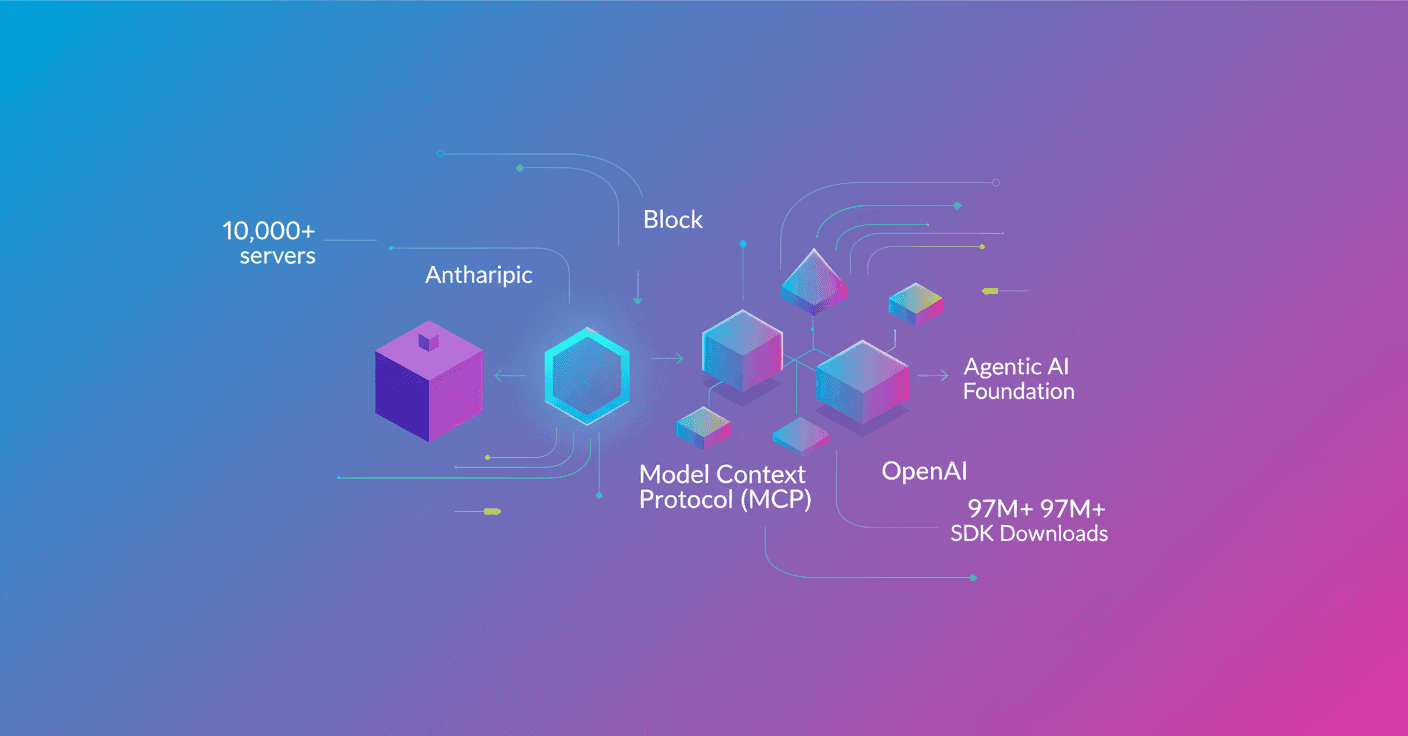
Anthropic donates today the Model Context Protocol (MCP) to the new Agentic AI Foundation, a foundation hosted under the Linux Foundation. What does that mean for you — developers, companies, or the future of agentic AIs that act autonomously? I'll explain it clearly and practically.
What is the Model Context Protocol and why it matters
MCP is an open, universal standard to connect AI applications with external systems: databases, tools, web services and more. Instead of each team inventing its own way for a model to talk to the world, MCP standardizes that communication.
Why does that matter? Because a common interface speeds adoption, lowers integration costs, and prevents proprietary solutions that silo projects. It's the difference between building with compatible parts or with mismatched connectors.
Think of it like using a common plug instead of dozens of adapters — integrations become faster and less fragile.
Adoption and key data
- More than 10,000 public MCP servers active, from developer tools to deployments in Fortune 500 companies.
- MCP is integrated in popular products like ChatGPT, Cursor, Gemini, Microsoft Copilot and Visual Studio Code.
- Enterprise infrastructure support from AWS, Cloudflare, Google Cloud and Microsoft Azure.
- Claude (from Anthropic) has a directory with over 75 MCP-based connectors.
- There are official SDKs for major languages, with 97M+ combined monthly downloads for Python and TypeScript.
- The specification version from November 25 added features like asynchronous operations, statelessness, server identity and official extensions.
Those numbers aren't marketing fluff: they show MCP is already a real, production-ready piece.
What is the Agentic AI Foundation and the Linux Foundation
The Linux Foundation is a non-profit with decades of experience running critical open projects: the Linux Kernel, Kubernetes, Node.js and PyTorch are examples. Its advantage is offering neutral governance and enabling multidisciplinary collaboration.
The Agentic AI Foundation (AAIF) is a fund hosted by the Linux Foundation, co-founded by Anthropic, Block and OpenAI, and supported by Google, Microsoft, AWS, Cloudflare and Bloomberg. Its goal is to make the evolution of agentic AI (AI that can act and make decisions) transparent, collaborative and oriented to the public interest.
What changes with the donation
Anthropic donates MCP to the AAIF so the protocol lives inside a neutral, community-driven ecosystem. MCP joins foundational projects like goose (from Block) and AGENTS.md (from OpenAI).
Governance of the protocol won't change radically: current maintainers will continue prioritizing community input and transparent decision-making. Anthropic will also keep contributing — for example, integrations in Claude and capabilities like Tool Search and Programmatic Tool Calling designed to optimize large-scale deployments.
Practical impact for different stakeholders
- For developers: using
MCPmeans connecting tools and services without rewriting integrations. SDKs and the registry make it easy to find servers and connectors. - For companies: platform adoption and infrastructure support reduce vendor lock-in risk and simplify enterprise deployments.
- For AI products: compatibility between tools speeds the creation of complex flows (agents that call APIs, handle data and maintain state efficiently).
- For the community: an open standard under the Linux Foundation offers transparency and more neutral governance.
And what can you do now?
- If you develop, check the Python or TypeScript SDKs and explore the registry to find servers and connectors.
- If you manage products or infrastructure, evaluate how MCP can simplify integrations and reduce latency in multi-tool flows.
- If you're just curious, follow the project and join the community to contribute use cases or report improvements.
Official resources are available on the protocol's site. Participating early in open standards gives you a voice in how the rules of the game are set.
Donating MCP to the AAIF is a move to keep the technology open and collaborative in an area that will have real impact on how AIs interact with the world. It's not just a technical announcement: it's a bet on shared infrastructure so innovation stays accessible and responsible.