The new generation of AI models can simulate aspects of Earth’s climate with an efficiency that used to be unthinkable. What’s the catch? Until now, we didn’t have strict, shared ways to test whether those predictions are actually trustworthy. AIMIP was created to close that gap.
What AIMIP is and why it matters
AIMIP (AI Model Intercomparison Project) is a community effort led by the Allen Institute for AI that brings together modeling groups — including Ai2 Climate Modeling, ArchesWeather, NVIDIA, Google Research, University of Washington and University of Maryland — around a shared experiment and dataset.
Why does this matter to you? In climate science, intercomparison projects (the familiar MIPs) have been crucial to compare traditional physical models and build confidence in long-term projections. AIMIP applies that same idea to the world of climate AI: a common framework lets you evaluate very different systems with consistent criteria.
AIMIP Phase 1: technical specification
Phase 1 was designed to be simple enough to allow broad participation, but rigorous enough to compare real performance. The key points are:
- Training only with
ERA5from 1979 to 2014. The years 2015–2024 are held out as test data. - Prediction of the global atmosphere for 1979–2024, with outputs at monthly and daily frequency.
- Required variables: temperature, humidity and wind at seven vertical levels; surface temperature and precipitation, among other key variables.
- Ocean and sea-ice states prescribed from historical observations (that is, no ocean coupling in this phase).
- Outputs compatible with typical
CMIPformat specifications to ease comparisons with physical models.
These rules let you compare models with very different architectures without dictating how they’re built internally. The aim: measure behavior, not force solutions.
Evaluations and technical findings
Organizers received eight simulations from five external organizations plus Ai2. The results show a mix of real progress and significant challenges.
-
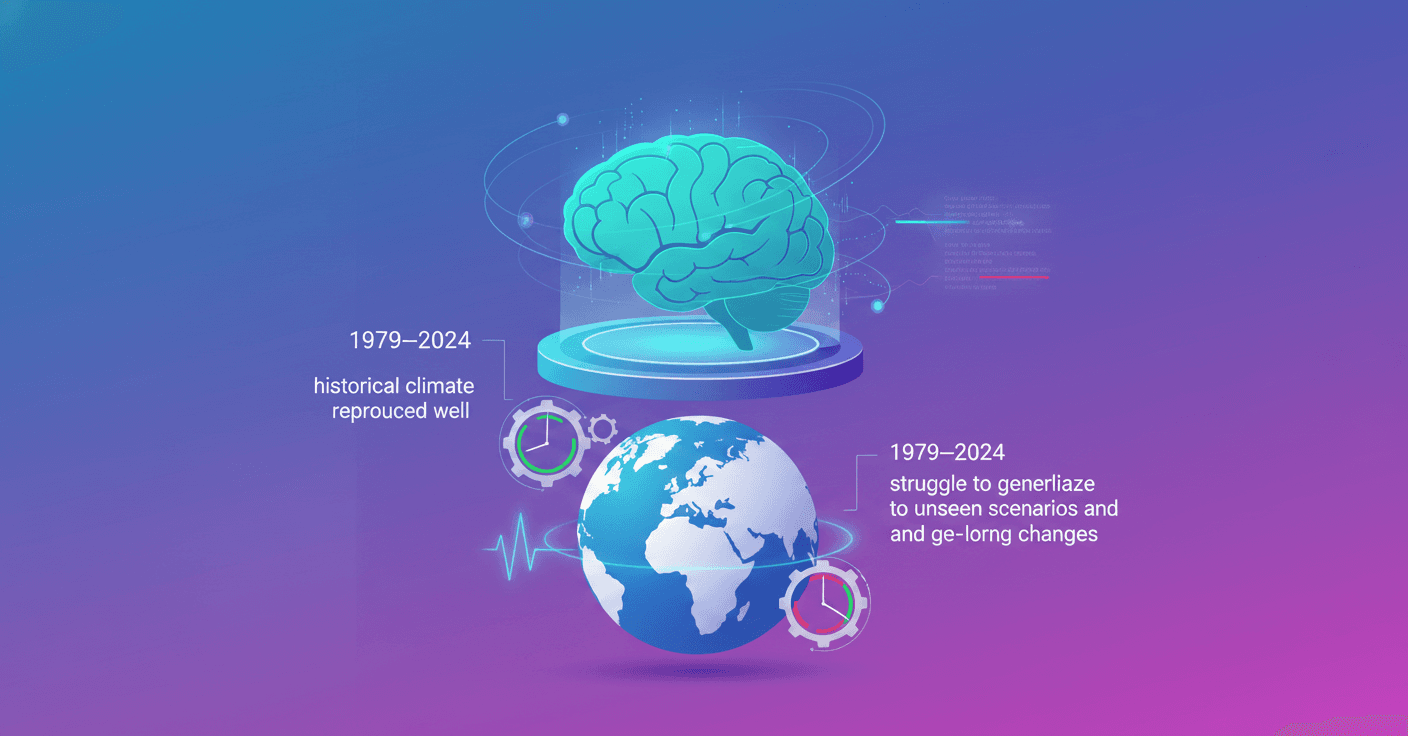
Historical climate simulation: overall, AI models reproduce average climate patterns better than a conventional physical model on many metrics. Some setups cut average error in variables like surface temperature by nearly half.
-
Long-term warming trend: here the picture is mixed. Some models capture the warming signal beyond the training period well; others underestimate warming in the held-out decade. That raises questions about generalization to future scenarios.
-
Responses to forcings and events: tests include responses to El Niño conditions, day-to-day variability and an out-of-sample experiment where ocean surface temperatures are instantaneously warmed by 2 or 4 °C. In those out-of-distribution cases the simulations diverge a lot and some become physically implausible.
-
Computational efficiency: as with short-term weather, AI models deliver predictions at up to three orders of magnitude less computational cost than physical models, which opens the door to wider exploration and experimentation.
In short: AI models show strong skill at reproducing historical average climate, but their ability to generalize to unseen changes remains a critical problem.
Technical implications and next phases
What does this mean for researchers and advanced users?
-
Generalization will be the keyword. Relying on a model for emissions projections or risk analysis requires that it behaves sensibly outside the range of observed conditions.
-
Integration with physical models: Phase 1 used prescribed ocean and ice. Future phases will likely move toward coupled atmosphere–ocean–ice models, adding complexity and new evaluation needs.
-
Data and governance: the Phase 1 dataset is hosted at
DKRZand will be published onESGFfor broad access. That matters: reproducibility and open access enable auditing and improvements. -
New training strategies: you may need to supplement
ERA5with outputs from physical models or specific AI techniques (for example, fine-tuning on forced scenarios, physics-aware data augmentation, or training on counterfactuals) to improve robustness.
What the community and decision-makers can expect
AIMIP Phase 1 isn’t the final word, but it is an operational baseline. If you’re a researcher, the dataset is a platform to compare methods and diagnose failures. If you’re a decision-maker or a user of climate products, the practical takeaway is clear: AI promises to democratize access to climate simulations thanks to speed and lower cost, but you still need guarantees that those models will behave well in extreme or unseen scenarios.
Final reflection
AIMIP is an important technical and community step: it brings rigor, open data and shared criteria to the growing field of climate AI. We’re moving toward faster, more accessible models, but trust will come from solid testing, continuous benchmarking and joint evolution between AI and physical modeling.