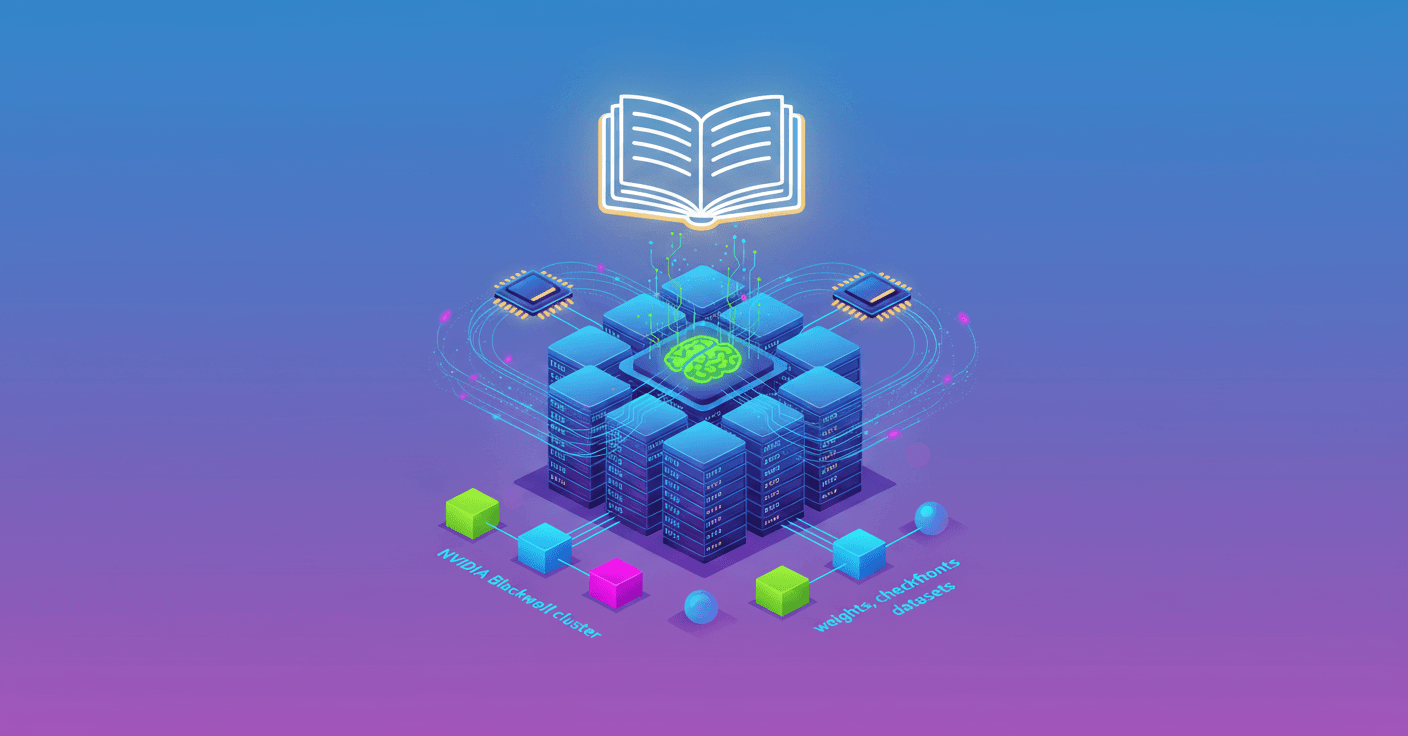
Ai2 and the NSF are bringing an open computing infrastructure online designed for research: it’s not just new hardware, it’s a change of model. Instead of your GPU hours feeding proprietary black boxes, each experiment can become a reusable artifact: weights, checkpoints, data and methods available for others to reproduce, extend and reuse.
Qué es NSF OMAI y por qué importa
NSF OMAI (Open Multimodal AI Infrastructure for Science) is a project funded by the National Science Foundation with additional investment from NVIDIA to create fully open AI infrastructure aimed at science. Ai2 received the funding to deploy a cluster designed from the ground up to maximize reuse and transparency.
Why should you care? Because in research reproducibility means being able to inspect and reproduce experiments. In AI that requires access to weights, data, checkpoints and training procedures; without those, studying how a model behaves becomes speculation. NSF OMAI bets on the opposite: that every GPU hour should produce an artifact that persists and multiplies its impact.
"NSF OMAI represents a national investment in open infrastructure that turns into usable compute for a broader community." — Noah A. Smith, Principal Investigator, NSF OMAI, Ai2
Infraestructura técnica: qué hay debajo del capó
The cluster was built on NVIDIA B300 systems with Blackwell Ultra. Beyond FLOPS counts, the project’s architecture prioritizes efficient use and sharing: the resource should be used for large-scale training and for continuous iteration on language, multimodal and scientific tasks.
Operation and management of the cluster are done in collaboration with Cirrascale Cloud Services, aiming for an environment where every run generates downloadable artifacts: checkpoints, preprocessing scripts, logs and the metadata needed to reproduce experiments.
From a technical perspective this implies:
- Systems
B300andBlackwell Ultraoptimized for training throughput. - Training flows that document stages like pretraining, midtraining, long-context training and post-training branches (Instruct, Think, RL Zero).
- Publication of checkpoints and datasets under permissive licenses to facilitate adoption and independent validation.
Qué investigación está habilitando (ejemplos concretos)
Ai2 is already publishing results that show the value of the open approach:
-
Molmo 2: the multimodal family introduced video understanding, pointing and tracking. Surprisingly, an 8B-parameter model outperformed the original 72B Molmo on key benchmarks, accompanied by the release of nine new datasets for video grounding, ultra-dense captioning and video QA, all under permissive licenses. -
MolmoPoint: a pointing architecture that replaces text-coordinate outputs with a tokenized grounding mechanism tied to the model’s visual features; this improves accuracy in spatial reasoning. -
Olmo Hybrid: combines transformer attention with linear RNN layers to match prior performance using significantly less training data, in some cases about 2x more efficient. -
Agentic AI and meta-RL: experiments with meta-reinforcement learning and self-reflection that let agents improve exploration using cross-episode reflection without relying solely on external reward signals.
These projects aren’t isolated experiments; they are reproducible artifacts that other teams can inspect, adapt and build on.
Impacto en eficiencia y retorno de la inversión
Ai2 estimates that up to 82% of training effort goes to exploratory work: intermediate runs, hyperparameter tests, iterations that would normally stay inside a single lab. If those runs are published as open artifacts, each GPU hour contributes not just to one final product but to a body of work useful to the whole community.
That’s the multiplier: reuse instead of repetition. Less duplication of experiments, faster progress for new projects, and better public assessment of results and biases.
Acceso, flujo de modelos y reproducibilidad
Ai2 offers a public "model flow" where you can follow every stage of models like Olmo 3: from pretraining to Instruct, Think and RL Zero variants. Each stage includes downloads of artifacts, metadata and documentation to reproduce or continue the work.
If you’re a researcher or engineer, this lets you:
- Download checkpoints and resume training.
- Reproduce evaluations and benchmarks with the same data and parameters.
- Use the artifacts as a base for transfer learning, scientific adaptations or audits.
Riesgos, límites y consideraciones técnicas
Opening weights and data accelerates research, but it also requires responsibility. Publishing checkpoints implies managing licenses, data documentation and security protocols for misuse. The community needs governance tools, risk assessments and best practices for benchmarking and bias mitigation.
Technically, designing clusters for openness also means investing in replicability: traceability of hyperparameters, experiment logs and metadata standards that let third parties understand what changed between runs.
Qué sigue y por qué te debería interesar
NSF OMAI is already operational and expands the open AI ecosystem. For science this means fewer walls between results and reproducibility. For industry and entrepreneurs it means access to research artifacts that speed prototypes and cut R&D costs.
Interested in working with these models? Check the model flow, download artifacts and try reproducing an experiment: it’s the most direct way to understand both the opportunities and the limits of this open approach.
The bet is clear: open infrastructure is not just academic idealism, it’s a strategy to maximize scientific impact per GPU hour.