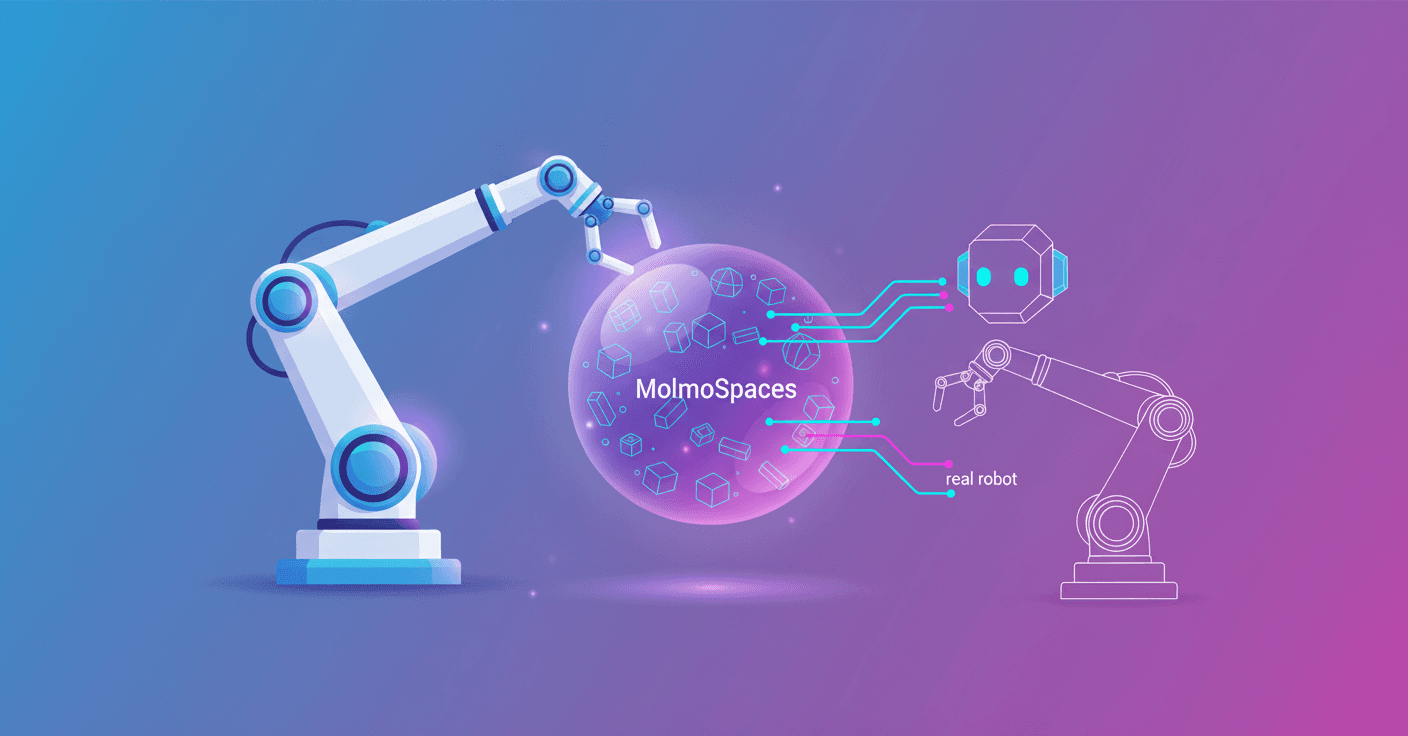
Ai2 announces a practical break in robotics: models trained only in simulation that work on real robots without extra real data or fine-tuning. Sounds impossible? What if we stop asking 'how do we collect more demonstrations' and start asking 'how do we design richer virtual worlds'?
What Ai2 announces
Ai2 introduces MolmoSpaces, a large-scale simulation ecosystem, and MolmoBot, a suite of manipulation models trained exclusively on synthetic data. The key outcome is zero-shot sim-to-real transfer: models you can deploy on real hardware directly, without fine-tuning or teleoperated demonstrations.
"Our goal is to build AI that advances science and expands what humanity can discover," said Ali Farhadi. Ai2 provides the open infrastructure so other researchers can reproduce and extend this work.
MolmoSpaces: simulation ecosystem for embodied learning
MolmoSpaces is not just a single scene; it's a platform built at scale and diversity to support generalization. It includes over 230,000 indoor scenes, 130,000 curated objects, and more than 42,000,000 physics-validated grasp annotations. You can systematically vary object properties, spatial layouts, lighting, joints, and task definitions.
Data and design
- 230,000 interior scenes to cover a wide variety of layouts and contexts.
- 130,000 object assets to represent diverse shapes, textures, and articulations.
- 42,000,000 physics-backed grasp annotations to train robust manipulation policies.
The central hypothesis is simple: you don't need photorealistic replication of the real world if you reach enough diversity in scenes, objects, and physical conditions. Ai2 opens the assets, data-generation pipelines, and benchmarking tools so the community can use and validate them.
MolmoBot: zero-shot transfer from simulation
MolmoBot is the family of models trained on MolmoSpaces. Tested on two robot platforms, including a mobile manipulator, MolmoBot performs real tasks like pick-and-place, manipulating articulated objects (opening drawers and doors), and handling previously unseen objects in new environments.
Key technical points:
- Training: exclusively on synthetic data with no real demonstrations or fine-tuning.
- Rendering: they did not rely on photorealistic rendering to achieve transfer.
- Robustness: diversity in simulation mattered more than scaling up repetitions of the same scenario.
Why it works (concise technical explanation)
The strategy links to principles of domain randomization and coverage of the training distribution. By expanding variety across:
- scene geometries and layouts,
- physical and grasping properties,
- lighting and camera conditions,
- tasks and success definitions,
you shrink the gap between synthetic and real distributions. In other words, rather than pushing the simulator to mimic reality exactly, you push the simulator to cover so many variants that the real world becomes just one more case inside that diversity.
Interoperability and openness
Ai2 releases everything openly: models, simulation infrastructure, grasp annotations, generation pipelines, and benchmarking tools. MolmoSpaces was designed to integrate with widely used simulators, including MuJoCo and NVIDIA frameworks like Isaac Lab and Isaac Sim.
Openness is strategic: if simulation becomes the core of training, reproducibility and collaboration are essential for scientific progress. More labs will be able to experiment without relying on closed datasets or months of manual data collection.
Practical impact and considerations
What does this mean for researchers, startups, and small labs? Three concrete things:
- it speeds up research cycles by reducing the need for costly real data;
- it improves reproducibility because assets and pipelines are public;
- it shifts the challenge toward engineering rich virtual worlds, a problem more accessible via software and compute than physical logistics.
Open considerations: there will still be cases where real-world physics, specific sensors, or mechanical failures require real data or online adaptation. Evaluating safety and generalization limits in critical scenarios remains essential.
Final thought
This isn't magic—it's an empirical and technical bet: increasing diversity in simulation reduces the gap to the real world. Ai2 shows that with massive synthetic data and open tools, the community can build manipulation systems that are faster to develop and easier to reproduce.
If you work in robotics or physical AI, this shifts priorities: investing more in diverse simulations and robust pipelines may give better returns than only collecting manual demos. Can you imagine the pace of experimentation when more teams share virtual worlds instead of private demos? That possibility is already open.